


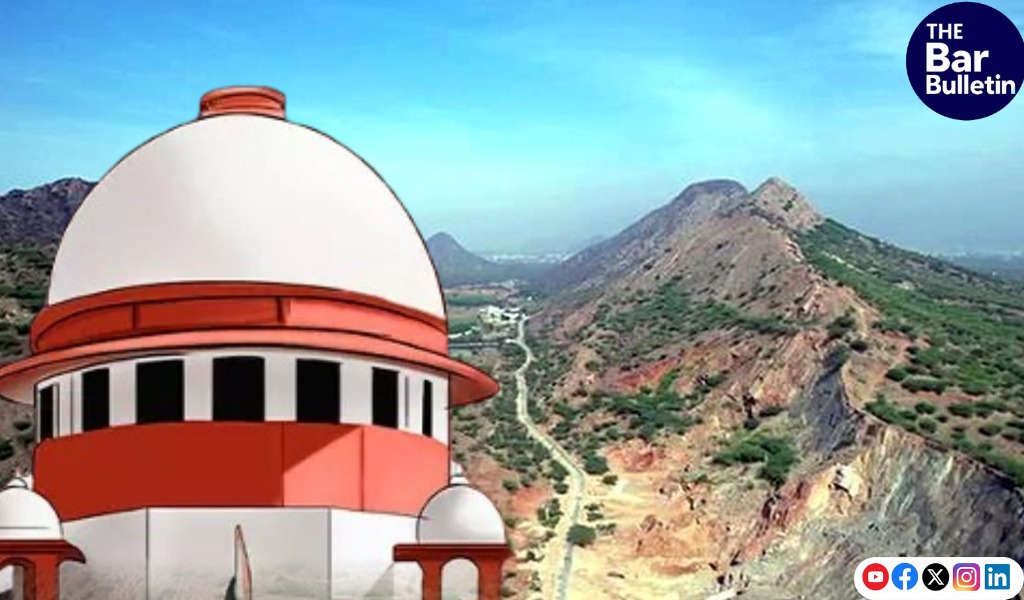

The Supreme Court stayed the operation of its November 20 judgment, which had restricted the definition of the Aravalli range to landforms rising at least 100 metres above the local terrain. A Vacation Bench comprising CJI Surya Kant, Justice J.K. Maheshwari and Justice Augustine George Masih decided to revisit the contentious issue surrounding the identification and protection of the Aravalli range after a ‘significant outcry among environmentalists’ and public concern.
The Court proposed the constitution of a high-powered expert committee comprising domain specialists to comprehensively re-examine questions relating to the height, extent, and ecological significance of the Aravallis, as well as the permissibility of mining activities in the region. The proposed committee will also review the earlier expert report that formed the basis of the stayed judgment.
The following issues are to be considered by the expert committee-
1. Whether the definition of ‘Aravalli Hills and Ranges’ restricted exclusively to the 500-meter area between two or more Aravalli Hills creates a structural paradox wherein the geographical scope of protected territory is significantly narrowed?
2. Whether the criteria adopted (elevation and proximity) result in exclusion of large ecologically significant areas of the Aravalli landscape?
3. Whether the proposed definition compromises ecological continuity of the Aravalli system? Whether regulated mining would be permissible in these gaps? If so, what precise spatial parameters or lateral width would be utilised to define the extent of the ‘Aravalli Range’ to ensure that ecological continuity is not compromised?
4. Whether the criticism that only 1,048 out of 12,081 hills in Rajasthan meet the 100-metre elevation threshold, thereby excluding the remaining Aravalli formations from environmental protection, is factually and scientifically correct, and if so, whether a comprehensive scientific and geological study is required to reassess elevation criteria to preserve the ecological and structural integrity of the entire Aravalli range.
5. Whether any additional issues or systemic vulnerabilities arise during the proceedings that warrant intervention by the Court.
The Supreme Court directed that the report to be submitted by the Expert Committee must undertake an exhaustive and holistic examination of the issues formulated by the Court on the following parameters-
1. A clear enumeration of the specific regions that would fall within the scope of the recommended definition of the Aravalli Hills and Ranges.
2. A detailed identification of territories that would be excluded from environmental protection under the proposed criteria.
3. An analysis of whether permitting “sustainable” or “regulated” mining within the newly demarcated Aravalli areas, despite regulatory oversight, would result in adverse ecological consequences.
4. An evaluation of areas no longer covered by the definition, particularly whether such exclusion poses a risk of their eventual erasure or degradation, thereby compromising the overall ecological integrity of the Aravalli range.
5. A multi-temporal assessment of both short-term and long-term environmental impacts arising from the implementation of the proposed definition.
Notice has been issued to the Union Government, the concerned States, and the amicus curiae. Solicitor General Tushar Mehta and the Attorney General have been requested to assist the Court in the matter along with the Central Empowered Committee (CEC).
Pending this expert review, the Court ordered that the Committee’s recommendations and its own judgment dated November 20, 2025, shall remain in abeyance. The matter has been listed for further hearing on January 21, 2026.
Appearances
Mr. Tushar Mehta, SG Ms. Aishwarya Bhati, ASG Mr. G.S. Makker, AOR Ms. Shreya Jain, Adv. Ms. Shagun Thakur, Adv. Mr. Rohan Gupta, Adv. Mr. M.K. Maroria, Adv. Ms. Manisha Chava, Adv. Ms. Anitha Shenoy, Sr. Adv. Mr. Ritwick Dutta, Adv. Mr. Rahul Chowdhary, Adv. Ms. Shishti Agnihotri, Adv. Ms. Ayushma Awasthi, AOR
