


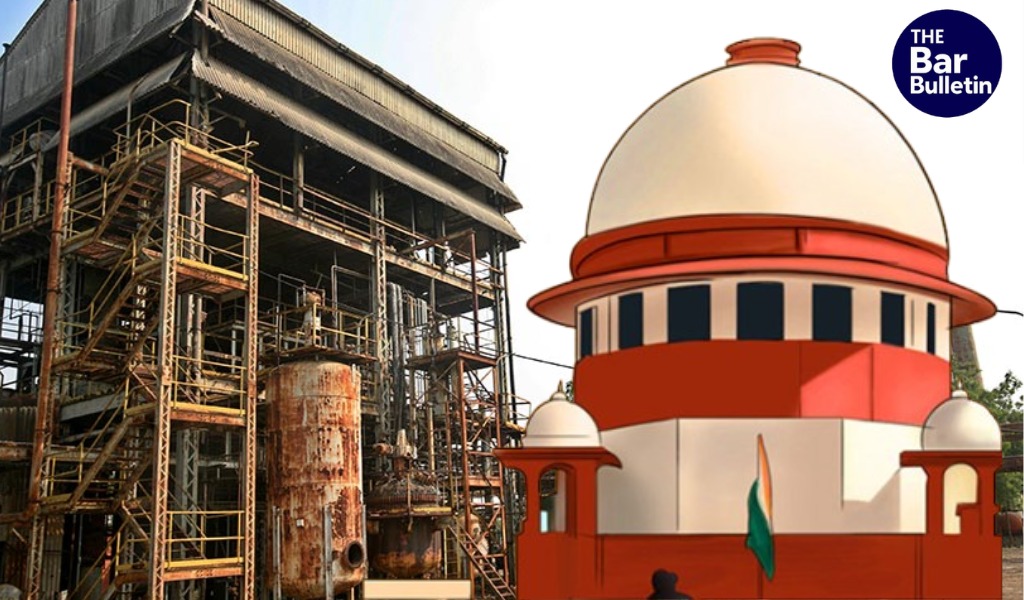

The Supreme Court on Monday declined to interfere in a plea raising concerns over the disposal of hazardous waste from the Union Carbide site linked to the Bhopal gas tragedy, observing that the appropriate remedy for the petitioner would be to approach the High Court supervising the matter.
The case relates to the disposal of toxic waste and residual ash generated after the incineration of hazardous material from the Union Carbide India Ltd. (UCIL) plant in Bhopal.
The petitioner raised concerns that the residual ash, now disposed of at a Treatment, Storage and Disposal Facility (TSDF) in Uttar Pradesh, may contain mercury and other toxic substances that could potentially leach into the environment over time. The submission relied on a report by Ashok Qureshi, which suggested that the methodology adopted during trial runs may have failed to correctly detect mercury levels.
Counsel argued before the Court that mercury contained in the ash could gradually leach out and contaminate soil and groundwater, and urged that the material be tested further.
However, the Bench of Chief Justice Surya Kant and Joymalya Bagchi observed that the issue involves scientific assessment and competing expert opinions, which should be examined by the High Court that has been monitoring the matter for years.
“You have a contrary report and say the methodology adopted by the oversight committee is faulty. It may be correct, it may not be correct, we are not experts to comment on it.”
The Court noted that due process requires that the expert committees examine and respond to such concerns, rather than the Supreme Court adjudicating scientific disputes directly.
“Due process requires that the other committee… look into it and respond. This deliberation must take place before the High Court.”
The Bench also emphasised that the High Court has been continuously monitoring issues relating to the disposal of toxic waste and environmental safety around the UCIL site. Observing that the waste had already been incinerated and disposed of at the designated facility, the Court said it saw no reason to interfere at this stage.
The Court added that the petitioner may place the expert report and supporting materials before the High Court, which can then consider the apprehension of future leakage or environmental impact and pass appropriate directions. The Bench expressed confidence that the High Court would examine the issue expeditiously.
“We have no reason to doubt that the High Court will provide expeditious consideration.”
With these observations, the Supreme Court disposed of the plea while granting liberty to the petitioner to raise the issue before the High Court monitoring the matter.