

The Supreme Court has clarified that the subsequent conduct of a party, such as instituting a suit for possession despite claiming to be in possession under a prior decree, and prolonged inaction after being granted liberty to file a fresh suit, can effectively undermine and negate the legal effect of that prior decree. The Court therefore held that the appellants’ claim, resting almost entirely on a century-old decree, was demonstrably undone by their own predecessor’s subsequent conduct.
The Apex Court declared that the respondents have established their claim throughout, through consistent documentary evidence, revenue records, the admission of the appellants own witness, and the testimony of independent witnesses, including the devotees of the temple, that they have been performing puja at the Amogasidda temple as hereditary wahiwatdar pujaries.
Further, the Court reaffirmed the principle that while exercising its jurisdiction under Article 136 of the Constitution, the Supreme Court will not interfere with concurrent findings of fact from lower courts unless they are found to be manifestly perverse. In the present case, the concurrent findings of the First Appellate Court and the High Court were deemed to be based on a correct and careful appreciation of the factual matrix and were therefore upheld.
A Two-Judge Bench comprising Justice Prashant Kumar Mishra and Justice K. Vinod Chandran observed that the appellants’ reliance on the 1901 decree was contradicted by their own predecessor’s action of filing a suit for possession in 1944. The Bench noted that a party in settled possession does not sue for possession. The institution of that suit was thus seen as a categorical admission that possession was not with the appellants’ predecessor at that time.
The Bench highlighted that after obtaining liberty to file a fresh suit in 1946, the appellants’ predecessors refrained from doing so for thirty-six years. This prolonged inaction was interpreted as an inevitable inference that they had reconciled themselves to the factual reality on the ground, which weakened their claim significantly.
The Bench gave considerable weight to the Record of Rights (RTC), which reflected the names of the respondents/plaintiffs’ ancestors in connection with lands granted for service to the temple. The complete absence of the appellants/defendants’ names in these revenue records was deemed significant.
Further, the Bench found the admission from the appellants’ own witness during cross-examination to be of ‘considerable significance’. The witness admitted that the lands granted for the temple’s service were being cultivated by the respondents/plaintiffs, which clinched the matter regarding the grant’s nexus to the respondents.
The Bench also criticized the appellants’ written statement for being reticent on each of these material particulars. It failed to plead essential facts, such as when they came into possession or how they were obstructed. The Bench therefore reiterated the legal principle that ‘Oral evidence cannot be a substitute for pleading, and a case not made out in the pleadings cannot be erected on evidence alone’.
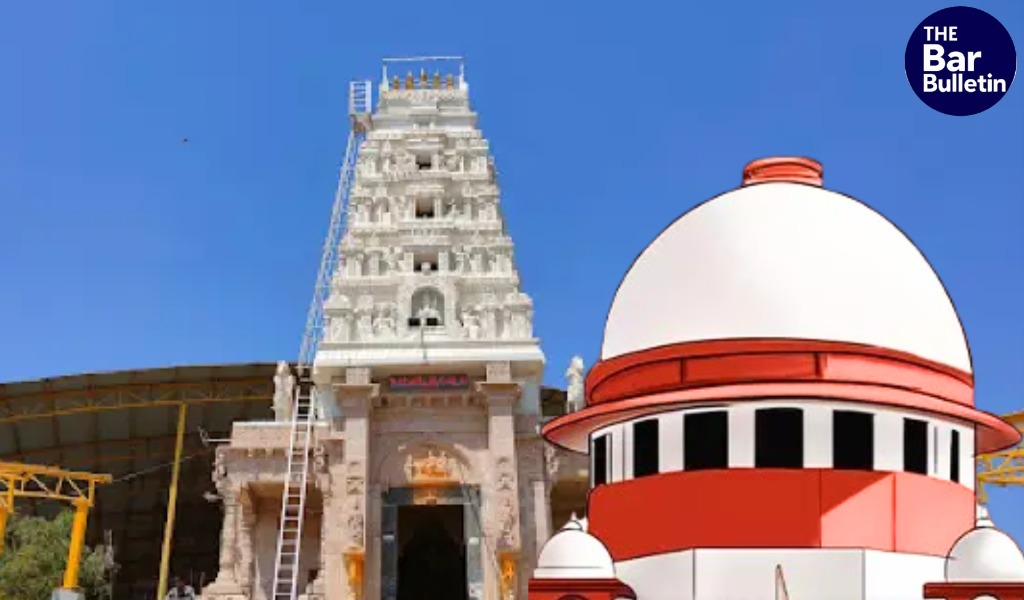
Briefly, the dispute, spanning over a century, concerns competing claims to the ancestral pujari (priestly) rights and the right to perform puja at the Amogasidda temple in Karnataka. The respondents claimed to be the ancestral wahiwatdar pujaries, with rights distributed among them, and alleged that the appellants obstructed their daily puja in March 1982. The appellants denied the plaintiffs’ rights, asserting their own claim based on a decree obtained by their ancestors.
Appearances:
Senior Advocate Basava Prabhu S. Patil, AORs Ankur S. Kulkarni and N. Annapoorani, along with Advocates S. K. Kulkarni, M. Gireesh Kumar, Uditha Chakravarthy, Arijeet Shukla, Tarun, B.K. Prasad, and Rajini. K. Prasad, for the Appellant
AOR T.V. Ratnam, along with Advocates Akhil Ranganathan S. and Rajendra Prasad Maurya, for the Respondent
