


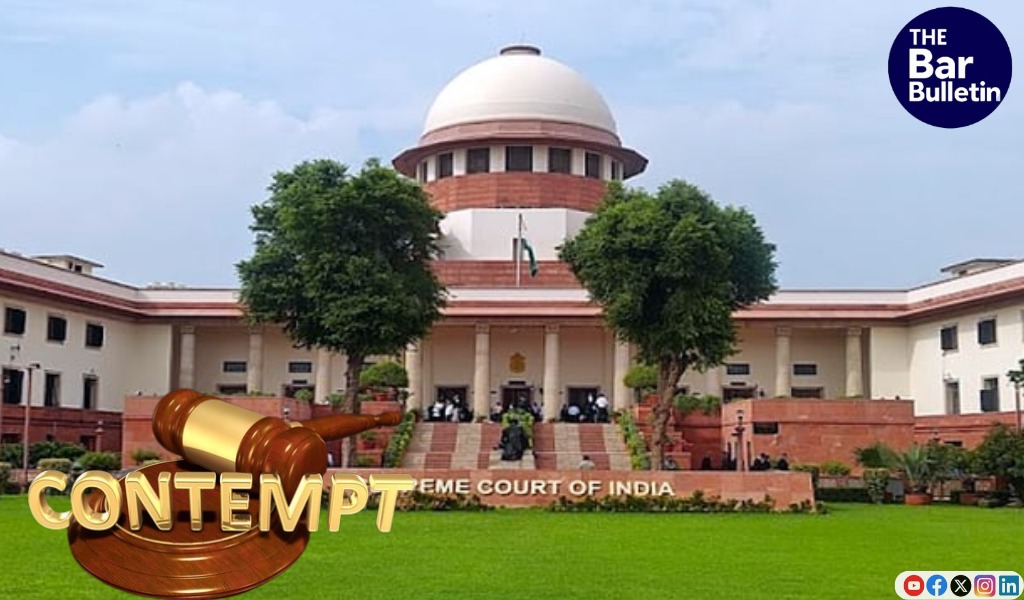

The Supreme Court dismissed a contempt petition as barred by limitation, curtly observing that the petitioner had failed to approach the Court within the statutorily prescribed period of one year under Section 20 of the Contempt of Courts Act, 1971.
The Bench of Justice Dipankar Datta and Justice Satish Chandra Sharma noted that the alleged contempt arose from non-compliance with a direction issued in February 2020, and the petitioner had filed the contempt petition only in 2024. The Court reiterated that contempt proceedings are original proceedings, and that there is no scope for condonation of delay beyond the one-year limitation prescribed under the Act.
The petitioner relied on Section 29(2) of the Limitation Act, 1963, to argue that the provisions of the Limitation Act apply to contempt proceedings, placing reliance on the Supreme Court’s decision reported as S. Tirupati Rao v. M. Lingamaiah, 2024 SCC OnLine SC 1764. However, the Court clarified that what the judgment holds is that Sections 4 to 24 of the Limitation Act would apply by virtue of Section 29(2). The Bench pointed out that this only permits a litigant to seek exemption from limitation, and not condonation of delay as a matter of course.
The Bench declined to grant time to make additional submissions, observing that procedural law requires such grounds of exemption to be specifically pleaded in the petition itself, in terms of Order VII Rule 6 CPC. The Court emphasised that pleadings cannot be improved by oral submissions
The Court further held that the petitioner had neither pleaded any ground seeking exemption from limitation nor explained how the alleged contempt constituted a continuing offence. Rejecting the argument that it is a continuing cause of action, the Bench observed that the contempt, if any, was complete once the stipulated period for compliance expired.
The Court declined to entertain the petition after four years, remarking: “Why didn’t you come within one year? You missed the bus.”
Accordingly, the contempt petition was dismissed as being clearly barred by limitation.