


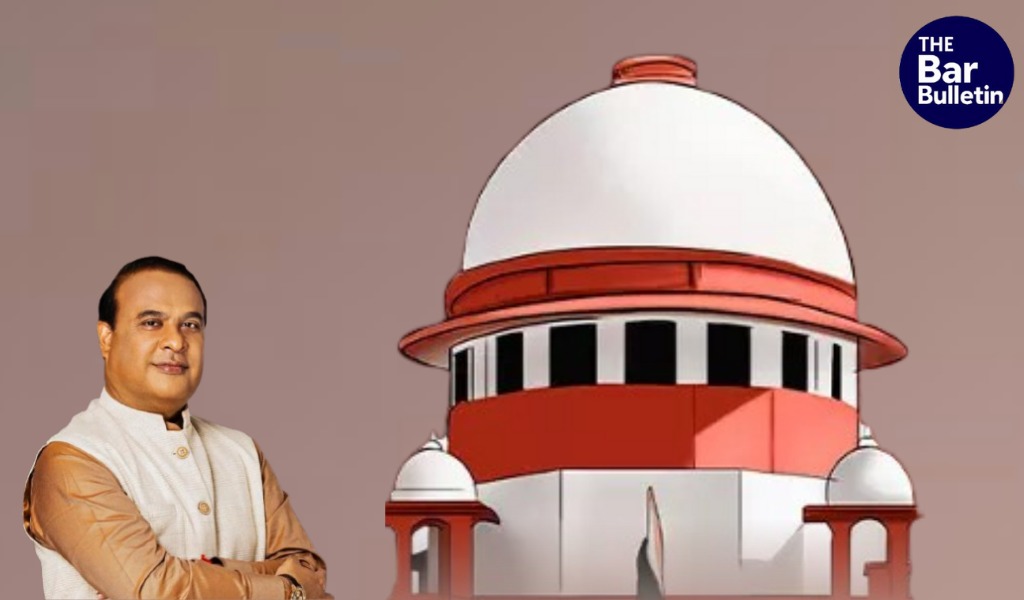

The Supreme Court on Monday declined to entertain a batch of petitions filed under Article 32 of the Constitution seeking registration of FIRs over alleged communal speeches attributed to Assam Chief Minister Himanta Biswa Sarma, as well as a since-deleted social media post purportedly depicting him firing at an animated image of two Muslim men.
The Bench of Chief Justice of India Justice Surya Kant, Justice Joymalya Bagchi and Justice Vipul M. Pancholi stressed that High Courts are fully empowered to address such grievances and cautioned against bypassing them by directly approaching the apex court.
Senior Advocate Dr Abhishek Manu Singhvi, appearing for the petitioners, argued that the case involved “fundamentals of constitutional pillars,” including Articles 14, 15 and 21, and warranted direct intervention by the Supreme Court. Petitioner contended that the matter had pan-India implications.
“This affects the fundamentals of your Lordships’ constitutional pillars… This is an appropriate case for Article 32,” Mr Singhvi submitted, while also seeking a court-monitored SIT, possibly comprising officers from outside Assam.
However, the Bench expressed strong reservations about bypassing the High Court, cautioning against turning the Supreme Court into what it described as a “political battleground” during election seasons.
“This is also a new emerging trend that whenever elections come in A State, B State, D State, this Court becomes a political battleground,” the Bench observed.
The Court emphasised that Article 226 jurisdiction of High Courts is wide and robust, and litigants must first approach them. “Please don’t undermine our constitutional courts of High Courts. This is absolutely a disturbing trend that every matter lands upon the Supreme Court,” the Bench remarked.
While acknowledging the submission that Articles 32 and 226 provide concurrent jurisdiction, the Court noted that judicial discipline and constitutional design require respect for institutional hierarchy. “Under our anxiety to invoke one jurisdiction, we must not undermine the other jurisdiction,” it said.
Petitioners argued that multiple complaints had been filed across states and that no FIRs had been registered. They contended that, given the stature of the constitutional functionary involved, an independent mechanism was necessary. The Bench, however, held that High Courts are fully empowered to grant appropriate relief, including directing independent investigations if required. “Have faith in the system… That system starts from the High Courts,” the Court said.
In its order, the Court declined to entertain the petitions at this stage and relegated the petitioners to approach the jurisdictional High Court. At the same time, it requested the Chief Justice of the concerned High Court to ensure expeditious consideration of the matter, given the petitioners’ plea of urgency.
The Bench also made broader remarks on political discourse, stating: “We expect leadership in this country… This divisive sort of thing is so counterproductive for everybody. It does not help X or help Y. It is counterproductive for the entire nation.”
The petitions were accordingly disposed of, with liberty to pursue remedies before the High Court.