


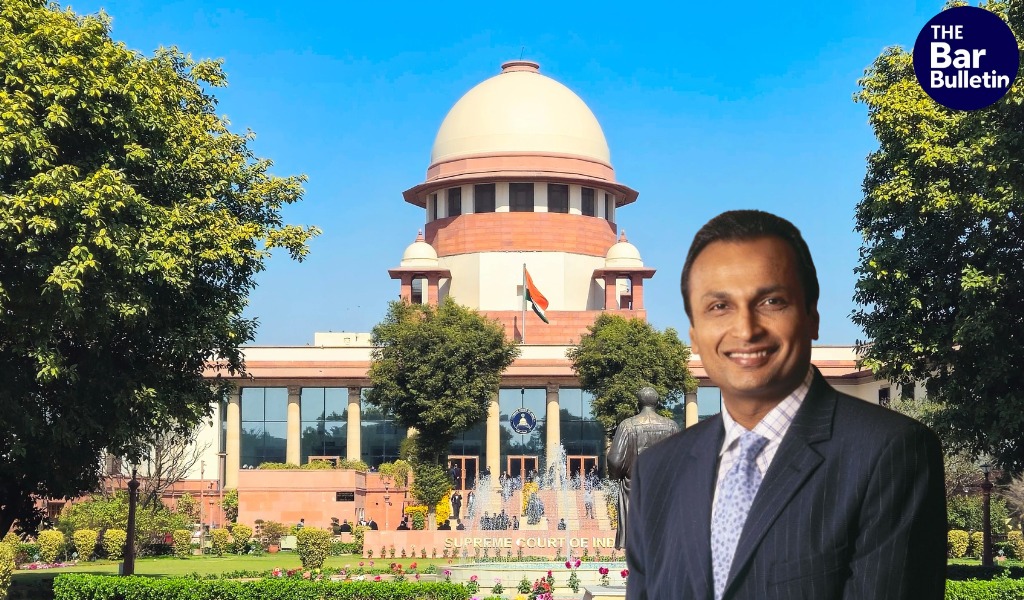

The Supreme Court heard a plea seeking the constitution of a Special Investigation Team (SIT) to probe alleged large-scale financial irregularities involving the Anil Ambani–led group, amid claims of massive siphoning of public funds through bank loans. The matter was heard by a Bench comprising Chief Justice of India Justice Surya Kant, Justice Jyomalya Bagchi, and Justice Vipul Pancholi.
Appearing for the Union of India, Solicitor General Tushar Mehta submitted that investigations were being conducted strictly in accordance with law under the Prevention of Money Laundering Act, 2002 (PMLA) and the Foreign Exchange Management Act, 1999 (FEMA). He informed the Court that forensic audits by independent auditors had revealed actual siphoning of funds to the tune of approximately ₹40,000 crore, while the overall bank exposure stood at around ₹1.78 lakh crore.
The Solicitor General stated that the first FIR was registered on a complaint by the State Bank of India, following which other banks also reported instances of diversion and siphoning of funds. He added that bank officials are also under investigation and would be proceeded against if any collusion is found.
Senior Advocate Prashant Bhushan, appearing for the petitioner, submitted that although the FIR was registered in 2025, the first arrest was effected only a day prior to the hearing, despite the case involving one of the largest corporate frauds in the country. He expressed apprehension that the principal beneficiary of the alleged fraud may flee the country, noting that the “kingpin” had not yet been arrested.
Senior Advocate Mukul Rohatgi, appearing for the corporate group, informed the Court that multiple investigations were already underway, including five FIRs by the CBI and ECIRs by the ED, and that properties worth nearly ₹12,000 crore had been attached. While stating that he was not opposing the formation of an SIT, Rohatgi argued that the transactions did not amount to siphoning in the strict sense and suggested that a committee of financial and banking experts could examine the matter instead of a purely prosecutorial approach. He also submitted that corporate bankruptcy, by itself, is not unusual.
During the hearing, Justice Jyomalya Bagchi referred to portions of the CBI report and questioned whether delays in registering regular cases were justified where forensic audits indicated breaches beyond loan terms. The CJI observed that where there is intent to siphon public funds, criminal prosecution cannot be ruled out.
Taking note of the magnitude of the alleged fraud and concerns regarding delay, the Bench observed that the ED is examining all suspected financial transactions constituting proceeds of crime. The Court held that the ED is well advised to constitute a SIT comprising senior officers to ensure that the investigation is taken to its logical conclusion.
The Bench further directed the CBI to probe any nexus, collusion, or conspiracy, particularly involving bank officials, and stressed that public funds could not have been released without possible complicity. Emphasising impartiality, the Court observed that both agencies must act in a fair and dispassionate manner.
Accordingly, the Supreme Court directed the ED and the CBI to file status reports within four weeks, followed by periodic progress reports, and to place a final status report within three months.