


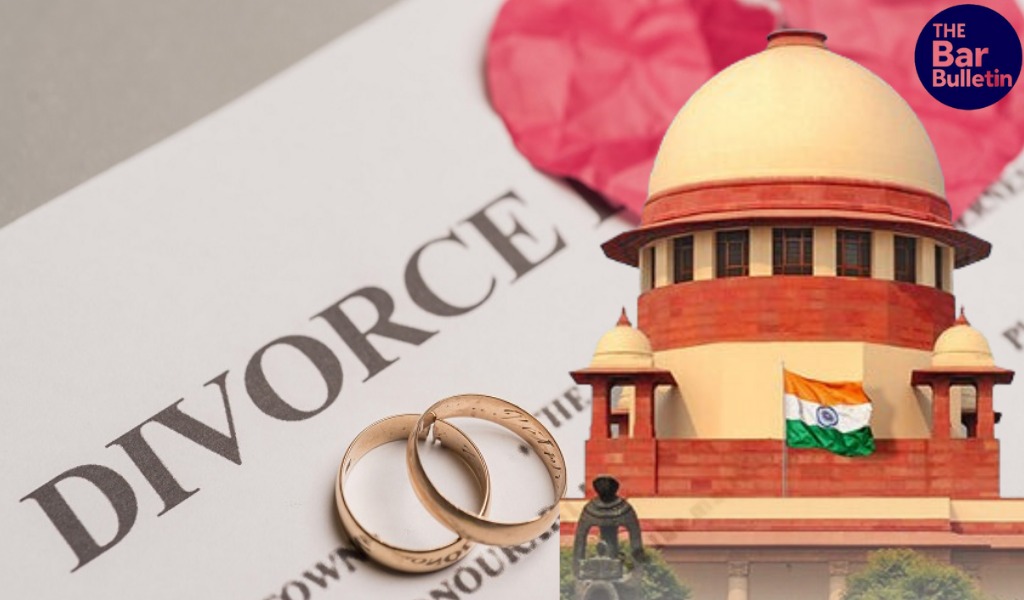

The Supreme Court has dissolved the marriage by exercising its power under Article 142 of the Constitution, holding that a marriage which has remained defunct for over two decades with no possibility of reconciliation amounts to cruelty to both spouses and deserves to be formally severed. The Court set aside the Gauhati High Court’s judgment, which had refused to grant a divorce, and restored the decree granted by the trial court.
The case arose out of matrimonial proceedings initiated by the appellant seeking divorce on the ground of desertion under Section 13(1)(i-b) of the Hindu Marriage Act, 1955. The parties had been living separately since 1 year after marriage. While the trial court dissolved the marriage, the Gauhati High Court reversed the decree on April 13, 2011, holding that desertion had not been proved and the wife had reasonable cause to live separately.
The husband challenged this decision, contending that the marriage had irretrievably broken down, since the parties had lived apart for over 24 years, had no children, and had failed to reconcile despite mediation efforts. The wife opposed the appeal, arguing that she had not deserted the husband.
The Division Bench of Justice Manmohan and Justice Joymalya Bagchi observed that prolonged separation without any hope of reconciliation constitutes mental cruelty to both parties.
Referring to Rakesh Raman v. Kavita (2023) 17 SCC 433, Naveen Kohli v. Neelu Kohli (2006) 4 SCC 558, Samar Ghosh v. Jaya Ghosh (2007) 4 SCC 511, and the Constitution Bench decision in Shilpa Sailesh v. Varun Sreenivasan (2023) 14 SCC 231, the Court held that its power to do “complete justice” under Article 142 is not fettered by the doctrine of fault or blame.
The Bench clarified that in cases where a marriage has completely collapsed, and continuation would only perpetuate misery, formal dissolution is in the interest of both the parties and society. Accordingly, the writ petition was allowed, dissolved the marriage under Article 142, and upheld the trial court’s decree of divorce.
Appearance
Appellant- AOR Arvind Kumar Gupta
Respondent- Advocates Bikas Kar Gupta, Azim H. Laskar, Chandra Bhushan Prasad, Nilkamal Chaubey
