


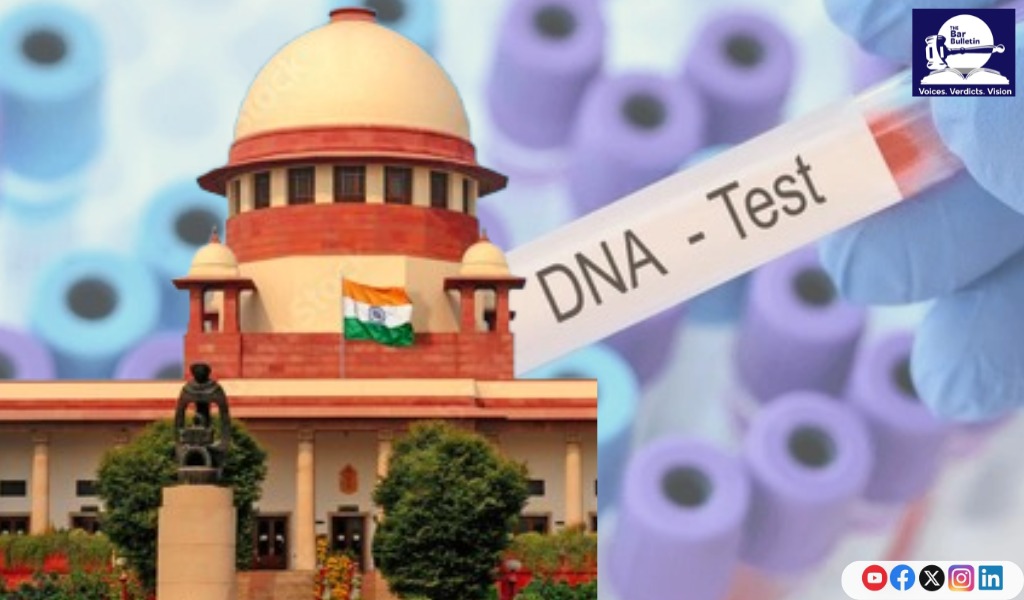

The Supreme Court set aside a Madras High Court order that had directed the appellant to undergo DNA testing in connection with allegations of cheating and harassment.
The bench of Justice Prashant Kumar Mishra and Justice Vipul M. Pancholi held that there was no “eminent need” or “balance of interests” warranting DNA testing, and compelling DNA profiling in such cases amounts to an unwarranted intrusion into privacy and bodily autonomy, protected under Article 21 of the Constitution.
The case stemmed from a complaint by a woman who alleged that the appellant, a doctor treating her husband, had developed a physical relationship with her, leading to the birth of a child in 2007. When her husband deserted her and the doctor later refused to marry, she appeared on a TV Channel narrating her complaint, leading to registration of an FIR under Sections 417 and 420 of the IPC and Section 4(1) of the Tamil Nadu Women Harassment Act, 1998. During the investigation, the police sought a direction for the DNA profiling of the appellant, the woman, and the child. The Division bench of the High Court upheld the direction of the single bench in the 2nd round of litigation, prompting the present appeal.
Allowing the appeal, the Court observed that the presumption under Section 112 of the Indian Evidence Act, 1872, that a child born during a valid marriage is legitimate remains conclusive unless non-access between the spouses is proved through strong and unambiguous evidence. The Court found that no such plea or proof was offered by the complainant. It noted that mere assertions of an extramarital relationship or simultaneous access do not dislodge this presumption.
The Court reiterated that DNA testing cannot be ordered as a matter of course and must be subject to stringent safeguards to protect the dignity of individuals and the legitimacy of children born during wedlock. Citing Ivan Rathinam vs. Milan Joseph, 2025 SCC OnLine SC 175, Goutam Kundu v. State of West Bengal, (1993) 3 SCC 418, and Bhabani Prasad Jena v. Convenor Secretary, Orissa State Commission for Women, (2010) 8 SCC 633, the bench noted that directions for DNA testing must balance privacy rights, dignity, and the potential psychological impact, particularly where a child’s legitimacy may be questioned. Referring to K.S. Puttaswamy and Another vs. Union of India and Others, (2017) 10 SCC 1, it reiterated that any forced DNA test must satisfy the tests of legality, legitimate state aim, and proportionality.
Rejecting the High Court’s reliance on Sections 53 and 53A CrPC, the Court held that those provisions apply only when medical examination of the accused, including the collection of blood, semen, hair samples, or nail clippings, may furnish material evidence directly bearing upon the commission of the offence. The offences of cheating and harassment, it said, do not necessitate a forensic determination of paternity. The bench cautioned that scientific tools should not become instruments of speculation or publicity but must serve a clear investigative purpose.
The Court held that in this case, the order of DNA testing has no direct and demonstrable nexus with the offences under investigation. Consequently, the High Court’s judgment was quashed, and the appeal allowed.
Appearances
Appellant- Mr. Pulkit Tare,Adv. Mr. D.Kumanan, Adv. Mr. Sheikh F. Kalia, Adv. Mr. Suvendu Suvasis Dash, AOR
Respondents- Mr. Ankur Prakash, AOR Mr. Balaji Subramanian, A.A.G. Mr. Sabarish Subramanian, AOR Mr. Vishnu Unnikrishnan, Adv. Ms. Arpitha Anna Mathew, Adv. Mr. Veshal Tyagi, Adv. Ms. Jahnavi Taneja, Adv. Mr. K.s.badhrinathan, Adv. Mr. Akash Kundu, Adv. Mr. Danish Saifi, Adv.
