


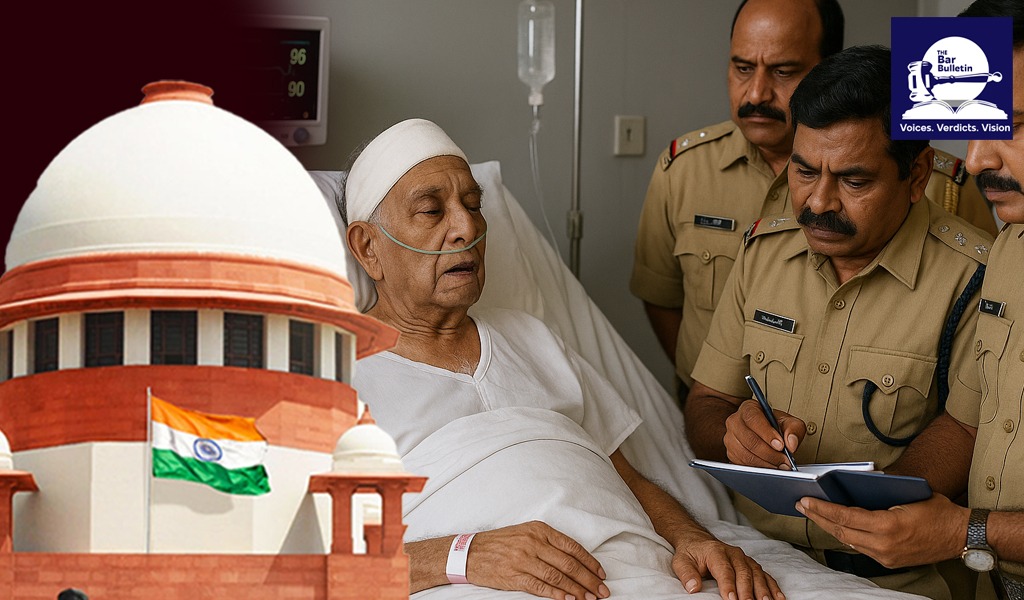

In an appeal filed before the Supreme Court against a final order dated 21-07-2016 by the Gujarat High Court, whereby the State’s appeal was allowed and the appellant was convicted for committing an offence under Section 302 of the Indian Penal Code, 1860 (IPC), a Division Bench of Justice Rajesh Bindal and Justice Vipul M. Pancholi refused to interfere with the impugned judgment of the High Court and affirmed the conviction of the appellant.
The appellant and the co-accused, after conspiring to kill a woman and her son, poured kerosene in their hut on the intervening night of 29-11-2004 and 30-11-2004 to set them ablaze. Resultantly, the woman suffered burn injuries and succumbed to the same, whereas the son suffered burn injuries to the extent of 10-12%.
The woman’s sister filed a complaint, and thereafter charges were framed against both accused under Sections 302, 307, 436, 34, and 120(b) of the IPC and Section 135 of the Bombay Police Act, 1951. They were acquitted by the Trial Court mainly because of discrepancies found in the dying declaration of the deceased.
The State of Gujarat challenged the said acquittal before the High Court, and the order by the Trial Court was set aside while convicting the appellant of an offence punishable under Section 302, IPC. The present appeal has been preferred against said conviction.
The appellant contended that there were significant inconsistencies in the prosecution’s story and that the deceased’s dying declarations also contained several discrepancies. It was also submitted that the High Court should not have interfered with the view taken by the trial Court.
The Court noted that when the deceased was brought to the hospital, she narrated the incident before the doctor, wherein she specifically mentioned that the appellant poured kerosene on her and set her ablaze. It was also noted that this documentary evidence was supported by the doctor’s testimony, who stated that the patient was conscious and able to speak.
Further, the Court perused the panchnama, which corroborated the deceased’s version as given to the doctor. Thus, the Court found that the prosecution’s evidence showed that the deceased’s dying declaration, given before the doctor, was supported by other evidence.
The Court found it clear that the deceased sustained 100% burn injuries, whereas her 4-year-old son sustained only 10-12% burn injuries, which is why the theory of an accidental fire could not be believed. The Court further opined that, merely because there were minor discrepancies in the prosecution witness’s version of the dying declaration, the first declaration given by the deceased to the doctor could not be ignored.
It was held that the High Court had rightly relied on Nallam Veera Stayanandam & Ors. v. Public Prosecutor, High Court of A.P., (2004) 10 SCC 769 while setting aside the order of acquittal by the Trial Court. The Court lastly held that no interference was required in the impugned judgment passed by the High Court and dismissed the present appeal.
Appearances:
For Appellant – Mr. S.C. Birla, Mr. Subrat Birla
For Respondents – Ms. Swati Ghildiyal, Mr. Rishi Yadav
