


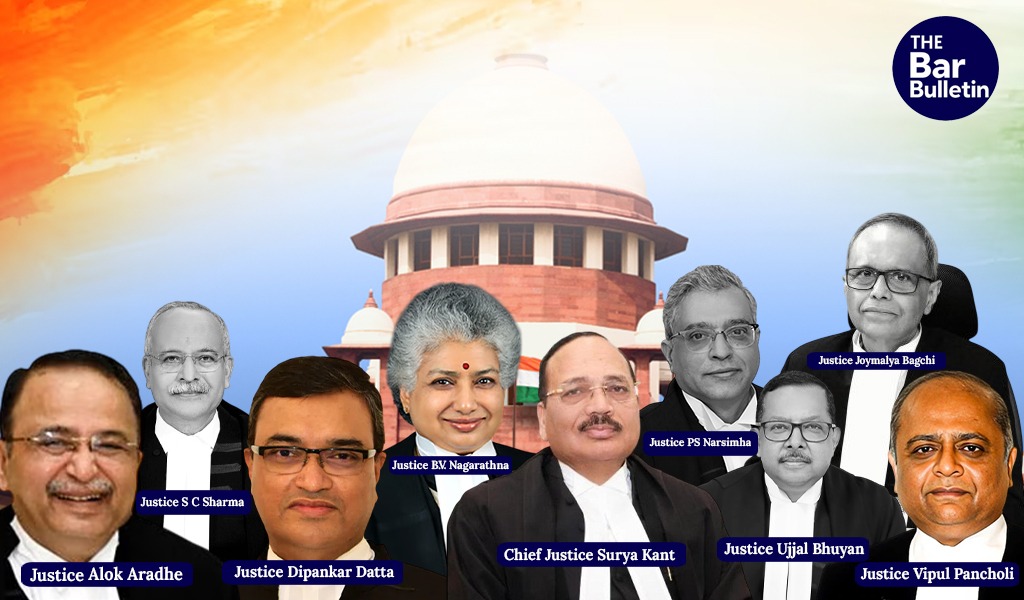

The Supreme Court on Thursday reserved judgment after hearing arguments over three days in a reference concerning the scope of the definition of “industry” under Section 2(j) of the Industrial Disputes Act, 1947.
The matter was heard by a nine-judge Constitution Bench led by Chief Justice Surya Kant, Chief Justice of India (CJI) Surya Kant and Justices B.V. Nagarathna, P.S. Narasimha, Dipankar Datta, Ujjal Bhuyan, Satish Chandra Sharma, Joymalya Bagchi, Alok Aradhe, and Vipul M. Pancholi.
The reference raises foundational questions on the correctness of the seven-judge bench ruling in Bangalore Water Supply & Sewerage Board v. R. Rajappa (1978), which adopted a wide interpretation of “industry”, thereby extending labour law protections to a broad range of institutions and employees. The issue has remained pending for over two decades, having been referred to a larger bench in 2005 in State of Uttar Pradesh v. Jai Bir Singh.
At the heart of the proceedings was whether the “triple test” evolved in Bangalore Water Supply laid down the correct legal standard. The triple test is mentioned below:
• systematic activity,
• employer-employee cooperation, and
• production or distribution of goods and services.
The Court also examined whether subsequent legislative developments, including the Industrial Disputes (Amendment) Act, 1982 and the Industrial Relations Code, 2020, have any bearing on the interpretation of Section 2(j).
Another key issue was whether activities undertaken by government departments, particularly welfare and public service functions, can be classified as “industry”. The bench considered arguments on whether sovereign functions, traditionally understood as core state activities, ought to fall outside the ambit of labour law, and where the line should be drawn between governmental and industrial functions.
The reference traces back to concerns expressed in Jai Bir Singh, where the Court had noted that despite the wide language of Section 2(j), certain services such as hospitals and educational institutions may require exclusion, given that concepts like strikes or closure could undermine essential public services. The Court had then observed that a “fair and just” line must be drawn in interpreting the provision.
During the hearings, counsel debated whether the expansive interpretation in Bangalore Water Supply amounted to judicial overreach or was necessary to advance the welfare objectives of the legislation. Submissions also addressed the limits of purposive interpretation, the role of precedent, and the balance between labour protection and administrative or sovereign functions of the State.
DAY 1 Hearing- https://thebarbulletin.com/supreme-court-industry-definition-9-judge-bench-hearing/
DAY 2 Hearing- https://thebarbulletin.com/constitution-bench-industry-definition-day-2-live/
DAY 3 Hearing- https://thebarbulletin.com/constitution-bench-industry-definition-hearing-worker-protections/