


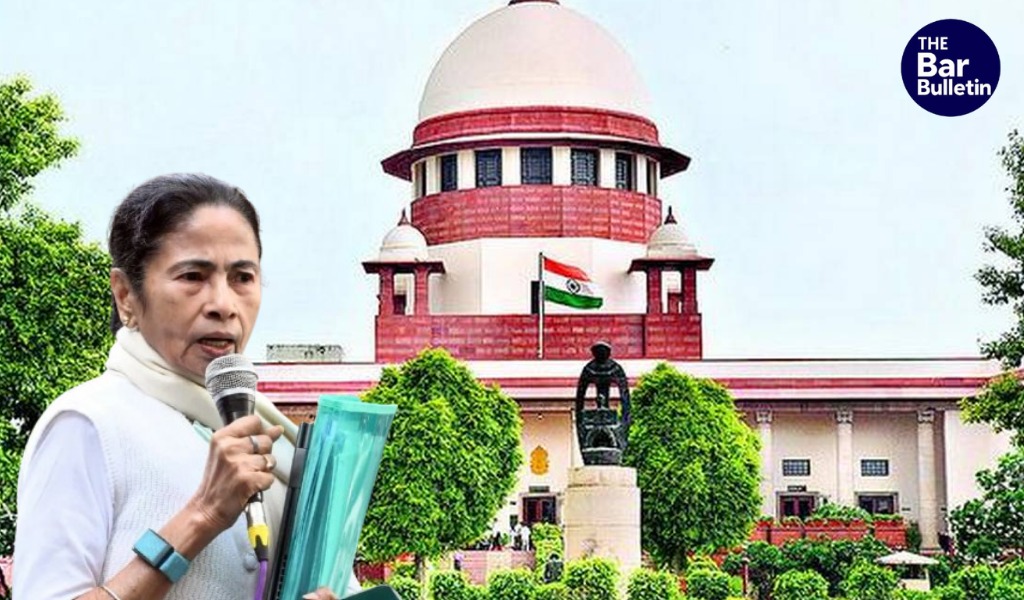

Directorate of Enforcement & Anr. v. State of West Bengal & Ors. & Connected Matters [Heard on March 18, 2026]
The Supreme Court on Wednesday partly heard the arguments against the maintainability of a writ petition filed by the Enforcement Directorate in connection with the I-PAC raid controversy. The Bench of Justice Prashant Kumar Mishra and Justice NV Anjaria raised concerns over the absence of remedies if such petitions are held non-maintainable. Observing that “there should not be a vacuum” in the constitutional framework, the Court questioned how situations involving alleged obstruction of central agencies by state authorities would be addressed. It further remarked that a scenario where a Chief Minister enters a government office during an ongoing investigation is “not a very happy situation.”
Also Read- I-PAC Raid Case: SC Issues Notice In ED Plea Over Alleged Obstruction By CM Mamata Banerjee, Stays FIRs, Orders Preservation Of CCTV Footage
https://thebarbulletin.com/ipac-raid-case-sc-notice-ed-stays-firs-cctv/
Appearing for the State of West Bengal and other respondents, senior advocates Shyam Divan, Kapil Sibal and Menaka Guruswamy sought time to respond to the ‘expansive rejoinder’ introducing new facts. They submitted that a proper response was necessary before the matter could be heard in full.
However, the Court refused to adjourn the hearing in a petition filed by the Enforcement Directorate, indicating that it would proceed with the matter despite requests for additional time to respond to a detailed rejoinder filed by ED. Bench remarked: “You cannot dictate what the Court should do…what is on record, we will consider it.”
The Court also expressed disinclination towards fragmented hearings, observing that the matter would be best addressed comprehensively rather than in parts. It indicated that issues of maintainability and merits may be examined together to avoid a piecemeal approach.
During the hearing, senior advocate Shyam Divan, appearing for the State of West Bengal, raised a preliminary objection to the maintainability of the petition. He broadly mentions the following grounds against the maintainability of the petition:
1. ED is not a juristic entity. It cannot be filed under Article 32
Sr Adv Shyam Divan argued that the Enforcement Directorate is merely a government department without independent legal personality. Since it is neither a body corporate nor a “person” in law, it lacks the capacity to initiate proceedings under Article 32.
2. No violation of fundamental rights
He submitted that Article 32 is available only for the enforcement of fundamental rights. A state instrumentality like the ED cannot claim such rights, and therefore, the very foundation of the petition is defective.
3. Federal structure bar
He further submits that the dispute, in substance, is between the Union and a State. Such issues must be addressed under the constitutional scheme (notably Article 131), and not through Article 32. Entertaining this petition would disrupt the federal balance and bypass designated mechanisms.
Senior advocate Shyam Divan, appearing for the State of West Bengal, took the Court through provisions of the Foreign Exchange Management Act (FEMA) to argue that the ED is merely an administrative creation of the Central Government. He emphasised that while the statute mandates the establishment of a Directorate, it does not confer juristic personality or a right to sue, making any petition under Article 32 untenable.
Relying on precedent, Divan cited Chief Conservator of Forests v. Collector to submit that government departments cannot litigate in their own name. He stressed that “every post in the hierarchy… is not recognised as a juristic person,” and that litigation must be instituted in the name of the State as per constitutional requirements.
He further contrasted the ED with bodies like SEBI and the National Highways Authority of India, where Parliament has expressly created body corporates with the power to “sue and be sued.” He argued that the absence of similar language in statutes governing the ED is decisive.
He then argued that multiple investigative bodies, including the CBI, Narcotics Control Bureau, Directorate of Revenue Intelligence and SFIO do not possess any statutory right to sue, reinforcing his submission that the ED similarly cannot invoke Article 32. He cautioned that recognising such a power could lead to “all these authorities… suing one another,” potentially disrupting the federal structure.
The Bench, however, pushed back on the implications of this argument, questioning whether such a position would create a remedial vacuum. It observed that “there should not be a vacuum” in the constitutional framework where unlawful actions go unaddressed. The Court also flagged practical concerns, asking who would adjudicate situations where one arm of the State allegedly obstructs another, remarking that such a scenario, where a CM barges into a government office, is “not a very happy situation.”
In response, Divan maintained that while individual departments like the ED cannot sue, the Central Government itself may seek remedies through constitutionally recognised routes such as Article 131. He reiterated that Article 32 is intended for the enforcement of fundamental rights by persons, not for inter-departmental disputes within the State.
Senior Advocate Kapil Sibal, appearing for West Bengal Chief Minister Mamata Banerjee, has also opposed the maintainability of the ED’s plea, arguing that the agency was seeking to stretch its statutory mandate into the realm of constitutional remedies. He submitted that the ED’s powers flow strictly from statute, particularly the Prevention of Money Laundering Act (PMLA), and do not amount to enforceable fundamental rights. “It is not a fundamental right to investigate,” Mr Sibal argued, emphasising that search and seizure powers under the PMLA are merely statutory functions exercised by authorised officers, not constitutional entitlements.
Mr Sibal further contended that the ED cannot seek a writ directing the CBI to register an FIR in the absence of a predicate offence, calling such a prayer legally untenable. Questioning the very basis of the petition, he pointed to provisions like Section 221 of the Bharatiya Nyaya Sanhita (BNS), which already address obstruction of public servants. He maintained that even if ED officials were allegedly obstructed, the remedy lies within ordinary criminal law, not through a writ petition under Article 32.
Since Mr Sibal is yet to conclude his arguments, the court has posted the matter to be heard on Tuesday.