


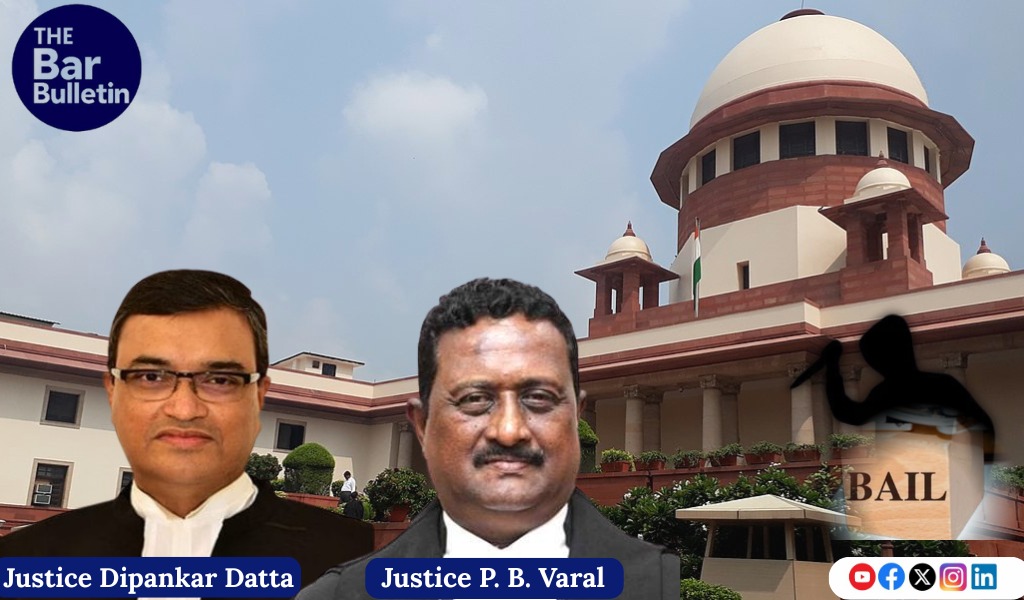

The Supreme Court has refused to modify the movement-restriction condition imposed on the murder-accused, while also rejecting a parallel plea seeking cancellation of his bail. Emphasising the importance of finality in judicial decisions, the Court observed that the prospect of opening up a further round of challenge before a succeeding bench, hoping for a different outcome, ‘would undermine this Court’s authority and the value of its pronouncements’.
The bench of Justice Dipankar Datta and Justice P. B. Varale observed that although the trial has been mired in unsettling developments, including witnesses turning hostile, attempts by the State to withdraw prosecution, and allegations of political patronage, it found no material to establish a breach of bail conditions, and also no change of circumstance that warranted relaxing the restrictions imposed earlier.
The case stemmed from the 2019 murder of a local political figure in Purba Medinipur, in which the accused was alleged to have conspired with others to eliminate a rival, leading to charges under Sections 302 and 120B of the IPC and the Arms Act. The Supreme Court has granted bail to the accused but applied a condition on him to remain confined to Kolkata. The accused challenged this condition, while the brother of the victim sought cancellation of the bail granted by a coordinate Bench.
The Court noted that although the concerns about the fairness of the prosecution were understandable, the plea for cancellation appeared “more of a retaliatory response” to the modification request of the accused rather than a case built on demonstrable violation of bail terms. The Court held that no instance of tampering, intimidation, or non-cooperation attributable directly to Anisur had been proved.
Reconstructing the turbulent trajectory of the case, the Court reiterated its earlier observations on how the West Bengal Government had attempted to withdraw prosecution under Section 321 CrPC in 2021, an exercise described by the High Court as opaque, politically influenced, and contrary to public justice. The Supreme Court reproduced prior judicial remarks that the State took a “complete u-turn” to help the accused, and that the manner in which witnesses turned hostile raised doubts about prosecutorial bona fides. Nevertheless, the Court said these systemic concerns, without direct evidence of breach by the accused, could not justify cancelling bail at this stage, especially when only a few witnesses, including magistrates and a doctor, remain to be examined.
On the plea of the accused to modify bail conditions, the Court strongly emphasised the principle of finality of judicial orders, cautioning against repeated attempts to reopen earlier directions merely due to a change in Bench composition. The Court has also noted that the recent trend of overturning judgments of the preceding benches is painful. “If a verdict is allowed to be reopened because a later different view appears to be better, the very purpose of enacting Article 141 would stand defeated”, the court observed.
It noted that the earlier Bench had taken a balanced view, granting bail despite grave allegations, but keeping his movement restricted to Kolkata as a safeguard, considering political influence, the history of witness intimidation, and the fragile environment of the trial. The Court refused to dilute this condition, remarking that relaxing it would undermine the very rationale under which bail was granted and would send a message that finality of judicial decisions can be casually unsettled.
In an important postscript, the Supreme Court also came down heavily on the Sessions Court for making “wholly uncalled for” and “ostentatious” remarks against the Special Public Prosecutor. These remarks were made while partly allowing his application to examine additional witnesses. Calling the criticism contradictory and unfair, the Court set aside the reference made by the trial court to the Legal Remembrancer and reminded that a Prosecutor appointed on the Supreme Court’s direction must not be undermined without cause. It urged the Special PP to continue the trial with fairness and diligence and directed the Sessions Judge to proceed without undue concern for earlier timelines, ensuring the remaining prosecution evidence is completed in accordance with the law.
Appearances
Petitioner- Mr. Mukul Rohatgi, Sr. Adv. Mr. Amarjit Singh Bedi, AOR Mr. Varun Chandiok, Adv. Ms. Riya Seth, Adv.
Respondents: Mr. P.S. Patwalia, Sr. Adv. Mr. Siddhesh Shirish Kotwal, AOR Mr. Paritosh Anil, Adv. Ms. Ana Upadhyay, Adv. Ms. Manya Hasija, Adv. Mr. Tejasvi Gupta, Adv. Mr. T. Illayarasu, Adv. Mr. Yatharth Gupta, Adv. Mr. Soumya Nag, Adv.
