


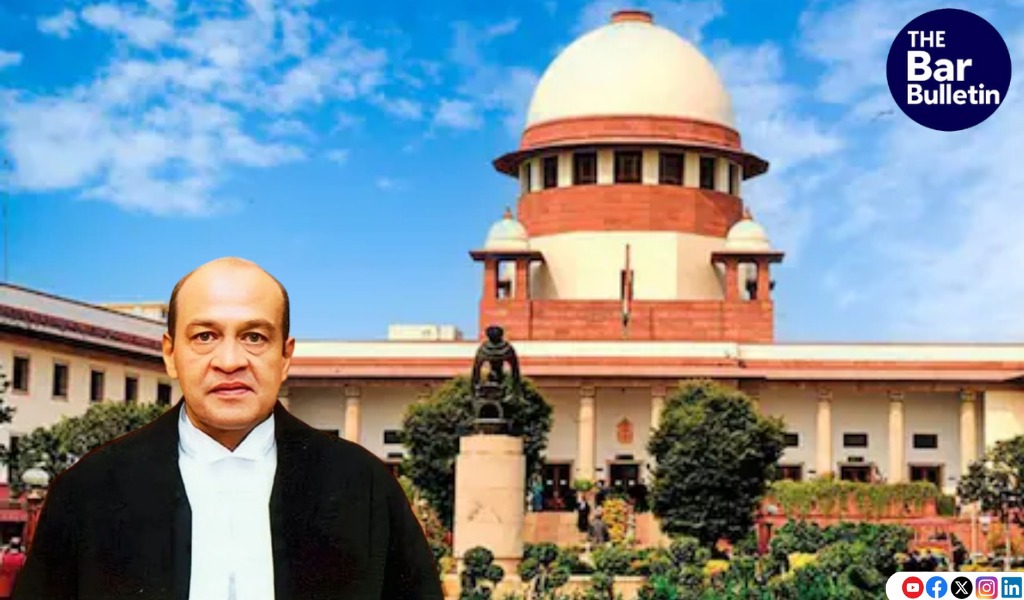

The Supreme Court today heard the submissions in a writ petition filed by Justice Yashwant Varma, a sitting judge of the Allahabad High Court, challenging the constitution of a three-member parliamentary inquiry committee formed to examine allegations of misconduct against him.
While the Court expressed prima facie reservations about the petitioner’s interpretation of the proviso to Section 3(2) of the Judges (Inquiry) Act, 1968, and the challenge to the competence of the Deputy Chairman of the Rajya Sabha, it identified a limited issue requiring further consideration- whether rejection of the Rajya Sabha motion, despite admission of the Lok Sabha motion, deprived the petitioner of the statutory benefit of a jointly constituted inquiry committee so as to warrant interference under Article 32 of the Constitution.
The proceedings stem from notices of motion seeking Justice Varma’s removal, which were presented on 21 July 2025 in both the Lok Sabha and the Rajya Sabha, each signed by the statutorily required number of Members of Parliament. Only the Lok Sabha motion was admitted, and a committee was constituted subsequently.
Justice Varma has approached the Supreme Court under Article 32, contending that the unilateral constitution of the inquiry committee violates the mandatory procedure under Article 124(5) of the Constitution, read with the Judges (Inquiry) Act, 1968.
Senior Counsel, Mukul Rohatagi, appearing for the petitioner, submitted that the Judges (Inquiry) Act constitutes a complete and exhaustive code governing removal proceedings against judges, and must be strictly construed in order to safeguard judicial independence.
The central challenge focused on the proviso to Section 3(2) of the Act, which deals with situations where motions are presented in both Houses of Parliament on the same day. It was argued that:
• Where simultaneous motions are presented, no inquiry committee can be constituted unless both motions are admitted; and
• If admitted, the committee must be constituted jointly by the Speaker of the Lok Sabha and the Chairman of the Rajya Sabha.
According to the petitioner, once motions were presented in both Houses on the same day, the statute disabled unilateral action by either presiding officer. The subsequent admission of the Lok Sabha motion alone, followed by the constitution of the committee, was therefore contrary to the statute.
The petitioner distinguished between presentation, admission, and adoption of a motion, submitting that admission requires a conscious decision by the competent authority. It was contended that while the Speaker of the Lok Sabha had passed a specific order admitting the motion, no valid admission order was passed in the Rajya Sabha.
A further ground of challenge related to the rejection of the Rajya Sabha motion by the Deputy Chairman. The petitioner submitted that the Act defines “Chairman” using the word “means” and not “includes”, and therefore does not permit delegation of this function. Since the Act flows directly from constitutional protections, it was argued that only the Chairman could exercise powers under Section 3.
The petitioner also questioned the alleged deficiencies in the Rajya Sabha motion. While affidavits suggested that the motion was found defective upon scrutiny, no specific deficiencies were disclosed, despite the motion being signed by more than the required 50 Members.
While the respondent, through Solicitor General Tushar Mehta, submitted that rejection of the Rajya Sabha motion operated in favour of the petitioner, and that ordinarily, a person against whom a removal motion is moved cannot complain of its rejection.
To this, Mr Rohatagi submitted that the petitioner was not challenging the rejection per se, but the legal consequence flowing from it, namely, unilateral continuation of removal proceedings by one House contrary to the statutory scheme.
While hearing the submissions, the Bench of Justice Dipankar Datta and Justice Satish Chandra Sharma indicated that the proviso to Section 3(2) cannot be read in isolation and must be construed together with the main provision. Prima facie, the Court noted that there appears to be no statutory bar on the Lok Sabha proceeding to constitute an inquiry committee when a valid motion has been admitted by it, and that an interpretation which would result in both motions failing by default may not align with the object of the statute.
The Bench observed that, prima facie, it was not inclined to accept the petitioner’s submissions on the construction of the proviso to Section 3(2) of the Judges (Inquiry) Act or on the competence of the Deputy Chairman of the Rajya Sabha.
However, the Court identified a limited issue requiring further consideration, namely, whether rejection of the Rajya Sabha motion, despite admission of the Lok Sabha motion, deprived the petitioner of the statutory benefit of a jointly constituted inquiry committee, and whether such deprivation amounted to prejudice warranting interference under Article 32.
The Bench accordingly granted time to the petitioner to address this question.
Appearances
Petitioner- Mr. Mukul Rohatgi, SC, Siddharth Luthra, Siddharth Aggarwal, and Jayant Mehta, Sr. Advs.
Respondent- Solicitor General Tushar Mehta