


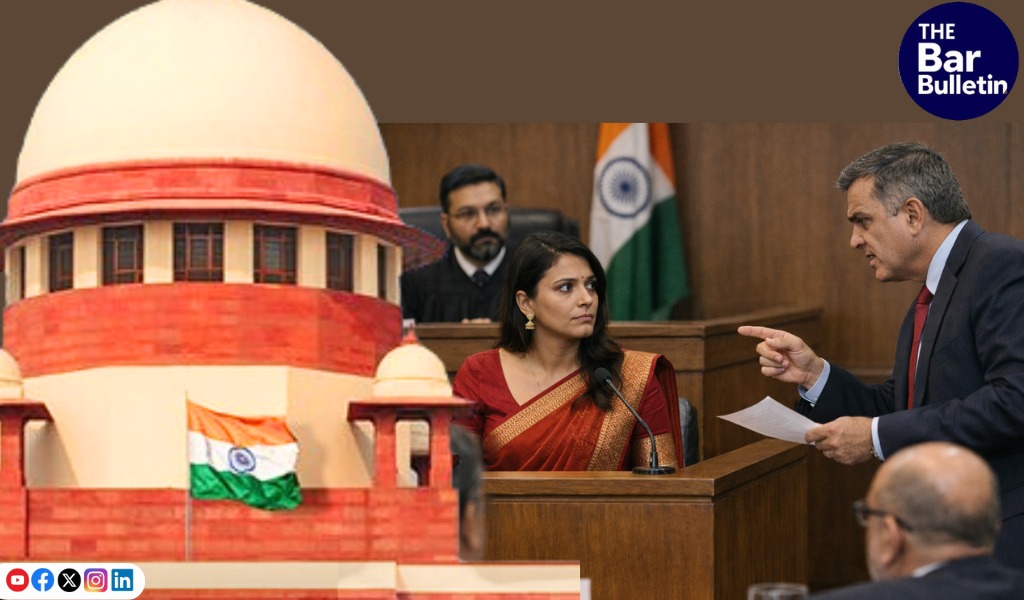

The Supreme Court has upheld the validity of a registered will executed by the Appellant in 1988, setting aside concurrent judgments of the trial court and the Kerala High Court, which had disbelieved the will and granted partition of the estate. The Bench of Justice Ahsanuddin Amanullah and Justice K. Vinod Chandran held that “leading questions are permitted in cross-examinations and the response elicited cannot be said to have lesser probative value, as held by the High Court.”
The case arose from a suit for partition filed by one of the nine children of the testator, who had been excluded under the will. The will bequeathed the testator’s properties to his other eight children, citing reasons for excluding the plaintiff, who had married outside the community. While the defendants relied on the will, the trial court held that it was not proved in accordance with the law and decreed partition. The High Court affirmed the finding, holding that the evidence of the sole surviving attesting witness was insufficient and his testimony suffered from inconsistencies.
Allowing the appeals, the Court held that the courts below had adopted an unduly technical approach in disbelieving the will. The Court found that the attesting witness had sufficiently spoken about the presence of the testator, the attesting witnesses, and the execution of the will.
The Court held that due execution was proved as the surviving attesting witness testified to the testator’s signature and proper attestation of the will, satisfying Sections 63(c) of the Succession Act and 68 of the Evidence Act.
The Supreme Court rejected the High Court’s view that answers elicited through leading questions in cross-examination lacked probative value, observing that such questions are permissible in cross-examination and the testimony as a whole clearly established due execution and attestation of the will. The Court also held that minor inconsistencies in the witness’s recollection, recorded more than two decades after execution of the will, could not be treated as suspicious circumstances.
Emphasising that courts must respect the intention of the testator once due execution is proved, the Bench held that the exclusion of one child from inheritance, by itself, did not render the will suspicious. Setting aside the judgments of the trial court and the High Court, the Supreme Court upheld the will, dismissed the partition suit, and held that the plaintiff had no partible claim over the estate.
Apperances
Appellant- Mr. A. Hariprasad, Sr. Adv. Mr. Bijo Mathew Joy, AOR Ms. Gifty Marium Joseph, Adv. Ms. Swathi H. Prasad, Adv. Mr. V. Chitambaresh, Sr. Adv. Mr. Mukund P. Unny, AOR Mr. Sanjay Nair S., Adv.
Respondents- Mr. P.B. Krishnan, Sr. Adv. Mr. Sarath S. Janardanan, AOR Mrs. Anila Tharakan Thomas, Adv. 2 Mr. Bijo Mathew Joy, AOR
