


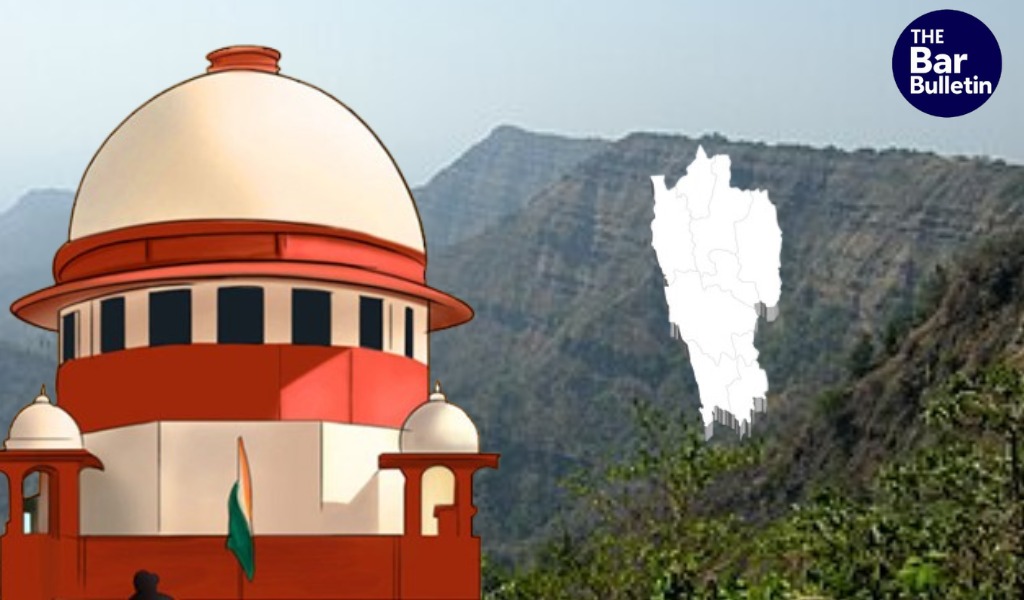
The Supreme Court has dismissed a writ petition filed by the Mizo Chief Council seeking compensation for lands allegedly acquired following the abolition of the traditional chieftainship system in the Lushai Hills district (present-day Mizoram). The petition was filed on behalf of the tribal chiefs of the erstwhile Lushai Hills and their legal heirs, who contended that the State had taken over their lands without paying adequate compensation, thereby violating their fundamental right to property as it existed at the time of acquisition.
The dispute arose from the enactment of the Assam Lushai Hills District (Acquisition of Chief’s Rights) Act, 1954, which empowered the State to extinguish the rights and interests of chiefs in their “Ram”, the territory administered by them, and vest those rights in the State. The Act also created a statutory mechanism for determining and paying compensation to chiefs whose rights were extinguished. Pursuant to the Act, a notification issued in March 1955 transferred the chiefs’ rights to the State and compensation was subsequently paid.
The petitioners argued that historically the chiefs were the absolute owners of the territories under their control and that the 1954 law merely extinguished administrative privileges, not their proprietary title over land. According to them, the compensation paid under the Act covered only the loss of “Fathang”, a customary tribute in paddy collected by the chiefs, and did not account for the vast tracts of land allegedly taken over by the State. They also argued that the deprivation violated Articles 14 and 21 and that the chiefs should be treated similarly to rulers of princely states who were granted constitutional guarantees such as privy purses.
The Union of India and the State of Mizoram contested these claims, arguing that the petition was filed decades after the events in question and was therefore barred by delay and laches. They also disputed the assertion that the chiefs were absolute landowners, contending that under colonial administration they functioned largely as intermediaries exercising administrative authority subject to the supervision of British officials and boundary arrangements known as “Ramrilekha”.
The Bench of Justice J.B. Pardiwala and Justice R. Mahadevan first addressed the preliminary objection of delay. Reviewing constitutional jurisprudence on delay in Article 32 petitions, the Court referred to Tilokchand Motichand v. H.B. Munshi, (1969) 1 SCC 110, Rabindranath Bose v. Union of India, (1970) 1 SCC 84, R.S. Deodhar v. State of Maharashtra, (1974) 1 SCC 317 and Aflatoon v. Lt. Governor of Delhi, (1975) 4 SCC 285. It reiterated that although Article 32 provides a guaranteed remedy, the Court may decline relief where claims are brought after an unreasonable lapse of time.
The Court, however, emphasised that although the petition was filed nearly six decades after the impugned notification of 1955, the doctrine of delay and laches cannot be applied mechanically when claims involve allegations of historical injustice. Referring to Navtej Singh Johar & Ors v. Union of India,(2018) 10 SCC 1, and Indian Young Lawyers Association & Ors v. State of Kerala, (2019) 11 SCC 1, the Court observed that the Constitution possesses a “profound potential to address and correct historical wrongs,” particularly where systemic inequities have persisted across generations.
The Bench also noted that the chiefs had continued making representations over the years and the State had at times indicated the possibility of resolving the issue amicably. Considering all these circumstances, the Court refused to dismiss the petition on the sole ground of delay:
“This Court is conscious of the fact that the delay herein is undeniably inordinate (SIX DECADS), and the explanation offered by the petitioner is, strictly speaking, not unequivocally convincing. Nevertheless, we are not inclined to dismiss this petition at the threshold solely on the ground of delay.”
On merits, the Court held that to obtain relief under Article 32, the petitioners had to establish both the existence of a fundamental right and its breach. Since the events occurred when the right to property was protected under Articles 19(1)(f) and 31, the petitioners were required to prove that the Mizo Chiefs possessed clear title over the lands and that such property had been taken without lawful authority or adequate compensation. However, the Court found that this burden had not been discharged. The materials relied upon by the petitioners, primarily colonial writings and historical accounts, did not conclusively establish ownership. The Bench observed that “it is, at the very outset, highly ambiguous whether these texts unequivocally recognise the Mizo Chiefs as the absolute owners of the land,” and therefore such writings could not be treated as conclusive proof.
The Court further noted that even on a prima facie examination, the record did not support the claim that land title vested in the chiefs during the British administration. Consequently, it held that the petitioners had “woefully failed to discharge their burden of proving title over the subject lands.” The Bench also rejected the argument that the chiefs should be treated similarly to rulers of princely states for the purpose of compensation or privileges, clarifying that such arrangements arose from specific political settlements and “cannot be claimed as a matter of a legally enforceable right, much less a fundamental right.” Holding that no violation of fundamental rights had been established, the Court dismissed the writ petition.
Appearances
Patitioners- Mr. Lalremsanga Nghka, Adv. Mr. Kedar Nath Tripathy, AOR Mr. Aditya Narayan Tripathy, Adv. Mr. Manoj Kumar Upadhyay, Adv. Mr. Siddhartha Jha, Adv. Mr. Gyanadutta Chouhan, Adv. Ms. Pallavi Sahu, Adv.
Respondents- Mr. R Venkataramani, Attorney General for India Mr. Tushar Mehta, Solicitor General Mr. Rajat Nair, Adv. Ms. Suhashini Sen, Adv. Mr. Chinmayee Chandra, Adv. Mr. Akshay Amritanshu, Adv. Mr. Sachin Sharma, Adv. Mr. Kartikay Aggarwal, Adv. Mr. Chitvan Singhal, Adv. Ms. Ameyavikrama Thanvi, Adv. Mr. Raman Yadav, Adv. Mr. Abhishek Kumar Pandey, Adv. Mr. Arvind Kumar Sharma, AOR Mr. Biswajit Deb, Sr. Adv. Mr. Anando Mukherjee, AOR Mr. Shwetank Singh, Adv. Mrs. Riya Dhingra, Adv. Mr. Utkarsh Anand, Adv. Mr. Mukesh Kumar Maroria, AOR Mr. Rajat Nair, Adv. Ms. Suhasini Sen, Adv. Mr. Chinmayee Chandra, Adv. Mr. Akshay Amritanshu, Adv. Mr. Sachin Sharma, Adv. Mr. Aman Mehta, Adv. Ms. Chandan Ramamurthi, AOR
