


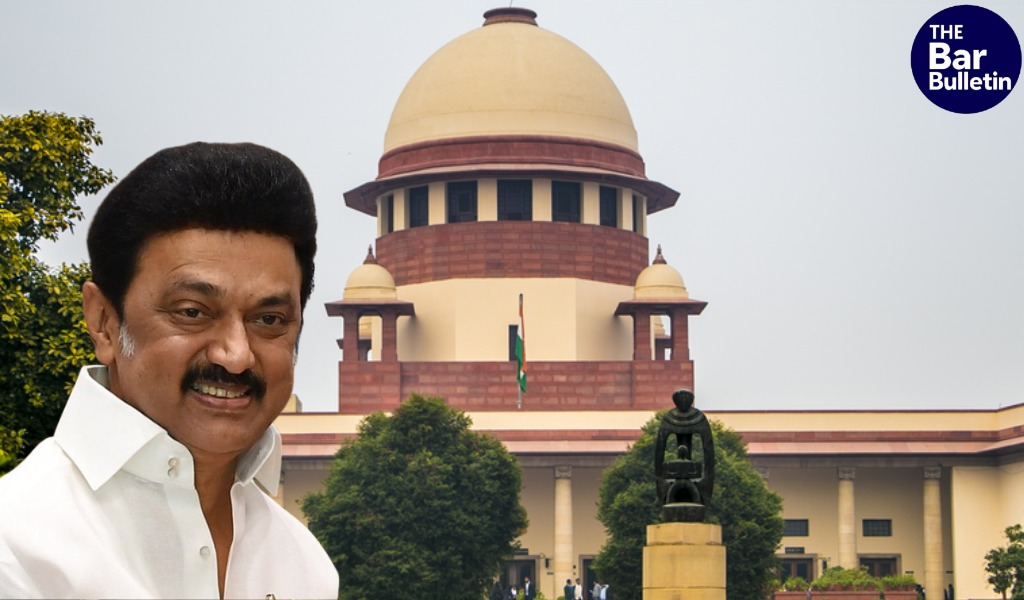
The Supreme Court on Tuesday continued hearing an appeal challenging the Madras High Court’s decision upholding Tamil Nadu Chief Minister M.K. Stalin’s 2011 Assembly election victory from the Kolathur constituency. The appeal, filed by Saidai S.A. Duraisamy, former AIADMK Mayor of Chennai, alleges multiple corrupt practices, including the distribution of money to voters, excess election expenditure, and character assassination during the campaign.
Senior counsel appearing for the appellant took the Bench through a structured tabulation of six alleged instances of corrupt practices, arguing that several incidents of money distribution were videographed by Election Commission officials and form part of the record. Referring to footage from Ishwari Hospital, counsel submitted that “the videography has been accepted as genuine and authenticated…Once the video speaks for itself, its authenticity has been accepted…The burden shifts onto the other side to demonstrate either the video is false or the event is false or that the event accepted as true still does not affect their prospects.”
The Bench of Justice J.K. Maheshwari and Justice Vijay Bishnoi, however, repeatedly questioned whether the alleged acts could be legally attributed to the returned candidate. “What is the guideline of the Election Commission?” the Court asked while examining the issue of whether expenditure or alleged distribution prior to formal nomination could be linked to the candidate. The court also sought clarity on the statutory position, observing that liability for corrupt practice arises only after a person becomes a “candidate” under Section 79(b) of the Representation of the People Act.
On the allegation of money distribution, the High Court had found that although videography showed certain events, there was no clear proof of consent or involvement of the returned candidate. The Supreme Court pressed the appellant on the evidentiary gap, asking whether members of the Flying Squad who conducted the search had been examined to substantiate the claims.
The hearing also touched upon allegations of excess expenditure, with the appellant arguing that campaign spending incurred during visits to the constituency must be added to the candidate’s election account. The Court indicated that broader political campaigning across the State cannot automatically be attributed to an individual candidate.
The matter is to continue with the remaining issues, including compensation-related aspects, on Monday.