


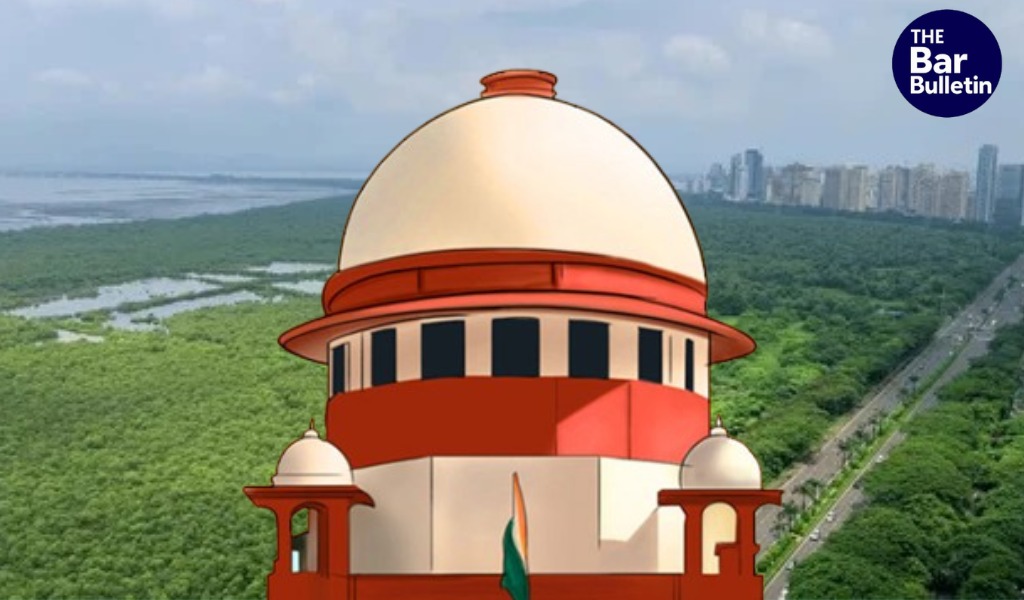

The Supreme Court on Friday declined to interfere with the Mumbai Coastal Road project involving large-scale mangrove cutting, emphasizing the need to balance environmental protection with developmental imperatives.
Hearing a challenge to the Bombay High Court’s order permitting cutting of mangroves for the project, the Bench of Chief Justice Surya Kant, Justice Joymalya Bagchi and Justice Vipul M Pancholi noted that all requisite environmental clearances, including Stage-I and Stage-II approvals, had already been granted and were not under challenge.
The petitioner argued that while the project itself was not opposed, the scale of mangrove destruction, particularly the cutting of nearly 60,000 trees for ancillary construction purposes, had not been independently assessed. It was contended that compensatory afforestation was inadequate and misleading, with “in-situ” replantation, on which the High Court permitted such cutting was taking place nearly 10 km away.
“We are not against the project… all we are saying is minimize the impact,” counsel submitted, urging that “some expert body” should assess whether fewer mangroves could be cut.
The Court, however, underscored that infrastructure projects of public importance cannot be indefinitely stalled.“The construction of this road is extremely important… we can’t stall everything that no development can take place in this country,”Chief justice Surya Kant observed. At the same time, the Court acknowledged the environmental concerns raised, noting that regulatory safeguards must be strictly enforced.
“Environmental measures… must be very rigorously enforced. It can’t be compromised,” the Court said.
The bench pointed out that the High Court had already imposed detailed conditions, including compensatory afforestation, third-party monitoring, and annual compliance reports for ten years. It also noted that expert bodies had assessed the project and determined the extent of mangrove diversion. On the plea to reassess the quantum of mangrove cutting, the Court was reluctant to second-guess expert findings:
“This we leave to the experts… we can’t say anything about it because that will result in second-guessing.”
The Court held that existing mechanisms, such as compliance reporting before the High Court, were sufficient. The bench ultimately held:
“In view of the safeguards having been taken by the High Court, we see no reason to interfere.”