


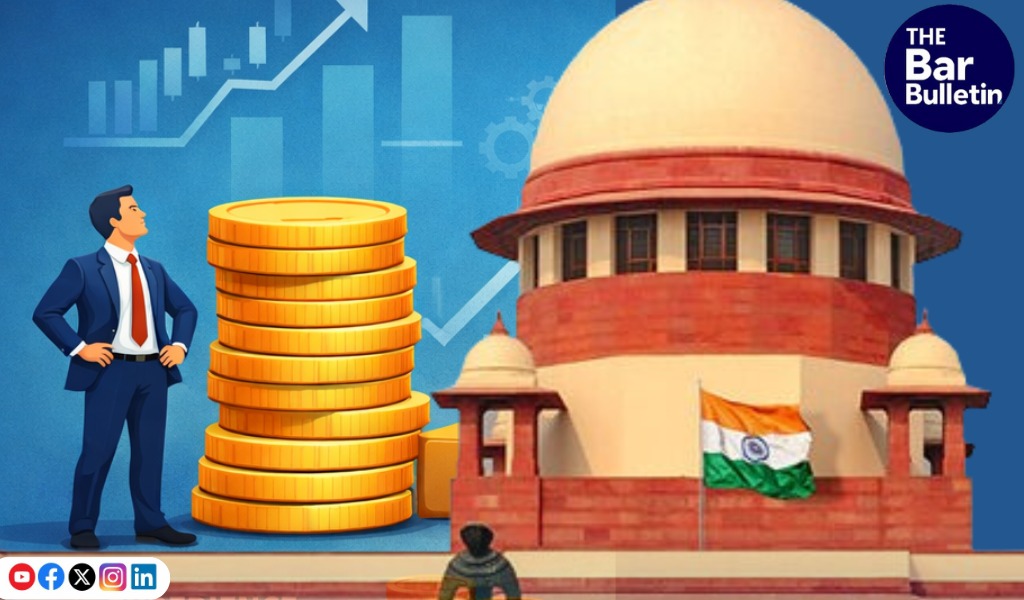

The Supreme Court has set aside a Jharkhand High Court Division Bench judgment that had denied the appellant a higher pay scale on grounds of delay, and had restored the relief earlier granted by a Single Judge. The Bench of Justice J.K. Maheshwari and Justice Vijay Bishnoi held that “the plea of delay and laches cannot be sustained in a case involving continuing violation of rights that too in the light of the nature of directions issued in rem. The Appellant’s consistent pursuit of his claim through representations and the timely filing of the writ petition after their rejection shows that he was not sleeping over his rights.”
The case concerned the grant of a higher pay scale to the appellant, an Industries Extension Officer, who was appointed pursuant to a common competitive examination conducted in 1981 for sixteen non-gazetted Class-III posts across various departments in the erstwhile State of Bihar. While all posts were initially placed in the same pay scale, anomalies arose following successive pay revisions, resulting in similarly situated employees being placed in different pay scales.
Earlier, the Patna High Court in Nagendra Sahani v. State of Bihar, CWJC No. 8419 of 1992, had held that there was no reasonable classification to justify such disparity and directed that all incumbents of the sixteen posts be placed in the higher pay scale, extending the benefit even to those who had not individually approached the Court. Despite this, Appellant’s representations seeking parity were rejected, leading him to file a writ petition before the Jharkhand High Court after his services were allocated to the State of Jharkhand following state reorganisation.
While a Single Judge granted relief, the Division Bench reversed the decision, citing inordinate delay and holding that the Patna High Court’s ruling had only persuasive value. The Supreme Court disagreed, holding that under Section 34(4) of the Bihar Reorganisation Act, 2000, judgments of the Patna High Court rendered prior to reorganisation are binding on the Jharkhand High Court.
The Court further held that claims relating to pay-scale parity and removal of anomalies constitute a continuing cause of action, and therefore cannot be rejected on grounds of delay or laches. It was observed that similarly situated employees cannot be denied benefits already granted to others from the same recruitment process. The Court held that the “financial implications and administrative convenience cannot override constitutional guarantees against arbitrary discrimination. The State, being the model employer, cannot plead its own inefficiency or negligence to deny legitimate rights to its employees. The recommendations of various committees acknowledging the anomaly only reinforces the constitutional obligation to remove the discrimination.”
Allowing the appeal, the Supreme Court restored the Single Judge’s judgment directing revision of the appellant’s pay scale with consequential benefits, and directed compliance within three months.
Appearances
Appellant- Mr. Sudhanshu S. Pandey, Adv. Mr. Gaichangpou Gangmei, AOR Mr. Arjun D. Singh, Adv. Mr. Roshan Kumar, Adv. Mr. Maitreya Mahaley, Adv. Mr. Yimyanger Longkumer, Adv. Mr. Kamei Bestman Kabui, Adv.
Respondents- Mr. Shantanu Sagar, AOR Mr. Anil Kumar, Adv.
