


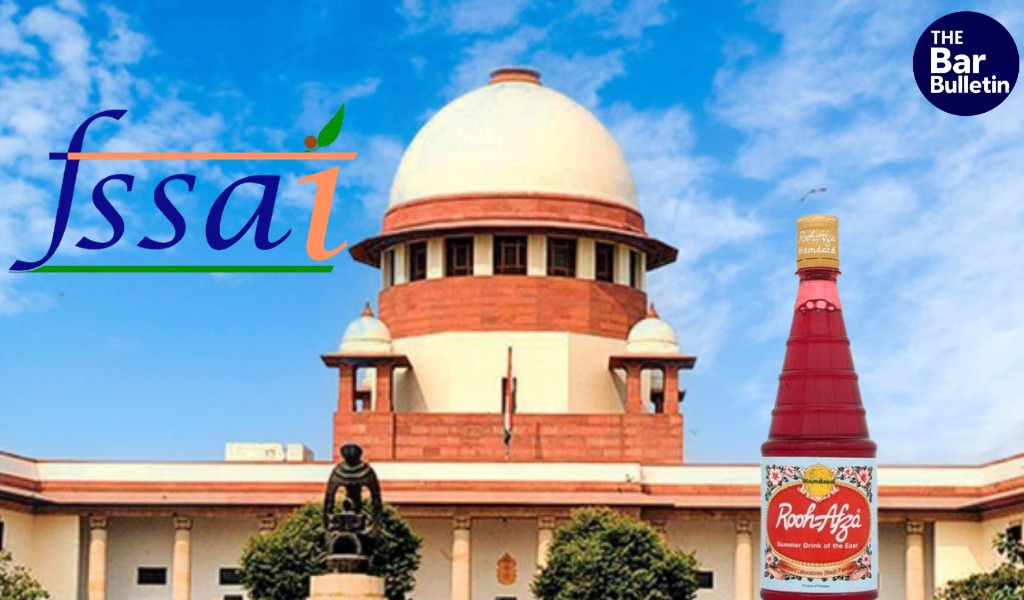

The Supreme Court has ruled that “Sharbat Rooh Afza” is classifiable as a “fruit drink” under Entry 103 of Schedule II, Part A of the UPVAT Act and is consequently liable to be taxed at the concessional rate of 4%. The ruling is based on the cumulative findings that the product derives its essential character from its fruit-based constituents, not its sugar base; and the common parlance test, supported by the product’s treatment in other states, indicates it is understood as a fruit-based beverage.
The Court took note that the same product was classified as a fruit-based beverage and taxed at a lower rate under similar VAT laws in several other states. While not binding, this consistent treatment across multiple jurisdictions serves as evidence of the product’s commercial understanding.
A Two-Judge Bench of Justice B V Nagarathna and Justice R Mahadevan observed that the regulatory laws like the Fruit Products Order, 1955 (FPO) or standards set by the Food Safety and Standards Authority of India (FSSAI) operate in the domain of quality control and licensing. Their classifications are not determinative for fiscal purposes unless a taxing statute expressly incorporates them. Therefore, the classification of “Rooh Afza” as a “non-fruit syrup” under the FPO does not automatically govern its classification under the UPVAT Act.
As the term “fruit drink” is not defined in the UPVAT Act, the Bench held that the common parlance test must be applied. This test requires determining how the product is understood in a commercial and popular sense by those who deal with it. The Bench noted that factors such as the product’s composition, literature, label, character, and end-use are crucial in applying this test, rather than technical definitions or marketing terminology.
The Bench reiterated the established principle that the burden of proof to classify a product under a particular tariff entry, especially one different from that claimed by the taxpayer, lies squarely on the Revenue. In this case, the Revenue failed to provide any cogent evidence like trade enquiries, consumer surveys, or market data to demonstrate that “Sharbat Rooh Afza” is not understood as a fruit-based beverage. Reliance on licensing norms alone was deemed insufficient to discharge this burden.
Further, the Bench found merit in applying the “essential character test”. It observed that although invert sugar syrup is the predominant ingredient by volume (80%), its role is merely that of a carrier, sweetener, and preservative. The product’s essential character, including its flavour, aroma, and identity as a beverage, is derived from the fruit juice and herbal distillates. Therefore, classification should follow the component that confers the essential character, not the one that is quantitatively dominant.
As far as interpretation of Inclusive Entries are concerned, the Bench noted that Entry 103 is inclusive and illustrative, covering “processed or preserved vegetables and fruits including… fruit drink”. The use of the word “including” expands the scope of the entry. Since the legislature did not prescribe a minimum fruit content, it would be inappropriate to read such a rigid requirement into the entry.
Lastly, the Bench emphasized that recourse to a residuary entry is a last resort and is impermissible when a product can reasonably be classified under a specific entry. Citing precedent, it cautioned against consigning a product to the “orphanage of the residuary clause” when it has a reasonable claim to a specific classification.
Briefly, the case pertains to a dispute over the classification of the product “Sharbat Rooh Afza” for the purpose of levying Value Added Tax (VAT) under the Uttar Pradesh Value Added Tax Act, 2008 (UPVAT Act) for the period from January 01, 2008 to March 31, 2012. The appellant is the manufacturer of the product, which is a non-alcoholic sweetened beverage containing 10% fruit juice (pineapple and orange), invert sugar, and various vegetable and herbal extracts.
The appellant classified the product as a “Fruit Drink” under Entry 103 of Part A of Schedule II of the UPVAT Act and paid VAT at the rate of 4%. However, the tax authorities, including the Assessing Authority, the Appellate Authority, and the Commercial Tax Tribunal, held that the product was an unclassified item taxable at 12.5% under the residuary entry in Schedule V of the Act. This view was subsequently affirmed by the High Court of Judicature at Allahabad, which led the appellant to approach the Supreme Court.
Appearances:
Senior Advocate Arvind P. Datar, AOR Ritwik Tyagi, along with Advocates Aditya Bhattacharya, Abhishek Kumar Singh, Simran Tandon, Simran Tandon, Akriti Sharma, and Vipin Upadhyay, for the Appellant/ Taxpayer
AOR Bhakti Vardhan Singh, along with Advocates Vikas Singh Jangra, Samar Vijay Singh, Pawan Kishore Singh, J. Tarun Kumar, and Sandeep Singh Somaria, for the Respondent/ Revenue
