


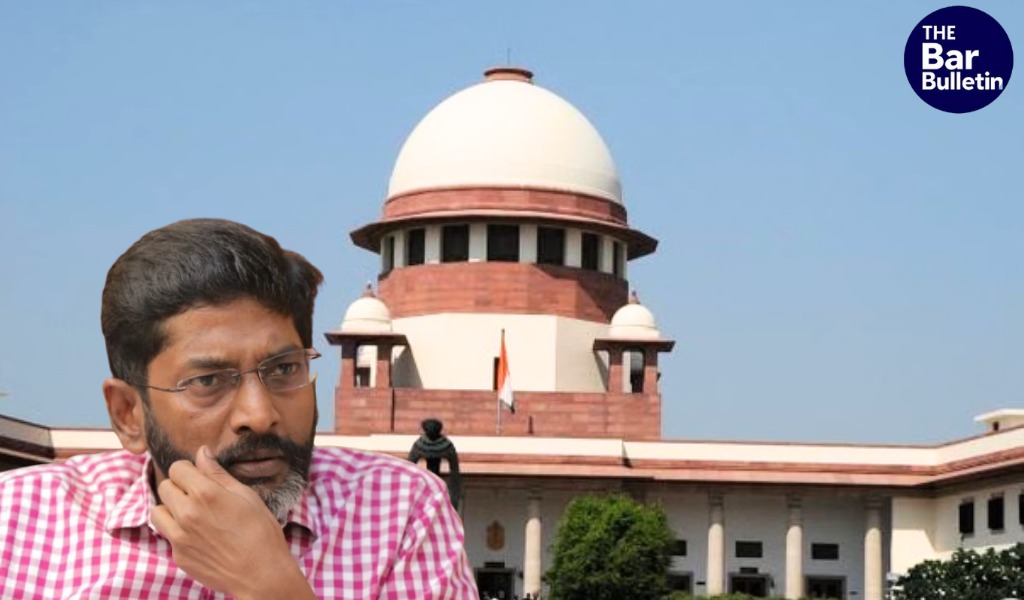

The Supreme Court has set aside portions of a Madras High Court order that directed the police to complete investigations, file charge-sheets within a fixed timeline, and expedite trials against journalist and activist A. Shankar, popularly known as Savukku Shankar, holding that such directions amounted to an improper exercise of writ jurisdiction and placed the appellant in a worse position for having approached the court.
A Bench comprising Justice Dipankar Datta and Justice Satish Chandra Sharma was hearing a criminal appeal arising from the dismissal of Savukku Shankar’s writ petition by the Madras High Court on 29 July 2025. While the High Court had declined to grant relief on his plea alleging abuse of power and victimisation through multiple criminal cases, it went on to direct the police to complete investigation in 13 pending cases within four months and ordered trial courts to dispose of 24 cases within six months.
Before the Supreme Court, the appellant contended that these directions effectively prejudiced him, as he was left in a worse position after approaching the writ court. It was argued that the High Court could not have compelled the investigating agency to file charge-sheets irrespective of the material collected, nor could it have fixed timelines for trials without examining their stage or complexity.
The Supreme Court agreed, reiterating the settled principle that no litigant can be put in a more disadvantageous position merely for invoking the jurisdiction of a court. Relying on its earlier decision in P. Radhakrishnan v. Cochin Devaswom Board, 2025 SCC OnLine SC 2118, the Bench held that the High Court’s directions were unwarranted and exceeded the permissible limits of judicial intervention at the stage of investigation.
The Court also strongly disapproved of the direction to mandatorily file charge-sheets, observing that investigation and the decision whether to prosecute fall squarely within the executive domain. Referring to Kunga Nima Lepcha v. State of Sikkim, (2010) 4 SCC 513 and H.N. Rishbud v. State (Delhi Administration) (1954) 2 SCC 934, the Bench noted that it is for the investigating officer to independently form an opinion, based on material collected, on whether a case is made out for trial. Any judicial direction foreclosing this discretion, the Court said, could undermine the fairness of the criminal process.
Taking note of the appellant’s submission that charge-sheets had already been filed in two cases pursuant to the High Court’s directions, the Supreme Court ordered that paragraphs 8 and 9 of the impugned High Court order be deleted. It further directed that any steps taken in pursuance of those directions, including the filing of charge-sheets, would be of no effect and stood set aside.
At the same time, the Court clarified that the investigating agencies were at liberty to proceed strictly in accordance with law, uninfluenced by the High Court’s earlier observations, and to file appropriate reports under Section 173 of the CrPC or Section 193 of the Bharatiya Nagarik Suraksha Sanhita, 2023, as the case may be. Trial courts were also left free to conduct proceedings in accordance with law, without being bound by rigid timelines.
While the Supreme Court did not interfere with the ultimate dismissal of the writ petition itself, it emphasised that directions which compel prosecution or rush trials without regard to due process could render the concept of a fair trial a “casualty”. The appeal was accordingly disposed of with these observations, reaffirming the limits of writ jurisdiction in criminal matters and the need to preserve investigative and trial autonomy.
Appearances:
For Petitioner(s) : Mr. Balaji Srinivasan, AOR; Mr. K. Gowtham Kumar, Adv.; Ms. Kanishka Singh, Adv.; Mr. Vishwaditya Sharma, Adv.; Mr. A.p. Balaji, Adv.
For Respondent(s) : Mr. Sidharth Luthra, Sr. Adv.; Mr. Sabarish Subramanian, AOR; Mr. K.S. badhrinathan, Adv.
