


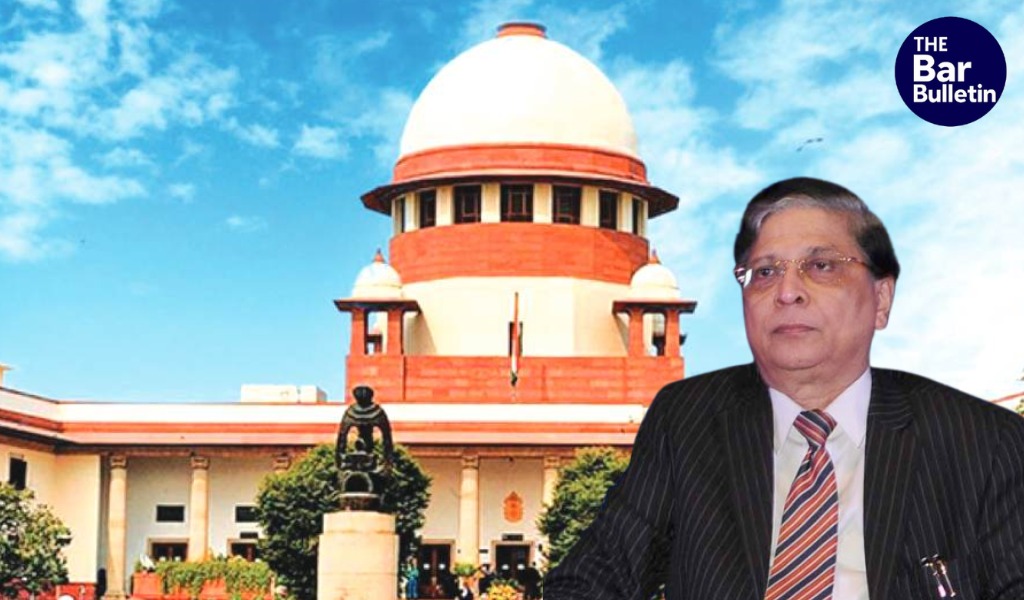

The Supreme Court on Thursday dismissed a plea filed by Advocate Ashok Pandey, who sought ₹1 crore as fees and expenses for filing multiple cases in defence of the then Chief Justice of India, Dipak Misra, from “humiliation, torture, removal”, during the controversy surrounding him.
Appearing in person, the petitioner told the Court that he had spent money and effort filing several petitions to defend the institution of the judiciary. He claimed that he incurred expenses while pursuing the litigation, including borrowing money from his daughter when his entry to the High Court premises was restricted.
The bench of Chief Justice Surya Kant, Justice Joymalya Bagchi, and Justice Vipul M. Pancholi, however, observed that the claim for compensation was misconceived and could not be entertained. Responding to the submissions, the Court remarked that any effort made in defence of the institution would amount to social service, which cannot be monetarily quantified.
“You provided social service to the institution. And social service is always priceless. How can it be assessed as one crore, two crore, three crore?…If you want appreciation, we appreciate you for that.” the CJI said.
The Court further noted that the petitioner’s claim seeking payment from the government for filing such cases had no legal basis and that the High Court had rightly rejected it.
Counsel appearing for the Union of India also submitted that the claim was “totally misconceived and misdirected”, as the government already maintains a panel of advocates to represent its interests before the Supreme Court.
During the hearing, the Petitioner also referred to past proceedings and costs imposed on him in earlier matters. The bench acknowledged his submissions but reiterated that there was no case to entertain the present claim.
The Court ultimately declined to interfere with the High Court order dismissing the plea.
“There is no case for us to entertain this kind of claim.”
A dramatic courtroom exchange unfolded in the Supreme Court during the hearing of Ashok Pandey v. Union of India & Ors., where the petitioner sought ₹1 crore as fees and expenses for filing multiple cases to defend the then Chief Justice of India during a past controversy.
Appearing in person, Pandey argued that he had spent money and effort filing several petitions to protect the dignity of the judiciary when, according to him, others remained silent.
“When the impeachment proceedings were going on and the Chief Justice of India was being insulted, neither the Attorney General nor the Solicitor General came forward,” Pandey told the bench, insisting that his efforts had helped safeguard the institution.
He claimed that his legal pursuits came at personal cost.
“My entry in the High Court was prohibited at that time. I had to take money from my daughter… I made at least 15 mentions just to get the matter moved,” he said, adding that his expenses were at least ₹2 lakh.
The bench, however, was unimpressed by the demand for compensation and responded with a pointed remark that drew a moment of levity in the courtroom.
“You provided social service to the institution. And social service is always priceless. How can it be assessed as one crore, two crore, three crore?” the Court remarked.
The judges further indicated that the claim for monetary compensation from the government for filing such petitions was misconceived.
Counsel appearing for the Union of India also argued that the petitioner had no legal basis to seek payment, pointing out that the government already maintains a panel of advocates to represent its interests before the Supreme Court.
During the hearing, Pandey continued to press his point, referring to earlier proceedings and costs imposed on him in previous cases, while maintaining that his actions were aimed at protecting the judiciary.
The bench, however, declined to entertain the plea, reiterating that such efforts, if undertaken, amount to public service rather than a payable professional engagement.