


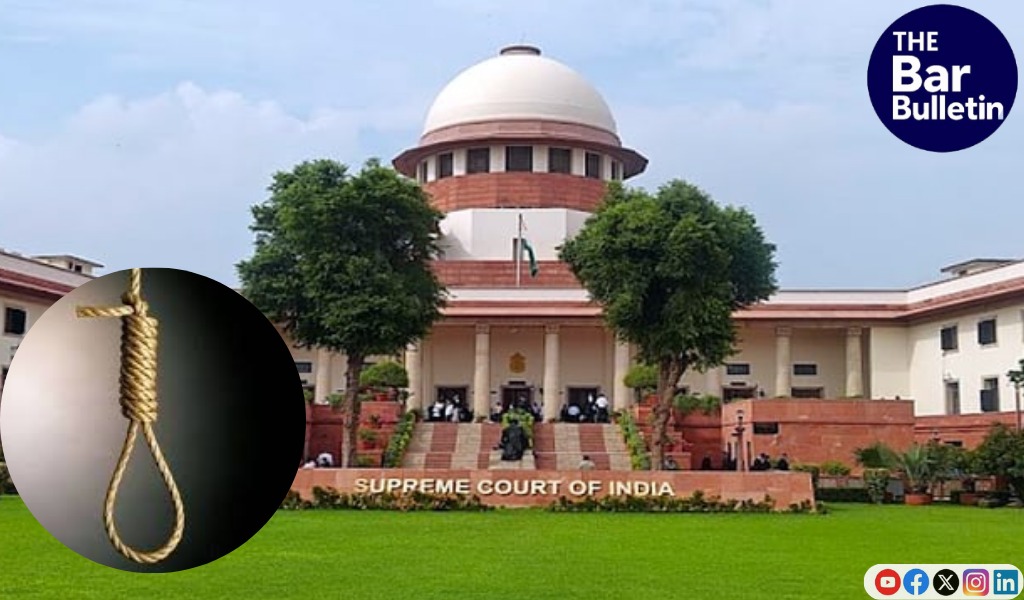

The Supreme Court has issued a comprehensive set of directions aimed at addressing the rising incidence of student suicides in higher educational institutions (HEIs), mandating immediate reporting of all student suicides and strengthening institutional accountability for student mental well-being.
In an earlier judgment dated March 24, 2025, the Supreme Court had clarified the law on mandatory registration of FIRs upon disclosure of a cognizable offence, and categorically held that educational institutions are under a moral and legal obligation to promptly lodge an FIR when a student suicide occurs on campus.
Taking judicial notice of the alarming rise in student suicides across the country, the Court had then found it necessary to go beyond individual criminal liability and examine systemic and institutional causes of student distress. In pursuance of this objective, the Court constituted a National Task Force (NTF) to study the issue holistically and recommend preventive, remedial, and reformative measures for student mental well-being in HEIs.
Findings of the National Task Force
Placing reliance on data from the Sample Registration System (SRS), the National Crime Records Bureau (NCRB), stakeholder surveys, and institutional visits, the NTF flagged that suicides among persons aged 15-29 years are among the leading causes of death, with students forming a particularly vulnerable group.
The Task Force identified that student suicides represent only the “visible tip of the iceberg” of deeper distress caused by factors such as:
• Structural and social inequalities faced by marginalised students
• Tokenistic or ineffective functioning of Equal Opportunity Cells and Internal Complaints Committees
• Persistent ragging and discrimination
• Excessive academic pressure and rigid institutional policies
• Severe shortage of qualified mental health professionals on campuses
• Financial stress due to delayed scholarships and institutional practices
The NTF observed that many statutory grievance redressal bodies exist merely on paper, lack independence, or function in a manner that discourages students from seeking redress.
Endorsing the findings of the NTF, the Court rejected the tendency to individualise blame for student suicides and absolve institutions of responsibility. The Bench underscored that HEIs cannot shirk their duty to provide a safe, inclusive, and responsive learning environment, regardless of where penal culpability may ultimately lie.
The Court also expressed serious concern over the apathetic response of most HEIs to the NTF’s survey, noting that non-engagement itself reflected systemic neglect of student well-being.
Directions issued by the Supreme Court
The bench of Justice J.B. Pardiwala and Justice R. Mahadevan, while noting a “disturbing pattern” of suicides across HEIs, emphasised that institutions cannot evade responsibility by attributing such incidents solely to individual autonomy.
Taking note of an interim report submitted by a National Task Force (NTF) constituted by the Court, the Bench observed that student suicides are a result of deeper structural distress, including academic pressure, discrimination, lack of mental health services, financial stress, and ineffective grievance redressal mechanisms.
Among the key directions, the Court ordered that:
1. SRS suicide data for the 15–29 age group to be centrally maintained to ensure accurate estimates of student suicides.
2. NCRB directed to separately classify suicides of school students and higher-education students in its annual reports.
3. All HEIs must immediately report every student suicide or unnatural death to the police, irrespective of where it occurs.
4. HEIs to submit annual reports of student suicides to the UGC and concerned professional regulators.
5. Residential HEIs must ensure 24×7 access to qualified medical assistance, either on campus or within a one-kilometre radius.
6. All vacant teaching and non-teaching posts to be filled within four months, with priority to reserved categories.
7. Key administrative posts such as Vice-Chancellors and Registrars to be filled within prescribed timelines, preferably within one month of vacancy.
8. Pending scholarships to be cleared within four months; students not to face academic or hostel penalties due to delays.
9. Strict compliance with binding UGC regulations mandated, including anti-ragging measures, ICCs, equity and grievance-redress mechanisms.
The Court also requested the National Task Force to assist in preparing model standard operating procedures to ensure that the proposed recommendations are accompanied by concrete mechanisms for implementation. NFT is required to assist in-
1. Preparing a model SOP for periodic well-being audits in HEIs.
2. Framing a model SOP for faculty sensitisation and training.
3. Developing a model SOP for campus mental health services.
The Court further said it expects the National Task Force to suggest a model ‘Universal Design Framework’ or a comprehensive ‘Student Well-being or Suicide Prevention and Postvention Protocol’ that consolidates the proposed SOPs with existing guidelines on ragging, equity, sexual harassment and grievance redressal into a single guiding document, without creating parallel mechanisms. It added that statutory and professional regulators such as the UGC, AICTE, NMC and Bar Council of India may incorporate additional measures addressing sector-specific issues under their respective domains.
The Union of India and State Governments were directed to communicate the Court’s directions to all HEIs and ensure immediate compliance.
Appearances
Appellants- Mr. R. H. A. Sikander , AOR
Respondents- Mr. Arvind Kumar Sharma, AOR Ms. Mrinal Gopal Elker, AOR Mr. Mukesh Kumar Maroria, AOR Mr. E. C. Agrawala, AOR Mr. Akshay Amritanshu , AOR Mr. Mayank Sapra, AOR Ms. Disha Singh , AOR Ms. Swati Ghildiyal , AOR Mr. Sanchit Garga, AOR Miss Snehpreet Kaur, AOR Mr. Kunal Mimani, AOR Mr. Aaditya Aniruddha Pande, AOR Mr. Avijit Mani Tripathi, AOR Mr. Nishe Rajen Shonker, AOR Mr. Sanpreet Singh Ajmani, AOR Mr. Sameer Abhyankar, AOR Mr. Sudarshan Lamba, AOR Mr. Pukhrambam Ramesh Kumar, AOR Ms. K. Enatoli Sema, AOR Ms. Vidushi Bajpai, AOR Mr. Samar Vijay Singh, AOR Mr. Amith Krishnan H , AOR Mr. Parmanand Gaur, AOR Ms. Nidhi Jaswal, AOR Mr. Pashupathi Nath Razdan, AOR
