


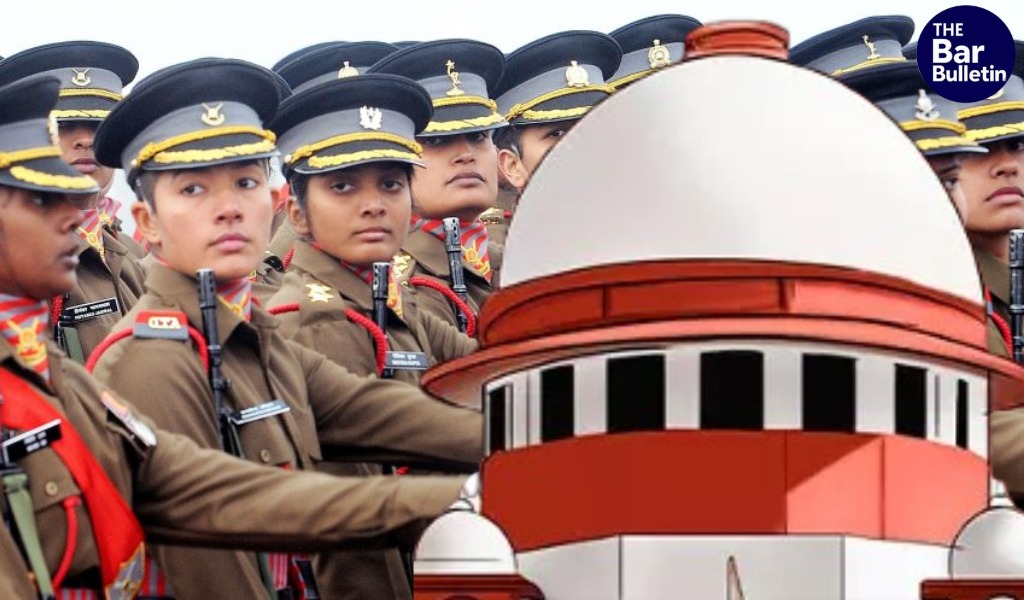

The Supreme Court on Tuesday pronounced its long-awaited judgment on the grant of Permanent Commission to women Short Service Commission (SSC) officers in the armed forces, holding that the denial of such commission was a consequence of systemic discrimination.
The Court observed that the exclusion of women officers was not merely the result of individual assessments but stemmed from a structural framework that operated to their disadvantage.
“The denial of commission… was not merely the outcome of individual assessments, but the consequence of a systemic framework rooted in assumptions that entrenched disadvantage in career progression. Where the evaluative framework applied to assess their performance under various parameters lacked the depth and rigor applied to their male counterparts, these assessments have inevitably influenced their service reports, comparative merit and career progression.”
Invoking its constitutional powers under Article 142 of the Constitution to ensure complete justice, the Court held:
“Thus, we deem it appropriate to invoke our power under Article 142 of the Constitution to grant such relief which is molded towards doing complete justice.”
At the same time, the Court balanced institutional considerations by protecting past selections and service decisions, while granting a one-time pensionary benefit to affected officers by deeming them to have completed 20 years of qualifying service.
“All… officers who were considered for grant of Permanent Commission… shall be deemed to have completed substantive qualifying service of 20 years and shall be entitled to pension and all consequential benefits except arrears of pay.”
DIRECTIONS
The Bench of Chief Justice Surya Kant, Justice Ujjal Bhuyan, and Justice N Kotiswar Singh has granted the following relief:
• The grant of Permanent Commission already made to SSC officers by Selection Boards (including 2020 and 2021 boards) shall not be disturbed.
• As a one-time measure, all women SSC officers (including intervenors) who were considered for Permanent Commission, and released from service during the pendency of proceedings (before AFT, High Court, or Supreme Court), shall be deemed to have completed 20 years of qualifying service.
• Such officers shall be entitled to pension and all consequential benefits, except arrears of pay. Pension shall be calculated based on the deemed completion of 20 years of service, with arrears payable only from the specified date (as directed).
• Certain categories (e.g., JAG and AEC cadres) are excluded from these directions where they were already eligible for Permanent Commission earlier.
• Officers still in service who were considered in the relevant Selection Boards and meet the prescribed benchmark (e.g., cut-off grading), shall be eligible for the grant of Permanent Commission, subject to medical fitness and vigilance/disciplinary clearance.
• Officers aggrieved by results of subsequent Selection Boards (post-2021) are at liberty to pursue remedies in accordance with the law.
• For the future, authorities are directed to (1) ensure transparency in evaluation criteria, (2) disclose vacancies and marking systems, and (3) review the ACR evaluation framework to avoid disproportionate impact on women officers.
BACKGROUND
The issue traces back to the position prior to 2020, when women Short Service Commission (SSC) officers in the armed forces were not granted permanent commission in several branches, unlike their male counterparts. This led to constitutional challenges, and the Supreme Court subsequently recognised the right of women SSC officers to be considered for permanent commission, directing the government to frame appropriate policies.
Following these directions, the Union Government introduced revised policies and evaluation criteria to assess eligibility for permanent commission. This marked the implementation phase, where women officers were formally considered under structured parameters such as service record, performance, and other institutional requirements.
However, disputes arose when several women SSC officers, despite being considered under this framework, were denied permanent commission. These officers contended that the evaluation process lacked transparency and fairness, and the criteria were applied in a manner that disproportionately excluded them.
The matter ultimately reached the Supreme Court again, where the core issue was whether such denial was legally sustainable. The Court examined whether the implementation of the policy adhered to constitutional guarantees of equality and non-discrimination, and whether it was consistent with the spirit and intent of its earlier judgments recognising the rights of women officers in the armed forces.
Case Details
Wg Cdr Sucheta Edn v. Union of India & Ors. Diary No. 28412-2024
Lt. Col. Pooja Pal & Ors. v. Union of India & Ors. C.A. No. 9747-9757/2024
Yogendra Kumar Singh v. Union of India & Ors. C.A. No. 14681/2024
