


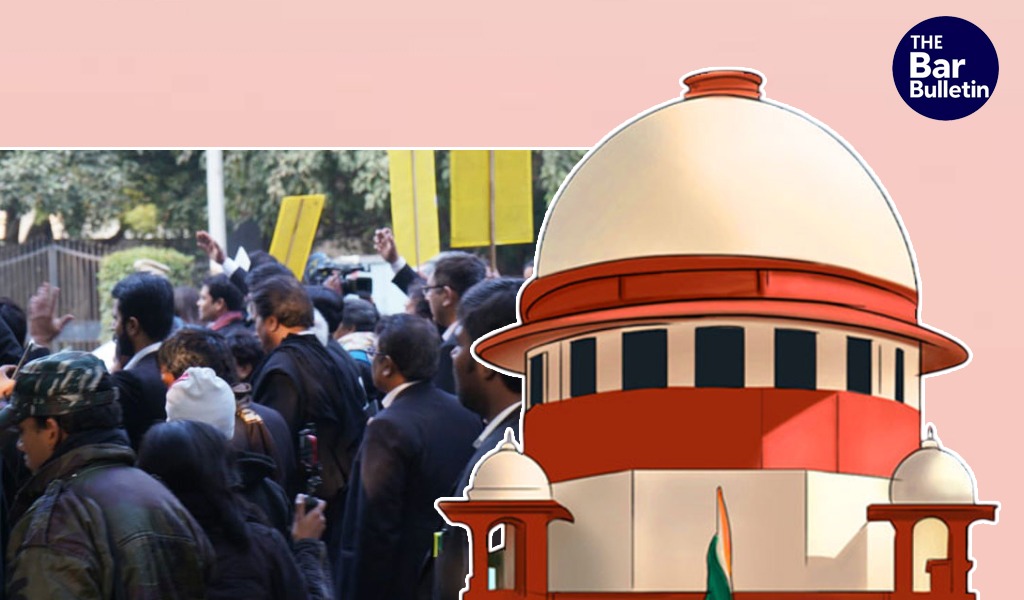

The Supreme Court on Friday continued hearing review petition arising from its earlier ruling mandating three years of practice at the Bar as a prerequisite for entry into the judicial service.
The Bench emphasised that the principle requiring practical experience at the Bar remains settled, but the Court is examining how the requirement should be implemented. At the same time, the court directed that the last date for submission of applications for judicial service recruitment be extended to April 30, 2026. The Court observed:
“Ultimately, the practice condition will have to be there… the only issue is the modality of giving effect to that.”
The Bench noted that the requirement was intended to improve the quality of the judiciary by ensuring practical exposure before joining the bench, but acknowledged that the method of implementation needs careful structuring. The Court remarked: “The fear should be there, but it should be structured.”
During the hearing, Amicus Curiae Siddharth Bhatnagar informed the Court that views among institutions were divided. While several High Courts supported retaining the rule, a large number of National Law Universities had raised concerns.
The amicus also noted that High Courts broadly favoured retaining the requirement but suggested improving accessibility for persons with disabilities.
“Broadly the High Courts are of the view that the three-year rule should remain. For specially-abled candidates there should be measures for better accessibility.”
Senior Advocate Pinky Anand suggested that the Court consider temporarily keeping the rule in abeyance while modalities for implementation are worked out.
“These are not annual examinations. Every State conducts its examinations at whatever time. For the time being the condition may be stayed while the Court considers the modalities.”
During the course of the hearing, the Court also examined suggestions placed in the review petition highlighting certain practical difficulties arising from the three-year practice requirement. It was submitted that judicial service examinations are not conducted annually in many States, and since recruitment notifications are vacancy-based, candidates may effectively be required to practise for four to seven years before getting their first opportunity to attempt the examination. The petition also raised concerns that the requirement could delay career progression within the judiciary and disproportionately affect women, economically disadvantaged candidates and persons with disabilities.
As an alternative approach, the review petition proposed that practical exposure could be incorporated as part of structured post-selection training instead of mandating pre-entry Bar practice. Under this model, selected candidates could undergo practical training by working with District Judges as apprentices or judicial trainees, or by being attached to the chambers of designated senior advocates, government pleaders or law officers for a specified period. The petition also suggested introducing structured practice modules or specialised judicial training courses during law degrees to better prepare aspiring candidates for judicial service.
Senior Advocate Nandita Rao highlighted the potential impact of the rule on women candidates entering the judiciary.
“This barrier is hurting women. At the entry level it is not that difficult, but when we are put back that is a crucial time. If we are set back another three years then we may never be able to move forward in our career.”
Senior Advocate Colin Gonsalves also questioned whether the rule would unintentionally push talented law graduates away from litigation altogether. Referring to data placed before the Court, he submitted that several graduates from National Law Universities may abandon practice if compelled to wait for three years before attempting judicial service examinations. He argued:
“Quite a considerable number will abandon litigation completely… So you’re losing the best brains coming out of NLUs.”
During the hearing, the Court indicated that the requirement of practical experience must be implemented in a meaningful manner rather than being a mere formality. The Bench observed: “Only as an enrolled advocate sitting idle in one court or the other… will that make them eligible? It has to mean that they have actually learnt something.”
After hearing the submissions, the Court stated that it would continue examining suggestions from stakeholders and revisit the issue. The Court said:
“You have given some suggestions and the amicus has also given some suggestions. You also revisit it while we are considering it. Next week again we will take this up.”
In the interim, the Supreme Court directed that the last date for submission of applications for judicial service recruitment be extended to April 30, 2026.
The Court ordered that all High Courts which have already issued advertisements must extend the deadline accordingly, and that fresh advertisements issued by High Courts or State Public Service Commissions must also provide April 30 as the application deadline.