


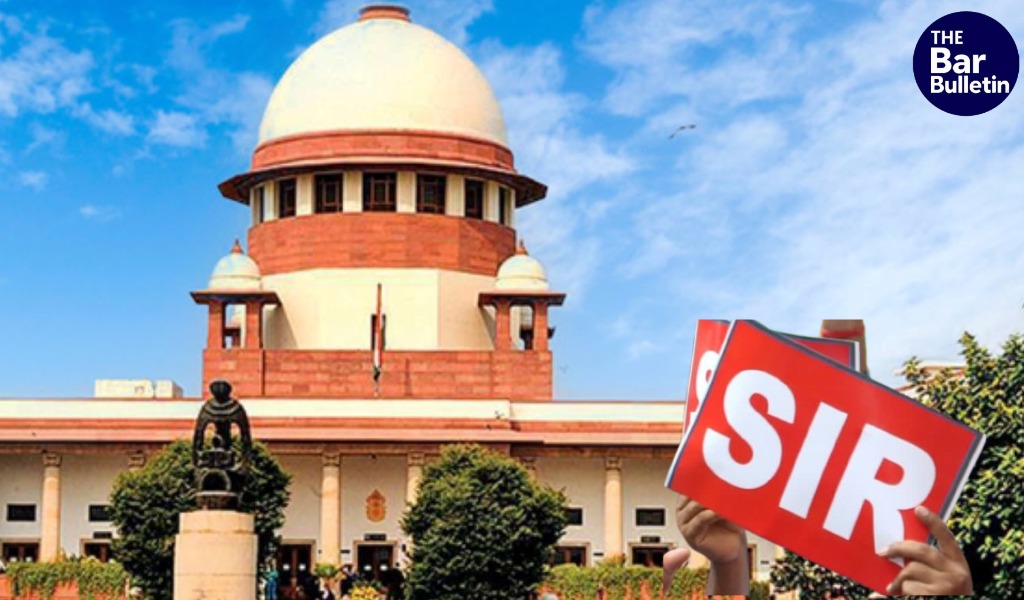

The Supreme Court today has issued detailed directions to address the practical difficulties in verifying approximately 50 lakh claims and objections arising out of the Special Intensive Revision (SIR) of electoral rolls in West Bengal.
Taking note of a letter from the Chief Justice of the Calcutta High Court, the Bench observed that despite deploying around 220-250 judicial officers of the rank of District Judge and Additional District Judge (including some retired officers), the scale of the task remained daunting.
“If each officer decides 250 objections a day, it will take 80 days,” the Court noted, underscoring the urgency created by the electoral timeline. Recognising that the existing manpower would be insufficient, the Chief Justice dictated further directions to widen the pool of officers who may undertake verification.
The Court emphasised that the objective was to preserve “the purity and sanctity of the electoral process” while ensuring that democratic rights are not compromised due to administrative constraints.
In view of these constraints, the Court issued the following directions:
• In addition to District Judges and ADJs already assigned, the Chief Justice of the Calcutta High Court may draw upon Civil Judges (Senior and Junior Division) with at least three years of service to assist in verification.
• Inter-State Judicial Assistance: If further manpower is required, the Chief Justice of the Calcutta High Court may approach the Chief Justices of the High Courts of Jharkhand and Odisha to provide judicial officers of similar rank. On the language barrier concerns, CJI pointed that:
“The only way out is neighbouring states. Let’s go by the history also, Jharkhand and Odisha were part of Bengal at one point. People still understand the local dialect. People have some familiarity with that. And then sending from Delhi, Rajasthan or Haryana is completely irrelevant. They can’t perform. Only the neighbouring states can do it.”
• All travel, boarding, lodging and incidental expenses of officers drawn from neighbouring states shall be borne entirely by the Election Commission of India. The Court clarified: “We don’t want any vagueness. You pay the entire expenditure. If you face any difficulty, let us know.”
• Verification shall be confined to documents permitted under:
◌ ECI Notification dated October 27, 2025 (SIR commencement),
◌ Notification dated June 24, 2025,
◌ Order dated September 8, 2025 (accepting Aadhaar as identity proof),
◌ Order dated January 19, 2026 (permitting Madhyamik admit card and pass certificate).
• Only documents submitted physically or electronically on or before February 14, 2026 shall be considered. Judicial officers shall verify documents based on receipts issued before February 14. Discrepancies between uploaded and physical documents may be examined.
• It shall be the responsibility of Electoral Registration Officers (EROs) to satisfy presiding judicial officers regarding authenticity.
• Final electoral roll shall be published on February 28, 2026. If verification remains incomplete, the ECI may publish supplementary lists on a continuous basis.
• Voters included in subsequent supplementary lists shall be deemed to have been part of the final roll published on February 28, 2026.
“We deem it appropriate to invoke our powers under Article 142… voters enlisted in subsequent supplementary lists shall be deemed to have been part of the final list published on 28th February 2026.”
Upload Delays and Receipt-Based Verification
The Court also addressed concerns regarding technical delays in uploading documents submitted before the February 14 cut-off. Counsel submitted that due to the massive volume and occasional system crashes, some documents submitted before the cut-off date were uploaded later, and some remained pending for upload. The Bench clarified that what would be determinative is whether the document was submitted before February 14 and whether a receipt was issued.
“If the receipt contains a document which has not been uploaded, certainly they will have a right to represent,” the Court observed.
The Court reiterated that this is an inquisitorial exercise, not an adjudicatory one, and that judicial officers would compare physical documents with receipts to verify authenticity.
“If a receipt has been fraudulently created, the ERO will immediately say this is not right,” the Bench said. It was further noted that judicial officers are empowered under evidentiary principles to compare disputed documents and receipts.
Aadhaar is for Identity, Not Citizenship
Concerns were raised regarding the alleged misuse of Aadhaar in border districts. The Court declined to widen the scope of the proceedings into a broader debate on citizenship or alleged fake documents. “We are dealing with the Representation of the People Act. This is not the forum for that discussion,” the Bench observed.
The Court reiterated that Aadhaar was being considered strictly as proof of identity. “There is no question of citizenship. Aadhaar is for the purpose of identity.”
Any legislative changes, the Court suggested, must be pursued through statutory amendment rather than judicial direction in the present matter.
Also read-
https://thebarbulletin.com/supreme-court-calcutta-hc-judicial-officers-wb-electoral-roll-revision/
Appearances
Sr. Adv Kapil Sibal, Shyam Diwan, Gopal Sankaranarayanan, Menaka Guruswamy and Kalyan Banerjee appearing for petitioners
Sr Adv Dama Seshadri Naidu for ECI.