


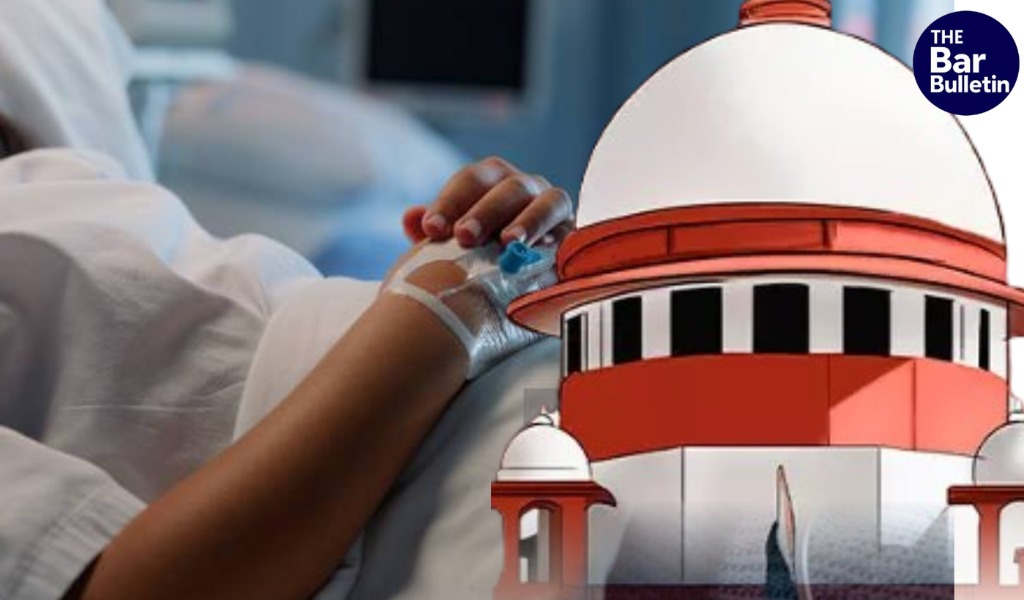

The Supreme Court on Wednesday permitted the withdrawal of life-sustaining treatment for a 32-year-old man who has remained in a persistent vegetative state (PVS) for 13 years after suffering a severe brain injury in 2013.
The Bench of Justice JB Pardiwala and Justice KV Viswanathan ruled that clinically assisted nutrition and hydration (CAN) constitutes medical treatment, meaning it can legally be withdrawn when continuation is not in the patient’s best interests, in accordance with the framework laid down in Common Cause v. Union of India.
The case arose from a petition seeking permission to withdraw life-sustaining treatment for a man, who had been in a persistent vegetative state (PVS) for over 13 years following a severe traumatic brain injury suffered after a fall from the fourth floor of his accommodation in August 2013 while pursuing his B.Tech degree.
Since then, he has been in persistent vegetative state with quadriplegia, dependent on tracheostomy, catheterisation, and clinically assisted nutrition and hydration through a PEG tube. Medical boards found no improvement in his condition for over 13 years, and his family approached the Court seeking permission to withdraw life-sustaining treatment.
Judgement by Justice JB Pardiwala
1. Clinically assisted nutrition and hydration is a medical treatment
The Court held that CAN is not merely basic care but a technologically mediated medical intervention. Justice JB Pardiwala remarked that:
“CAN cannot be regarded as a mere means of basic sustenance or primary care, but should be recognised as a technologically mediated medical intervention… supervised and periodically reviewed by trained healthcare professionals.”
Because it qualifies as medical treatment, its continuation or withdrawal can be assessed under the passive euthanasia framework established in Common Cause.
2. “Best interests of the patient” is the governing test
The Court clarified the scope of the best-interest principle for unconscious or incompetent patients.
“The correct inquiry is not whether it is in the best interests of the patient that he should die, but rather whether it is in his best interests that his life should be prolonged by the continuance of such treatment.”
The principle must be applied by Medical boards, Family members or guardians, and Courts where necessary. The Court held there is initially a presumption in favour of preserving life, but it can be displaced where treatment becomes medically futile, prolongs suffering, or causes indignity to the patient’s life.
3. Withdrawal of treatment must be humane and medically supervised
The Court emphasised that withdrawal of life support does not mean abandoning the patient.
“The withholding or withdrawal of medical treatment is not a single abrupt act devoid of care… it entails a structured stepwise process anchored in a clearly articulated withdrawal plan.”
Such withdrawal must be accompanied by palliative and end-of-life care aimed at minimising pain and preserving dignity.
Directions issued by the Court
1. Medical treatment being administered to Harish Rana, including clinically assisted nutrition and hydration (CAN), shall be withdrawn or withheld.
2. The 30-day reconsideration period prescribed in Common Cause is waived because all stakeholders unanimously supported withdrawal.
3. All India Institute of Medical Sciences shall admit the patient in its palliative care department to supervise withdrawal of treatment.
4. AIIMS must provide all necessary arrangements to shift the patient from his residence to the hospital’s palliative care facility.
5. Withdrawal must occur through a robust palliative care plan ensuring, symptom management, minimal discomfort, and preservation of the patient’s dignity.
6. High Courts must issue directions so that Judicial Magistrates of First Class (JMFCs) receive hospital information when medical boards unanimously approve withdrawal of treatment.
7. The Union government and state health departments must ensure that Chief Medical Officers (CMOs) maintain panels of registered medical practitioners qualified to serve on secondary medical boards. These panels must be reviewed and updated every 12 months.
8. The matter will be listed after one month to review compliance with immediate directions and again in August 2026 for further compliance.
Justice JB Pardiwala acknowledged the emotional complexity of the case and the emotional burden carried by the family, noting their unwavering care over the past 13 years.
“Despite the catastrophic tragedy that struck the applicant, his family never left his side… this unwavering vigil is a testament to the true meaning of love. Our decision today is not about choosing death, but about not artificially prolonging life when treatment no longer heals or meaningfully improves life… survival is not always the same as living.”
Addressing the family directly, Justice JB Pardiwala added:
“You are not giving up on your son. You are allowing him to live with dignity. It reflects the depth of your selfless love and devotion.”
Concurring Opinion of Justice Vishwanathan
In a separate but concurring opinion, Justice K. V. Vishwanathan agreed with the reasoning and conclusions reached by Justice J. B. Pardiwala, while elaborating on the application of the principles laid down in Common Cause v. Union of India.
Justice Vishwanathan emphasised that the “best interest of the patient” must remain the guiding principle in cases concerning withdrawal of life-sustaining treatment. Echoing the words of Dr. William J. Mayo, he noted:
“The best interest of the patient is the only interest to be considered.”
Clarification on scope of Common Cause
Justice Vishwanathan clarified that the High Court had erred in restricting the Common Cause framework only to terminally ill patients. According to him, the judgment also applies to patients in permanent vegetative states (PVS) or similar irreversible conditions where continued treatment serves no therapeutic purpose.
Relying on Common Cause, the judgment in Aruna Ramachandra Shanbaug v. Union of India, and comparative jurisprudence such as Airedale NHS Trust v. Bland, he agreed that clinically assisted nutrition and hydration (CAN) constitutes medical treatment, and therefore falls within the passive euthanasia framework.
Best interest test
Justice Vishwanathan stressed that determining a patient’s best interests requires a holistic and fact-specific assessment, observing that:
“The starting point of the inquiry should not be whether it will be in the best interest of the patient that treatment should be ended, but whether it is in his best interest that treatment which artificially prolongs life should be continued.”
He noted that courts must consider multiple factors, including:
• the presumption in favour of preservation of life,
• whether treatment has become medically futile,
• the absence of therapeutic benefit,
• the indignity or suffering caused by prolonged treatment, and
• the opinions of medical experts and the patient’s family.
Applying these principles to the present case, Justice Vishwanathan observed that both the Primary and Secondary Medical Boards had confirmed that Harish Rana was in an irreversible permanent vegetative state, and that continuation of clinically assisted nutrition and hydration would offer no therapeutic benefit.
He concluded that the medical evidence, expert opinion, and the views of the family all pointed to one conclusion: that continuing treatment would not be in the patient’s best interests.
Justice Vishwanathan, therefore, concurred with the directions issued in Justice Pardiwala’s judgment permitting withdrawal of life-sustaining treatment, while also acknowledging the extraordinary care and devotion shown by Harish Rana’s family over the past twelve years.
Appearances
Petitioner- Advocate Rashmi Nandakumar
Respondent- Additional Solicitor General Aishwarya Bhati