


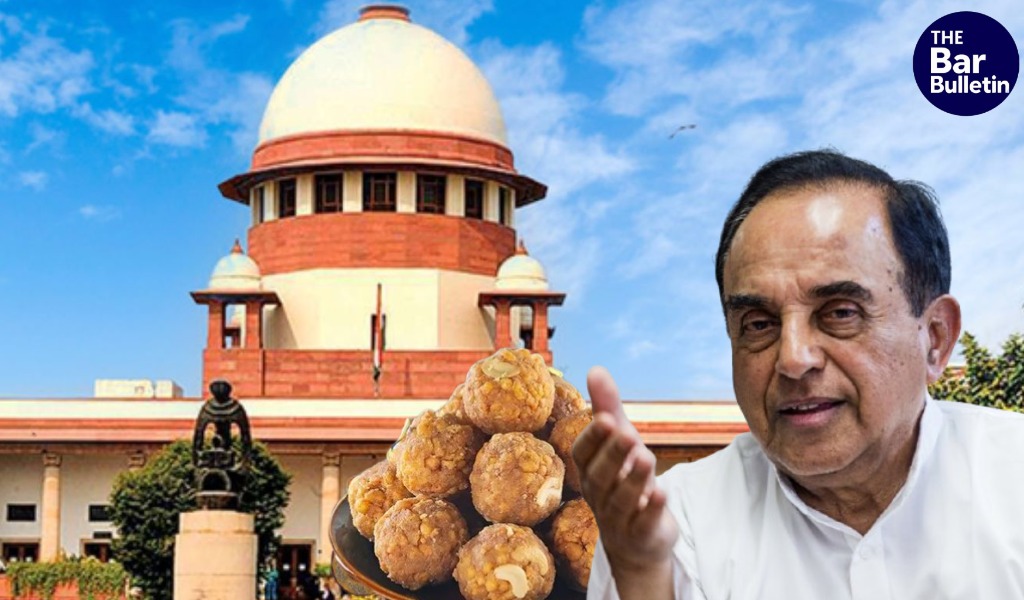

The Supreme Court on Monday addressed concerns over a parallel administrative inquiry initiated by the State of Andhra Pradesh in relation to the alleged adulteration of prasadam laddus at Tirumala (Tirupati Laddu case).
The controversy stems from allegations regarding the use of substandard or improper ingredients in the preparation of Tirumala prasadam, which led to the registration of an FIR in September 2024. The Court had earlier directed that the investigation be conducted by a Special Investigation Team (SIT). During the present hearing, it was brought to the Court’s notice that the criminal investigation had concluded and that a chargesheet, along with supplementary chargesheets, had been filed.
Senior Advocate Rajshekhar Rao, for the petitioner, expressed apprehension that the State’s decision to appoint a one-man administrative committee to examine lapses could overlap with or interfere with the criminal proceedings already undertaken by the SIT.
Responding to these concerns, the Bench of Chief Justice of India, Justice Surya Kant,Justice Joymalya Bagchi clarified that the administrative inquiry was limited to examining departmental or procedural lapses and fixing responsibility at an administrative level, and did not impinge upon the completed criminal investigation. The Court observed:
“Such an administrative inquiry, in our opinion, cannot be termed as overlapping with the real criminal proceedings which have culminated into filing of the chargesheet. There will be no overlapping, there will be no conflict of interest… The apprehension expressed has no foundational basis.”
Thus, the court emphasised that the scope of the criminal prosecution and the departmental inquiry were distinct and “well demarcated,” leaving no room for conflict.
At the same time, concerns were raised regarding public statements made by high constitutional functionaries in relation to the issue. The Court reiterated the need for restraint, particularly in matters that may affect public faith and religious sentiment.
The Bench ultimately allowed both processes, the criminal prosecution based on the chargesheet and the State’s administrative inquiry, to proceed in accordance with law, clarifying that neither would impede the other.
Appearances
Sr Adv Rajshekhar Rao
SG Tushar Mehta and Sr Adv Sidharth Luthra