



The Union Budget 2026-27, presented by the Union Minister for Finance and Corporate Affairs, Smt. Nirmala Sitharaman, eschews populist measures in favour of a strategic blueprint for sustained long-term growth, fiscal consolidation, and structural reform. Framed against a backdrop of global economic uncertainty and trade tensions, the Budget lays a deliberate path towards ‘Viksit Bharat 2047’.
Its core philosophy is anchored in three duties: accelerating economic growth through productivity and resilience; fulfilling the aspirations of the people by building their capacity; and ensuring equitable access to resources for every citizen, in line with the vision of “Sabka Sath, Sabka Vikas”. This budget is characterized by its continued emphasis on public capital expenditure, a landmark legislative overhaul of direct tax law, and targeted interventions in strategic sectors to bolster India’s domestic capabilities and global competitiveness.
Described by the Prime Minister as a ‘futuristic’ budget, it is designed to strengthen the foundation for a ‘Viksit Bharat’ by accelerating the ‘Make in India’ and ‘Aatmanirbhar Bharat’ initiatives. The budget’s architecture is built upon three central duties:
1. Accelerate and sustain economic growth: This is to be achieved by enhancing productivity, competitiveness, and building resilience to volatile global dynamics.
2. Fulfil aspirations of our people: The focus is on building their capacity to make them strong partners in India’s path to prosperity.
3. Ensure equitable access: This duty ensures that every family, community, and sector has access to resources and opportunities for meaningful participation.
Kartavyas to Capital: Budget 2026 Drives Inclusive Growth, Infrastructure, and a Fairer Tax Regime
Solicitor General India, Tushar Mehta, has lauded the Union Budget 2026 for providing a clear blueprint that guides our journey towards Viksit Bharat 2047 and a resilient, self-sufficient, and globally competitive India. The three Kartavyas of accelerating sustainable economic growth, building human capacity, and ensuring inclusive development animate every aspect of the reforms ushered in by the budget. Mr. Mehta elaborated that the vision of the Budget is as wide as it is deep. The substantial capital expenditure on crucial infrastructure spans high-speed rail corridors, national waterways, and digital public infrastructure, while maintaining fiscal discipline.
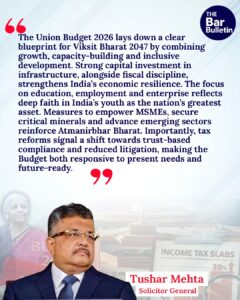
The emphasis on ‘Education to Employment and Enterprise’ is animated by the Hon’ble Prime Minister’s deep and unwavering faith in Yuva Shakti, which is our greatest resource, asserted Mr. Mehta, while emphasising that the vision of Atmanirbhar Bharat has been fortified by schemes for empowering MSMEs, advancing India’s leadership in emerging areas such as Biomaterials and semiconductors and increasing critical mineral security.
Mr. Mehta said that the fine print of the Finance Bill 2026 contains numerous measures aimed at providing relief to corporate India as well as the average individual taxpayer. The architecture of the taxation regime has been firmly moved towards trusting the tax paper and easing compliance. A number of welcome measures aimed at reducing pendency of tax related litigation and further improving fairness, clarity and expediency in tax administration will start to reap dividends in the short as well as long term. This is a budget that is responsive to the needs to today, while building a future-ready Bharat.
Unilateral APAs Fast-Tracked to Untangle Transfer Pricing for ITeS Sector
Senior Advocate, Supreme Court, Pinky Anand, has expressed that the benchmarking analysis of 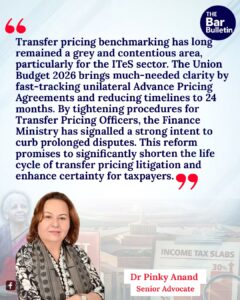 transfer pricing domain is such a grey area which though seemed difficult to entangle by 31st January 2026, is seeing the light of day with the Union Budget 2026. The finance ministry has sought to accelerate unilateral Advance Pricing Agreements (APA) with an aim to cut the APA timeline to 24 months, a transformative downsizing from the current average of 45 months.
By tightening timelines and clarifying the procedural steps for Transfer Pricing Officers, Ms. Anand said that the Budget is signalling a clear intent to reduce benchmarking disputes and shorten the cycle of tax controversy for Information Technology Enabled Services (ITeS) industry.
Beyond Decriminalization: Budget 2026 Brings Procedural Clarity and Landmark TP Reforms to Indian Taxation
Senior Advocate, Delhi High Court, Sachit Jolly, has expressed that this year’s budget has brought out several positive measures for reducing and streamlining tax litigation. The decriminalisation of offences, especially those related to depositing tax deducted or collected at source, is a big relief. Taxpayers and business can operate without worrying about criminal prosecution, which hung as a sword of damocles on their heads even for small errors in compliance.
Mr. Jolly pointed out that the clarifications in tax procedure, including putting an end to long pending controversies, the JAO/FAO issue, and limitation issue for draft and final assessment orders, are also welcome changes. However, the clarification regarding omissions and mistakes regarding computer-generated DIN remains nebulous, since the amendment validates orders which do not expressly mention a DIN, but does not take away from the mandate that each document issued by the income tax department must have a DIN, which will have to be generated prior to issuance of the order.
Significant amendments have also been brought in to reduce transfer pricing litigation, emphasised Mr. Jolly, to emphasise that the enhanced safe harbours of 15.5% for a wide range of services now clubbed into “information technology services”, with a sharp increase in the eligibility threshold to Rs. 2000 crores, will significantly reduce litigation relating to comparability analyses for transfer pricing in the IT sector, thereby adding to the ease of doing business for large multinational IT firms operating in India.
Budget 2026: Rationalisation or Retrospective Recalibration?
Delhi High Court Advocate Gaurav Jain, Former Partner, Vaish Associates, has expressed that the Budget 2026 introduces significant amendments to both the Income-tax Act, 1961 and the proposed Income-tax Act, 2025, which is scheduled to come into force from 1 April 2026. He viewed the Finance Bill as a clear legislative intent to rationalise and clarify provisions that had long remained ambiguous and, in several instances, were already under adjudication before appellate and constitutional courts. The underlying objective appears to be reduction of interpretational uncertainty and curtailment of protracted 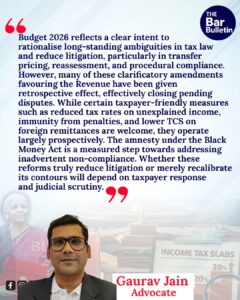 litigation.
Mr. Jain pointed out a number of amendments aligning with this stated objective, opining that the key changes pertaining to the time limits for completion of assessments under section 144C read with section 153 in transfer pricing and international tax matters, the validity of assessment orders passed without a Document Identification Number (DIN), and the legal sustainability of reassessment notices issued under section 148 by jurisdictional Assessing Officers instead of faceless authorities, have been framed in favour of the Revenue and, significantly, have been accorded retrospective effect, thereby extinguishing existing and anticipated disputes.
On the other hand, the Mr. Jain explained that the Finance Bill also proposes certain relief-oriented measures for taxpayers. A notable amendment concerns the allowability of deduction for employer contributions to employee welfare schemes, collected from employees, where such amounts are deposited within the extended time limit up to the due date for filing the return of income. While this change addresses a long-standing controversy, the relief has been made prospective, in contrast to the retrospective application accorded to revenue-favouring amendments.
Another important rationalisation is seen in the reduction of the tax rate applicable to additions made under the erstwhile sections 68 and 69, from the earlier punitive rate of 60% to 30%, thereby aligning such additions more closely with the general rate of taxation. Further, immunity from penalty has been extended in cases of misreporting of income upon payment of 200% of the underlying tax, reflecting a calibrated move towards settlement-based compliance, added Mr. Jain.
From a cash-flow and compliance perspective, Mr. Jain quoted a significant relief that has been granted through the reduction of Tax Collected at Source (TCS) on foreign remittances to 2% in most cases, including travel-related remittances. This amendment is likely to ease the immediate financial burden on taxpayers engaging in legitimate foreign expenditures.
The Finance Bill also introduces an amnesty scheme under the Black Money (Undisclosed Foreign Income and Assets) Act, aimed at small taxpayers who committed minor or inadvertent defaults, such as failure to declare foreign assets including ESOP-allotted equity shares or foreign insurance policies. This represents a measured acknowledgment of low-risk, non-wilful non-compliance.
Viewed collectively, Mr. Jain opined that the proposed amendments across both the existing and forthcoming tax regimes signal a broader policy shift towards legislative certainty, rationalisation of enforcement provisions, and promotion of voluntary compliance through immunity-linked mechanisms. At the same time, the differential treatment accorded to revenue-favouring and taxpayer-favouring amendments particularly in terms of retrospectivity raises important questions regarding legislative balance.
While the Revenue has extended multiple settlement-oriented options with the stated objective of reducing litigation, their practical success remains uncertain. On an initial reading, the monetary cost of availing these schemes does not appear sufficiently concessional to decisively dissuade taxpayers from pursuing legal remedies. Whether these measures will meaningfully reduce disputes or merely redefine the contours of tax litigation will ultimately be determined by taxpayer response and judicial scrutiny.
Administrative Overhaul: Budget 2026 Simplifies Tax Procedures, De-clutters Customs, and Empowers Exporters
Tax Litigator & India Tax Controversy Export, Tarun Jain, has expressed that the Budget is expected to provide a directional headway in Government’s tax policy. However, the Budget for Financial Year 2026-27 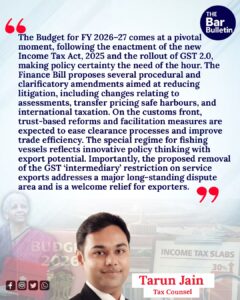 was preceded by two major reforms in tax arena. First, the enactment of the new Income Tax Act, 2025 which will replace decades old income tax law and will come into effect in matter of only couple of months. Second, the unveiling of GST 2.0 in September last year pursuant to the clarion call of the Prime Minister from the Red Fort on Independence Day signalling new foundational tenets of the indirect tax levy. Given this background, Mr. Jain emphasised that the need for the hour was to maintain certainty in tax policy and maintain tax reform outlook. The Budget proposals for Financial Year 2026-27 need to be appreciated in this light.
There are a large number of changes proposed in the Finance Bill, 2026, many with retrospective effect, to clarify and obviate technical issues, such as (a) prescription of ‘Document Identification Number’ (DIN) on departmental communication, (b) concurrent exercise of powers by jurisdictional assessing officers and faceless assessing officers, (c) timeline for assessment of international taxation cases, etc. In the light of these proposals, Mr. Jain opined that a large number of pending cases are expected to be heard and determined on their merits in near future, significantly reducing tax disputes. In the same spirit, addressing another potent litigation area, the proposals relating to ‘safe harbours’ have been announced which shall rule out transfer pricing disputes in the applicable sectors.
At the administrative level, Mr. Jain has explained that a large number of measures have been proposed, with imminent operational timelines, with an intent to de-clutter the processes in customs clearance of imported goods. These proposals are expected to reduce the avenues for bureaucratic friction at the ports. Simultaneously, incentives, such a duty deferral benefit, have been announced towards expediting ‘accreditation’ of the importers which shall fundamentally shift the focus of customs enforcement from pre-clearance to post-clearance by ushering a ‘trust-based’ system of customs law enforcement. While these changes deal with ground-level realities, they address clogs which dilute efficiency in global trading of Indian partners, and hence are heartily welcome.
A major proposed change in customs law framework is the special legal regime created for Indian fishing vessels, added Mr, Jain, while opining that the underlying objective and the framework unveiled for the change is expected to redefine export potential of the fishing industry on an immediate basis. The proposal is indeed a creative encapsulation of evolving tax law and policy, the implementation of which shall be closely observed as it has the potential to serve as a template for application to other industries in near future craving similar legal and administrative flexibilities.
Furthermore, Mr. Jain concluded that the proposal to amend GST laws by omitting ‘intermediary’ limitation on exports, a massive friction-point for service exporters is proposed to be concluded on favour of the industry. This one provision has been standalone responsible for wide-ranging GST disputes cluttering the courts and interjecting the exporters’ potential. One would hope that the proposal is effected soon enough to usher the long pending relief which was earlier announced by the GST Council.
Union Budget 2026: Navigating Retrospective Amendments Amidst Progressive Tax Reforms
Lastly, terming the Union Budget, 2026, as a welcoming step from several perspectives, Tax Counsel, Supreme Court of India, Ananya Kapoor, has said that though is a welcoming step from several perspectives, however, I want to focus largely with respect to alot of retrospective amendments that have been proposed on on-going litigative issues which are pending adjudication before several Courts including the Hon’ble Apex Court. Issues such as timelines to pass assessment orders, power of the Jurisdictional Assessing Officers to assume jurisdiction to issue reassessment notices even though the law provides for a Faceless regime, are large issues which are already posted for final hearing before the Hon’ble Apex Court. At this stage, retrospective amendments often pose policy questions. While these may or may not be tested in Courts, in today’s tax regime, while amendments are inevitable and often required, retrospective amendments are largely perceived differently. 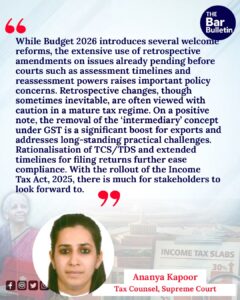
Having said that, under the GST regime, omission of the concept of ‘intermediary’ is a very welcoming step to promote exports in our nation and will definitely help ensure a level playing field to our exporters. Many have been given a relief though this amendment and the Budget ensures it caters to the practical problems being faced. Alot of TCS / TDS Rationalisation has also been taken care also. Even timelines for filing Income Tax Returns/Revised Returns/Updated returns have been taken care of which is a great step. Overall, and with the implementation of the Income Tax Act, 2025, there is alot for the stakeholders to look forward to this year .