


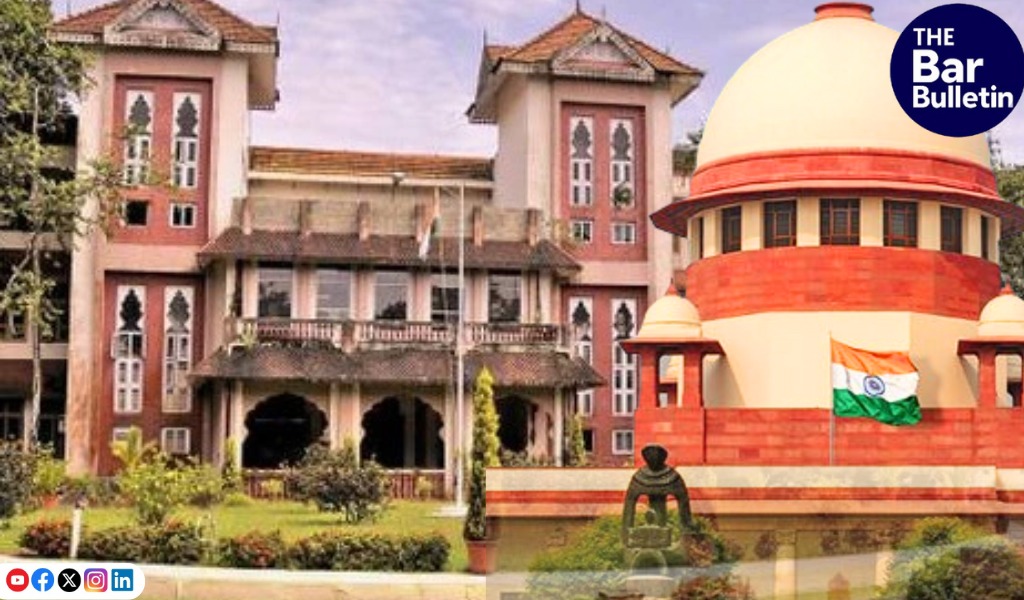

Whether a candidate next on a valid Rank List has the right to be appointed to a vacancy arising from the resignation of the appointed candidate? Or, whether the University is justified in applying the rule of communal rotation to fill this vacancy, in light of the seemingly conflicting provisions of Section 31(10) and Section 31(11) of the Cochin University of Science and Technology Act, 1986.
Answering the moot question, the Supreme Court ruled that the wait list by itself is not a source of recruitment, and that generally a candidate placed in the wait list has no vested right to invariably claim appointment therefrom; however, when the wait list is made valid for a stipulated period, it would operate for such period.
The Court clarified that a waiting list is not a ready reservoir for recruitment, but when it is made operative for a particular period under any provision, rule or circular, it has to be acted upon for the contingency when any of the selected candidates does not join, or the appointee resigns. The waiting list is intended to pave the way for the next-ranked candidate to be appointed in such a situation, provided the vacancy occurs.
The Court, therefore, affirmed the judgment of the High Court and concluded that the University correctly applied the rule of communal rotation to the vacancy arising from Dr Anitha’s resignation. The vacancy was assigned to the turn of the Latin Catholic/Anglo Indian Category. Since the appellant did not belong to this category, her claim for appointment was not tenable.
Emphasising upon the operation of the Wait List or Rank List and the corresponding rights of the candidates, a Two-Judge Bench comprising Justice Aravind Kumar and Justice N.V. Anjaria observed that rules of recruitment may provide a time stipulation about the validity and operation of the wait list.
The Bench explained that when the wait list or rank list is kept alive for the purpose of making appointment therefrom by virtue of provision or stipulation, such mandate will have to be adhered to and a candidate placed next on merit in the Wait List or Rank List would be entitled to lodge his or her claim for appointment successfully to the vacancy created by virtue of none being appointed.
Since Dr Anitha (an SC candidate) was appointed, her probation was declared, and she served for over a year, the Bench observed that the post reserved for the Scheduled Caste candidate stood satisfied in form and substance. Consequently, the vacancy that arose upon her resignation was a new vacancy that had to be filled by applying the communal rotation rule.
Briefly, the appellant, who belongs to the Scheduled Caste (SC) category, applied for the post of Associate Professor, Inorganic Chemistry, which was a single vacancy reserved for an SC candidate. Following the selection process, a Rank List was published with a validity of two years. Later, Dr Anitha C. Kumar was placed at rank No. 1 and the appellant at rank No. 2. However, Dr Anitha C. Kumar resigned after one year, after securing an appointment as a professor at another university.
The appellant, being next on the valid Rank List, staked her claim for the appointment, which was rejected by the Cochin University, on the ground that Dr Anitha C. Kumar had a lien on the post. The appellant challenged this decision in the High Court, which directed the University to reconsider her claim. The University again rejected the appellant’s request, stating that the resignation created a fresh vacancy that must be filled by applying the rule of communal rotation, offering it to a Latin Catholic candidate.
Appearances:
AOR Divyanshu Rai, along with Advocates Dr Mohan Gopal, Sugandha Batra, Taruna, Vansh Bhatnagar, T Rajesh, Vishal Sharma, and Shubh Gautam, for the Appellants
AOR M.P. Vinod, along with Advocates Pranjal Kishore, Atul Shankar Vinod, Dileep Pillai, and Kannan Gopal Vinod, for the Respondents
