


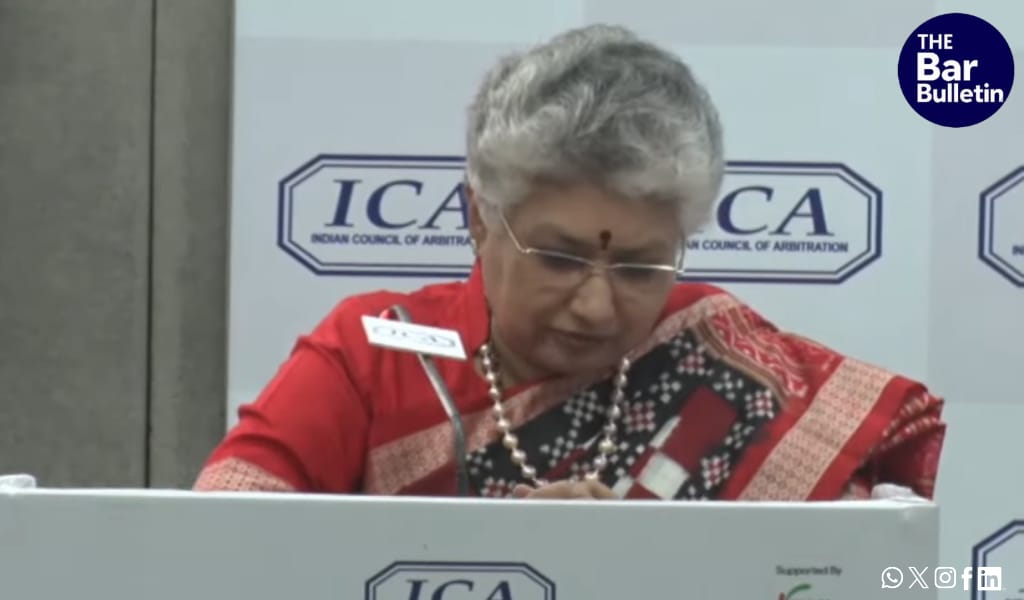

A symposium titled “Where Women Lead, Justice Follows” was organised by the Indian Council of Arbitration (ICA) and supported by FICCI (FLO) on the eve of International Women’s Day, bringing together judges, senior advocates, and professionals to reflect on women’s leadership in law, governance and arbitration.
The symposium commenced with a welcome address by Mr. Arun Chawla, Director General of ICA. He emphasised the economic and institutional significance of women’s participation in leadership roles. Referring to global economic data, he noted that increased participation of women in the workforce could significantly boost national economic growth.
 “If women in India participated in the economy at the same rate as men, our GDP could rise by an estimated 27 to 30%….we have seen encouraging signs of progress. Female labour force participation in India has risen from 23% in 2017-18 to just over 40% today….High participation becomes meaningful when systems are designed to support equality. When structure supports ambition, participation translates into power.” Adding to his address, he remarked that: “when women have equal voice, justice gains its full vocabulary.”
 Delivering the opening remarks, Ms Poonam Sharma, National President of the FICCI Ladies Organisation (FLO), highlighted the role of women across sectors ranging from governance and science to entrepreneurship and grassroots leadership. She stressed that women’s empowerment through education, economic participation and leadership opportunities is essential for inclusive national development.
Advocating for increased women’s participation in the bar, she remarked: “I firmly believe that women-led governance becomes more responsive, boards become more accountable, courts become more empathetic, and arbitration becomes more inclusive, and justice becomes complete.”
 Justice Mini Pushkarna, Judge, Delhi High Court, who also addressed the gathering, reflected on the broader meaning of justice and the importance of women’s representation in decision-making institutions. She observed that justice must extend beyond courtroom remedies and must encompass fairness, dignity and equality in lived experiences.
Highlighting constitutional values, Justice Pushkarna noted that the promise of justice under the Constitution must operate across all spheres of life. She emphasised that leadership roles occupied by women bring diverse perspectives that make institutions more inclusive and responsive.
“When women sit at the table where decisions are taken, constitutional promises move closer to a lived reality,” she said.
Delivering the keynote address, Supreme Court Judge Justice B.V. Nagarathna underscored the importance of ensuring women’s equal participation in leadership positions, particularly in the legal profession and arbitration. She highlighted that although increasing numbers of women are entering law schools, they remain significantly underrepresented as arbitrators, senior advocates and decision-makers in commercial dispute resolution.
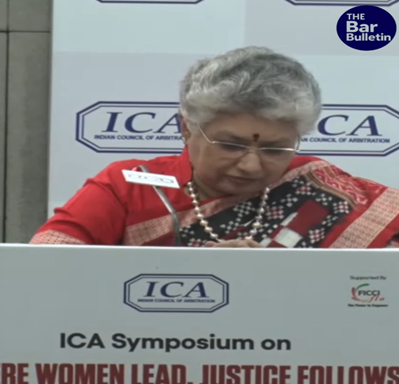
She recalled an incident from her early days at the Bar: “The learned judge said, today is 8th of March, let the lady begin her mentioning… My response was, my Lord, let every day be 8th of March.”
Addressing the issue of gender diversity in arbitration, Justice B.V. Nagarathna cautioned that arbitration appointments often favour familiarity over genuine merit, which ends up excluding many capable women professionals. She noted that although several women lawyers, former judges and domain experts possess strong credentials, they are frequently overlooked in favour of established names within a “very closed-door club.”
She emphasised that diversity and merit are not contradictory, stating that “considerations of experience and domain expertise are not at odds when it comes to diversity and inclusion.” Justice Nagarathna also called upon courts, arbitral institutions and senior members of the Bar to actively support women’s participation in arbitration by recommending women practitioners for appointments, ensuring mentorship and creating institutional frameworks that encourage diversity.
Justice B.V. Nagarathna also outlined a series of concrete measures aimed at increasing the representation of women in arbitration and ensuring greater diversity within the arbitral ecosystem.
• Minimum Representation in Tribunals: Justice Nagarathna suggested that at least one member in every three-member arbitral tribunal should be a woman, unless there are cogent reasons to depart from this principle.
• Broaden Arbitrator Appointments: She urged institutions to avoid repeatedly appointing the same arbitrators and consider capping the number of arbitrations handled by an individual to widen opportunities for others.
• Training and Mentorship for Women Practitioners: Arbitration institutions should identify capable women advocates and provide structured training and mentorship to prepare them for roles as arbitrators.
• Professional Exposure and Accreditation: She recommended internships, clerkships, certification programmes and shadow arbitration initiatives to give aspiring arbitrators practical exposure to arbitration proceedings.
• Institutional Support for Diversity: Courts, arbitral institutions and the Bar should actively promote diversity and inclusion in arbitral appointments, ensuring that women are not confined to token participation.
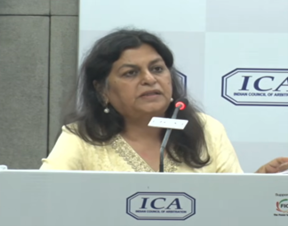 Senior Advocate Geeta Luthra, Vice President of ICA, delivered the vote of thanks and emphasised the need for concrete steps to ensure greater representation of women in arbitration. She echoed the call for diversity in arbitral tribunals and noted that the inclusion of women would strengthen institutional decision-making.
PANEL DISCUSSION
The symposium also featured a panel discussion titled “Breaking Barriers: Gender Diversity in the Legal Profession, Challenges & Opportunities.”
The session was moderated by Dr. Pinky Anand, Senior Advocate and former Additional Solicitor General of India, who currently serves as a judge at the Bahrain International Commercial Court. The panel brought together distinguished legal professionals, including Shirin Khajuria, Senior Advocate & Mediator at the Supreme Court of India; Prof. (Dr.) Ruhi Paul, Professor of Law and Registrar at National Law University Delhi and Chair Professor of the UNESCO Chair for Legal Dimensions of Clean Sports; Sujatha Balachander, General Counsel at EY India; and Mehak Oberoi, Legal Head (Hydro–APAC) at GE Vernova. The discussion examined structural barriers faced by women in the legal profession and explored pathways to enhance gender diversity and leadership across litigation, corporate law, and arbitration.
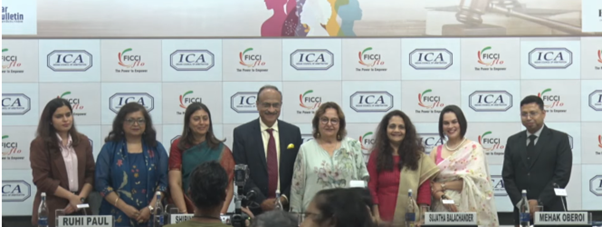
Opening the discussion, Dr. Pinky Anand highlighted that diversity and inclusion must be embedded structurally within institutions rather than left to individual discretion. She emphasised that while entry into the legal profession has broadened significantly, representation continues to decline at senior levels. “You have a very wide entry level today… but that does not translate into equal participation at the top. The pyramid narrows dramatically as careers progress,” she observed.
Shireen Khajuria spoke about non-linear career paths and the importance of flexibility in professional journeys. Reflecting on her own experience transitioning across roles, she noted that career detours can add depth to professional expertise. “Life itself is not really a straight line, and our profession is slowly recognizing that,” she said, encouraging young lawyers to explore different avenues without being constrained by rigid career expectations.
From an academic perspective, Prof. Ruhi Paul highlighted the paradox within legal education. While women increasingly dominate law school admissions, their representation declines significantly over time. “Women today constitute nearly 60% of law school entrants, but after ten or twenty years there is a noticeable exit from the profession,” she explained, attributing the trend partly to structural barriers such as caregiving responsibilities as well as internalised social expectations. She stressed the importance of visibility and self-advocacy, observing that women professionals often hesitate to promote themselves. “Where the world expects women to remain silent, they sometimes internalize that expectation. Breaking this pattern is essential,” she said.
Sujata Balachander, General Counsel at EY India, addressed gender diversity in corporate legal leadership. She challenged the stereotype that women are inherently risk-averse, arguing instead that women often approach decision-making with greater contextual awareness. “Women are not risk-averse; we are risk-aware. We understand the implications of decisions in a broader context,” she said.
Speaking about challenges in traditionally male-dominated sectors, Mehak Oberoi shared her experience working in infrastructure and renewable energy projects across the Asia-Pacific region. She observed that women professionals in technical sectors often have to repeatedly establish their expertise in negotiations and high-value commercial disputes. “Preparation is a great equaliser,” Oberoi noted. “When you walk into a room understanding not only the legal clauses but also the technical and commercial aspects of the dispute, the dynamics of the room change.”
Concluding the session, the panel underscored that progress requires sustained institutional commitment rather than symbolic gestures.