


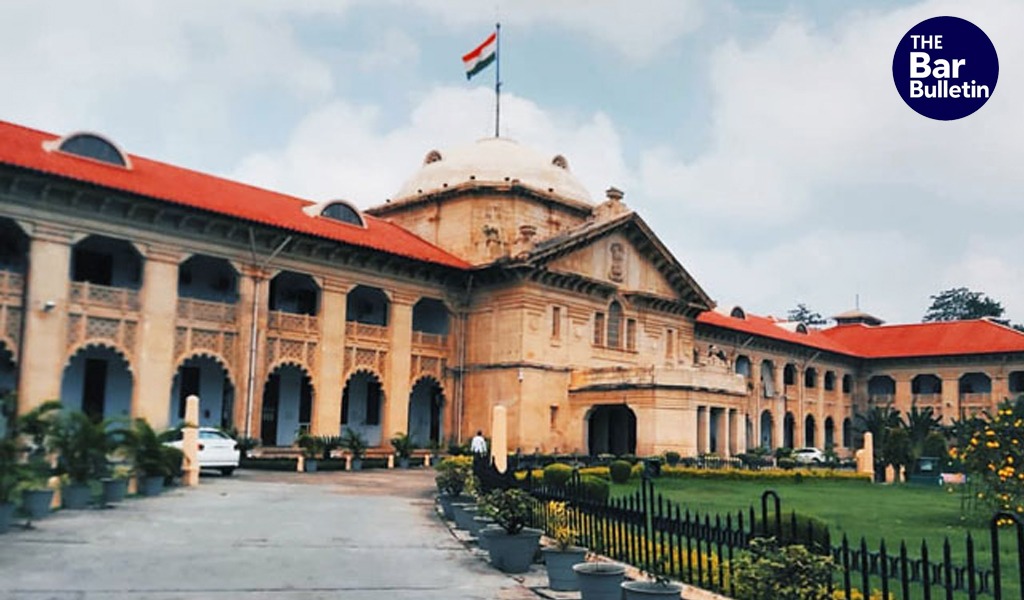

The Allahabad High Court has clarified that Save Financial Services Private Limited (Respondent no. 4) being a financial institution for the purposes of the SARFAESI Act, 2002, no writ is maintainable in view of the availability of an efficacious alternative statutory remedy. Hence, the Court dismissed the petition challenging symbolic possession of the secured asset, leaving it open for the petitioner to avail appropriate legal remedy before the appropriate forum in accordance with law including approaching the DRT to avail the statutory remedy available under Section 17 of the SARFAESI Act.
The Division Bench comprising Justice Swarupama Chaturvedi and Justice Ajit Kumar observed that the underlying purpose of the SARFAESI Act, 2002 is to empower financial institutions to take possession of securities and sell them, as translated into provisions falling under Chapter III of the Act. The Bench examined Section 2(1)(m)(iv) of the SARFAESI Act, which empowers the Central Government to notify institutions as “financial institutions”, and Section 45-I of the Reserve Bank of India Act, 1934.
The Bench noted that the notification dated Feb 24, 2020 was notified in supersession of the notification dated August 05, 2016. Through the notification dated Feb 24, 2020, the Central Government specified that all non-banking financial companies as defined in clause (f) of section 45-I of the RBI Act, 1934, having assets worth rupees one hundred crore and above, shall be entitled for enforcement of security interest in secured debts of rupees fifty lakh and above, as financial institutions for the purposes of the said Act.
The Bench observed that the presence or absence of the name of respondent no. 4 in the notification dated Aug 05, 2016 becomes irrelevant after the notification dated Feb 24, 2020. The Bench further observed that the notification dated Feb 12, 2021 amended the notification dated Feb 24, 2020, substituting the words “rupees fifty lakh and above” with “rupees twenty lakh and above”. Consequently, the Bench found no reason to doubt that respondent no. 4 is a financial institution and can invoke provisions of the SARFAESI Act within its statutory framework.
Regarding maintainability, the Bench observed that Section 17 of the SARFAESI Act provides a comprehensive and efficacious remedy to any person aggrieved by measures taken under Section 13(4) of the Act before the Debts Recovery Tribunal. It reiterated that where a statute provides for an efficacious alternative remedy, the High Court would ordinarily refrain from exercising its jurisdiction under Article 226 of the Constitution of India, and a writ petition against a private financial institution involving disputed questions of fact is not maintainable when a complete statutory mechanism is provided.
However, the Bench refrained from examining the issues regarding non-registration with CERSAI and insufficiency of stamp duty, stating those issues can be appropriately examined by the DRT in proceedings under Section 17 of the SARFAESI Act, 2002.
Briefly, the Petitioner No. 1 had availed two separate loan facilities from Respondent No. 4, namely Save Financial Services Private Limited, for the purposes of business expansion and meeting working capital requirements. The said facilities were sanctioned vide sanction letters for amounts of Rs. 4.50 lakhs and Rs. 8.80 lakhs respectively. In order to secure the said credit facilities, the petitioner created a security interest over an immovable property at Agra, by way of deposit of title deeds, including the original sale deed.
Defaults occurred in the loan accounts subsequently, and upon continued default, the loan accounts of the petitioner were classified as Non-Performing Assets (NPA). Respondent Nos. 3 and 4 issued demand notice under Section 13(2) of the Securitisation and Reconstruction of Financial Assets and Enforcement of Security Interest Act, 2002 (SARFAESI Act) claiming an outstanding amount of Rs. 22.33 lakhs. The respondents proceeded to issue possession notice under Section 13(4) of the SARFAESI Act, thereby taking symbolic possession of the secured asset.
The petitioners assailed the proceedings primarily on the ground of lack of jurisdiction, contending that Respondent No. 4 does not fall within the definition of a “Financial Institution” as contemplated under Section 2(1)(m)(iv) of the SARFAESI Act, 2002, relying upon an earlier government notification. It was further submitted that the security interest created in favour of the respondent had not been registered with the Central Registry of Securitisation Asset Reconstruction and Security Interest of India (CERSAI), precluding enforcement rights under Section 26-D of the SARFAESI Act.
Appearances:
Advocates Jagannath Singh and Surendra Nath Singh, for the Petitioner
A.S.G.I. Akshat Jaiswal, Ashish Kumar Mishra, for the Respondent
