


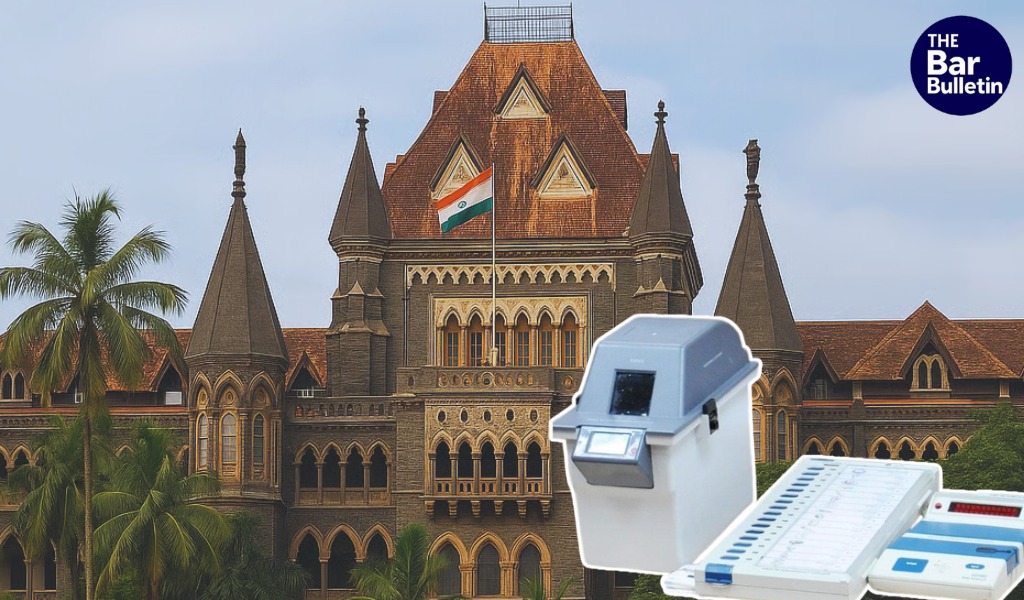

The Bombay High Court has ruled that an Election Petition is liable to be rejected under Order VII, Rule 11(a) of the Code of Civil Procedure, 1908, if it fails to disclose a complete cause of action due to the omission of specific, precise, and unambiguous material facts as mandated by Section 83 of the Representation of People Act, 1951.
The Court said that mere assertions of discrepancies in EVMs or Form 17C, without pleading the material facts as to how such discrepancies resulted in the improper reception of votes and materially affected the result of the election insofar as the returned candidate is concerned under Section 100(1)(d)(iii) of the R.P. Act, do not constitute a valid cause of action.
Accordingly, the High Court has dismissed in limine the election petition preferred by Pramod Patil, a candidate of the Maharashtra Navnirman Sena party, calling in question the election of Shiv Sena MLA Rajesh More, the returning candidate from 144, Kalyan Rural Constituency to the Maharashtra State Legislative Elections held on Nov 20, 2025.
A Single Judge Bench of Justice Sharmila U. Deshmukh observed that under Section 81 of the R.P. Act, an Election Petition must be filed within 45 days from the date of election, which is the date of declaration of results. Applying Section 12 of the Limitation Act, 1963, the date of declaration of results (23rd November 2024) is excluded, meaning the 45-day period expired on 7th January 2025.
Now, the Bench opined that since the Petition was filed on 6th January 2025, it was held to be within limitation. The delayed filing of the concise statement under Section 83 of the R.P. Act and the non-joinder of the Election Officer were held to be curable defects that do not entail dismissal at the threshold under Section 86 of the R.P. Act.
Regarding the cause of action, the Bench observed that the pleading for Booth No. 338 made no mention of the actual numbers appearing on the EVM or Form 17C, failing to make out a case of discrepancy. For Booth No. 45, no nexus was established between the annexed Form 17C and the EVM machine, and there was no pleading about the nature of the discrepancy or error.
Further, the Bench found the allegation regarding the discrepancy in the list of 3 EVMs, as incomprehensible, as the annexed Exhibit ‘F’ had no highlighted serial numbers, and there was no pleading on how this resulted in improper reception of votes. The Bench noted that the allegation regarding the non-maintenance of 5% burnt memory micro controllers was premised on an incorrect reading of the Supreme Court’s decision in Association for Democratic Reforms vs. Election Commission of India, which directed checking upon a written request, not mandatory maintenance, and no such written request was pleaded by the Petitioner.
The Bench observed that under Section 100(1)(d)(iii) of the R.P. Act, the Election Petitioner is required to plead material facts showing how the alleged discrepancies resulted in improper reception of votes or void votes, and how this materially affected the result of the election insofar as the returned candidate is concerned. The pleadings were found to be vague, bereft of material facts, and insufficient to demonstrate a cause of action, as there was no assertion that the Petitioner received the majority of valid votes as required for a declaration under Section 101.
Briefly, the election to the 144-Kalyan Rural constituency was held on 20th November 2024, and the results were declared on 23rd November 2024. The Election Petitioner secured 74,412 votes, while the returned candidate secured 1,40,770 votes, resulting in a margin of 66,358 votes. The Election Petition was filed on 6th January 2025, and the concise statement of material facts was filed subsequently on 9th January 2025.
The Petitioner alleged discrepancies between the B.U. and C.U. numbers maintained on the EVM machines and Form No. 17C at Booth No. 338. At Booth No. 45, it was alleged that no Form No. 17C was found when the EVM was opened, and the EVM subsequently showed an error as ‘not ok’. The Petitioner further alleged that the B.U. ID, C.U. ID, and VVPAT ID could not be tallied in 3 EVMs from the list provided by the Election Commission.
Additional allegations included the improper sealing of EVM machines and symbol loading units without the signatures of candidates or polling agents, and the failure to maintain 5% burnt memory micro controllers. The returned candidate filed an Application under Order VII, Rule 11 of the Code of Civil Procedure, 1908, seeking dismissal of the Election Petition for being barred by limitation, non-disclosure of cause of action, and non-compliance with Section 81 of the Representation of People Act, 1951.
Appearances:
Advocates Nilesh Pandey, Sameer S. Vispute, Sayali Shinde, and Rishabh Dubey, for the Petitioner
Advocates Chirag Shah, Bhavya Shah, and Vishal Acharya, for the Respondent
