


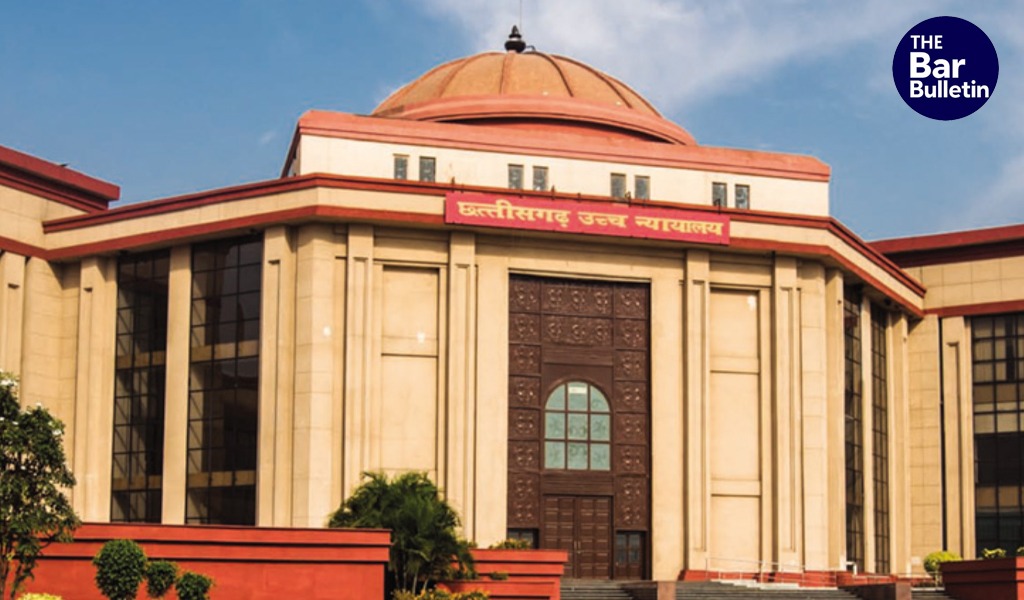

While granting continuity of service and retiral benefits, except back wages for period of suspension, to the CRPF Constable, the High Court of Chhattisgarh at Bilaspur Bench has clarified that major penalty cannot be imposed without proper enquiry and opportunity of hearing. Dispensing with enquiry must be supported by valid reasons; otherwise, the order is liable to be set aside.
Any administrative or quasi-judicial order entailing civil consequences cannot be sustained if passed without affording reasonable opportunity of hearing, and even where the statutory provisions are silent, the principles of natural justice are required to be read into the procedure, and any action taken in violation of audi alteram partem is liable to be set aside, added the Court.
The High Court thus held that the impugned action of the respondents, having been taken without conducting a regular departmental enquiry and without affording adequate opportunity of hearing to the petitioners, cannot be sustained in the eyes of law. The order of removal from service passed against the petitioners, along with the orders passed by the appellate and revisional authorities affirming the said punishment, are quashed.
The Court also directed that the petitioners shall be entitled to reinstatement in service; however, applying the principle of ‘no work no pay’, they are denied back wages, but the period from the date of removal till reinstatement was directed to be treated for all other service benefits, including continuity of service and retiral benefits.
A Single Judge Bench of Justice Amitendra Kishore Prasad observed that the procedure envisaged under Section 11 of the CRPF Act, 1949 read with Rule 27(CC)(II) of the CRPF Rules, 1955 has not been followed in its true spirit, as no proper opportunity of hearing was afforded to the petitioners. The appellate as well as revisional authorities mechanically affirmed the order of punishment merely on the premise that the disciplinary authority had recorded satisfaction that holding a regular departmental enquiry was not reasonably practicable, and accordingly proceeded to remove the petitioners from service without conducting any enquiry.
The Bench found that none of the witnesses were examined in the so-called enquiry, and the department justified this omission on the ground that no witness was willing to come forward to depose, which is an approach wholly contrary to the settled principles governing disciplinary proceedings.
The Bench noted that removal from service entails serious civil consequences, and therefore, the competent authorities are required to strictly adhere to the mandatory procedural safeguards prescribed under law. The delinquent employee must be given adequate opportunity at every stage, issuance of show cause notice, framing of definite charges, supply of relevant documents, leading of evidence, and opportunity to cross-examine departmental witnesses as well as to adduce defence evidence. Unless such procedure is duly followed, imposition of a major penalty like removal from service, without holding a proper enquiry and without granting reasonable opportunity of hearing, cannot be sustained in the eyes of law.
Further, the Bench observed that the initiation of the so-called enquiry appears to have been founded solely upon a criminal case registered against the petitioners, wherein their conviction under Section 323 IPC was subsequently set aside by the High Court on the ground that the prosecution failed to prove the case beyond reasonable doubt. Though departmental proceedings and criminal proceedings operate in distinct spheres, once the departmental enquiry itself was not conducted in accordance with the procedure prescribed under law and no reasonable opportunity of hearing was granted to the petitioners, the entire action stands vitiated.
The Bench highlighted that other co-delinquent, who were similarly charged and were acquitted in the criminal case, were reinstated in service, and denial of similar treatment to the present petitioners results in manifest arbitrariness and discriminatory treatment. The satisfaction recorded by the disciplinary authority that holding a regular enquiry was not reasonably practicable is not supported by any cogent or compelling material, and the mere assertion that witnesses were unwilling to depose cannot, by itself, justify dispensing with a full-fledged enquiry.
Briefly, the petitioners were appointed and posted as Constable (GD) in the 39th Battalion of the Central Reserve Police Force (CRPF) at Narayanpur. During the course of service, an FIR was registered against the petitioners and other co-accused for offences under Sections 147, 148, 294, 506-B and 307 of the Indian Penal Code, 1860. On account of their arrest in the said criminal case, the petitioners were placed under suspension. Considering the alleged gravity of the accusations, the Disciplinary Authority formed an opinion that it was not reasonably practicable to conduct a departmental enquiry, and accordingly, no departmental enquiry was held, and the petitioners were dismissed from service with effect from Nov 09, 2009 by the Commandant, 39th Battalion, CRPF, by invoking Section 11 of the CRPF Act, 1949 read with Rule 27-CC(ii) of the CRPF Rules, 1955.
Aggrieved by the dismissal order, the petitioners preferred a statutory appeal before the DIG, Range, CRPF, Bhubaneswar, which was rejected. Meanwhile, the criminal trial proceeded before the Additional Sessions Judge, wherein the Trial Court acquitted the petitioners of all major charges and convicted them only under Section 323 IPC, imposing a fine of Rs. 500/-. Against the said conviction, the petitioners preferred criminal appeal, wherein the High Court set aside the conviction and acquitted the petitioners of all charges.
Upon their acquittal attaining finality, the petitioners submitted representations seeking reinstatement in service with all consequential benefits including back wages. Due to inaction, the petitioners filed writ, which was disposed of, by directing the respondent authorities to consider and decide the representation. Pursuant thereto, a fresh representation was submitted, which was rejected by Respondent No. 5. However, similarly situated co-delinquents, who were dismissed by the same order and later acquitted, were reinstated in service.
Appearances:
Advocate Mayank Kumar, for the Petitioner
Ramakant Mishra, DSGI and Bhupendra Pandey, C.G.C., for the Respondents
