
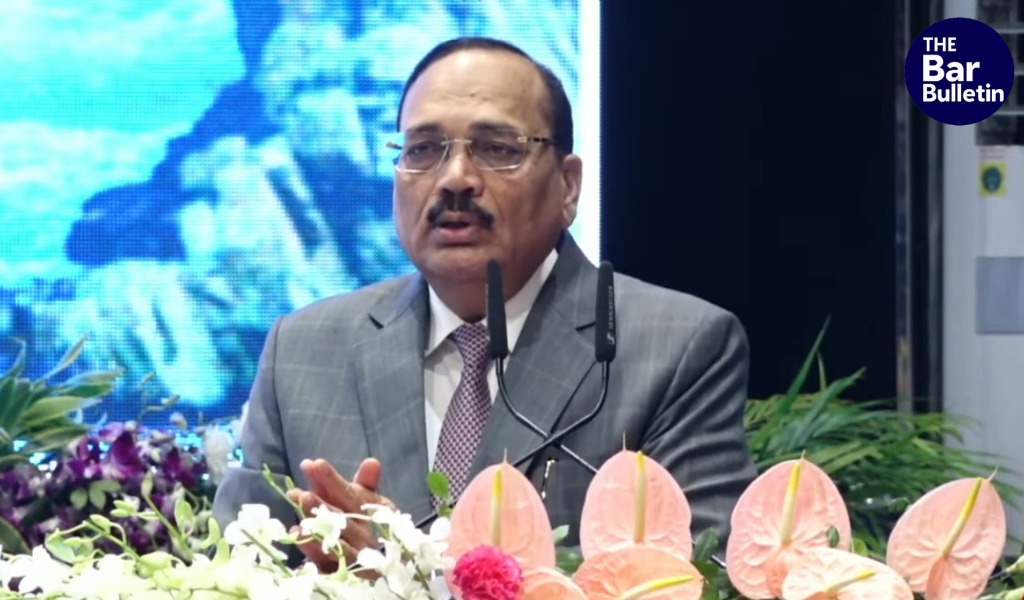

Chief Justice of India Surya Kant on Saturday expressed anguish over what he described as a misrepresentation of his oral observations by a section of the media, clarifying that his criticism during a court hearing was directed only at persons entering professions with “fake and bogus degrees” and not at the youth of the country. The remarks were made during an event on “Fragmentation to Fusion: Empowering Justice via United Digital Platform Integration” in Jabalpur, Madhya Pradesh.
“I am pained to read how a section of the media has misquoted my oral observations made during the hearing of a frivolous case yesterday. What I had specifically criticised were those who have entered professions like the Bar (legal profession) with the aid of fake and bogus degrees. Similar persons have sneaked into the media, social media, and other noble professions as well, and hence, they are like parasites.
Rejecting reports suggesting that he had criticised India’s youth, the Chief Justice said such claims were “totally baseless.”
“Not only am I proud of our present and future human resource, but every youth of India inspires me. It is not an exaggeration to say that Indian youth have great regard and respect for me, and I too see them as the pillars of a developed India.”
____________________________________________
He inaugurated the MP High Court’s newly developed digital initiative in Jabalpur, Madhya Pradesh, aimed at strengthening the integration of digital judicial platforms and improving access to justice through technology-driven coordination across institutions. The programme was attended by several Supreme Court judges, including Justices Satish Chandra Sharma, Prasanna Bhalachandra Varale, N. Kotiswar Singh and Alok Aradhe, along with Madhya Pradesh Chief Minister Mohan Yadav and Union Minister of State for Law and Justice Arjun Ram Meghwal.
His address was largely focused on the judiciary’s ongoing transition towards paperless courts and digital governance. Speaking about the traditional functioning of Indian courts, the Chief Justice recalled how judicial culture had long been associated with massive paper records and physical files.
“One felt that the credibility of a case increased proportionately with the number of pages in the paper-book; the heavier the brief, the greater the preparation,” he remarked, adding that the judiciary had gradually realised that “the true strength of justice lies not in the number of pages or books we carry, but in the efficiency, accessibility, and clarity with which justice is delivered.”
Digital Systems will Reduce Avoidable Barriers to Justice
On the human cost of procedural inefficiency, Chief Justice of India Surya Kant pointed out that delays and administrative hurdles in courts impose serious emotional and financial burdens upon litigants. Referring to routine causes of adjournments such as missing files, incomplete photocopies and delays in movement of records, the Chief Justice observed that for ordinary citizens, these were not mere administrative inconveniences but deeply personal hardships.
“A farmer travelling overnight from a remote village, an old woman waiting for her family pension, a worker contesting wrongful termination, or an undertrial prisoner awaiting a hearing, experiences delay not as an administrative inconvenience but as a deeply personal hardship.”
The Chief Justice said it was precisely in this context that technology acquired “constitutional significance,” because digital systems could reduce avoidable barriers to justice and allow courts to focus more on adjudication rather than the movement of paper records.
The Chief Justice described the COVID-19 pandemic as a turning point in the judiciary’s relationship with technology, noting that courts across the country rapidly adapted to virtual hearings during the crisis.
Technological Reforms in Courts
Highlighting technological reforms introduced by the Supreme Court, the Chief Justice referred to e-filing systems, hybrid hearings, digital records and live-streaming of Constitution Bench proceedings as measures that had “significantly altered the way the institution functions.” He also described the National Judicial Data Grid as one of the most significant technological interventions in the justice delivery system because it allowed near real-time public access to data concerning pendency and disposal of cases.
Praising lawyers for adapting to digital systems, the Chief Justice observed that the transition towards paperless functioning had expanded professional opportunities rather than weakened the legal profession.
“Lawyers across generations have adapted themselves to technological systems with remarkable resilience. Senior members of the Bar, who once relied almost entirely upon physical compilations, today navigate electronic records with impressive ease. Young lawyers and first-generation practitioners, in particular, have utilised digital platforms to enhance accessibility and professional opportunity. The transition towards paperless functioning has therefore not weakened the legal profession; rather, it has expanded its possibilities.”
Accessible, Sustainable and Inclusive Digital Justice
The Chief Justice also stressed that technology had made courts appear “less distant and far more accessible” to ordinary citizens by enabling online access to case status, orders and filings. Referring to environmental sustainability, the Chief Justice said paperless courts represented “institutional responsibility towards future generations.” He noted that he had recently declared Sikkim as the country’s first fully paperless judiciary and remarked that meaningful reform depended more upon “institutional will” than institutional size.
At the same time, the Chief Justice cautioned that digital transformation should not become digitally exclusionary, especially for rural litigants, senior citizens and economically weaker sections who may struggle with internet access or technological familiarity. He added:
“The constitutional promise of access to justice requires us to ensure that technology functions as a bridge rather than a barrier. Human interaction, procedural assistance, and institutional sensitivity must continue to remain central to judicial functioning. Courts must modernise without becoming impersonal.”
Concluding the lecture, the Chief Justice said the courtroom of the future would be defined not by endless stacks of files and overflowing record rooms but by intelligent systems, seamless access to information, efficient administration, and environmentally conscious governance.