


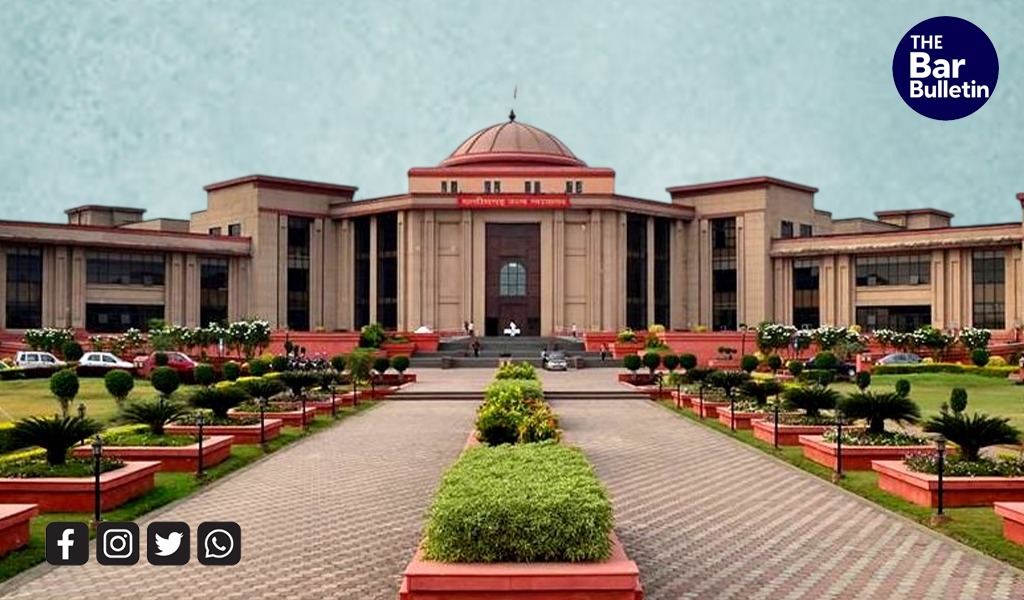

The High Court of Chhattisgarh at Bilaspur Bench has clarified that once it is proved that in spite of the death of the bread earner, the family survived and a substantial period is over, there is no necessity to say ‘goodbye’ to the normal rule of appointment and to show favour to one at the cost of interests of several others, ignoring the mandate of Article 14 of the Constitution.
The Court explained that the law of limitation rests on the foundations of greater public interest because long dormant claims have more of cruelty than justice in them, a defendant might have lost the evidence to disapprove a stale claim, and persons with good causes of action should pursue them with reasonable diligence.
Further, laches involves unreasonable delay or negligence in pursuing a claim involving an equitable relief while causing prejudice to the other party, and acquiescence implies active assent and is based upon the rule of estoppel in pais, barring a party afterwards from complaining of the violation of the right, added the Court.
The High Court pointed out that the doctrine of delay and laches, or for that matter statutes of limitation are considered to be statutes of repose and statutes of peace. There must be a lifespan during which a person must approach the court for their remedy, otherwise, there would be unending uncertainty as to the rights and obligations of the parties.
It is not expected to give indulgence to such indolent person; such delay does not deserve any indulgence and on the said ground alone this Court deems it appropriate to dismiss this petition at the very threshold. It is the duty of the court to scrutinize whether such enormous delay is to be ignored without any justification. Remaining innocuously oblivious to such delay does not foster the cause of justice, added the Court.
A Single Judge Bench of Justice Rakesh Mohan Pandey observed that the very object of providing compassionate appointment is to ameliorate the condition of the family at the relevant time, and the same has been achieved as the family has already survived for such a long period. Compassionate appointment is a way to provide immediate financial assistance to families who have experienced sudden hardship.
The Bench noted that compassionate appointment is an exception to the general rule of appointment in the public services and is in favour of the dependents of a deceased dying in harness and leaving his family in penury and without any means of livelihood. The whole object of granting compassionate employment is to enable the family to tide over the sudden crisis, and not to give such family a post, much less a post held by the deceased.
Briefly, the petitioner’s father, Prafull Nahak, was working on the post of General Mazdoor, Category-I under the respondents and died in harness on Nov 08, 1999. On the date of demise, the petitioner was aged 5 years, 7 months, and 3 days. The petitioner’s name was not kept in the live roster because he had not attained the age of 12 years at the time of his father’s death. The petitioner moved an application for the grant of dependent employment after 16 years, which was rejected by the Respondent No. 7, on the ground that the application was moved after a period of 17 years. Subsequently, the present petition was filed in the year 2021.
Appearances:
Advocate Govind Dewangan, for the Petitioner
Advocate Vinod Deshmukh, for the Respondent
