


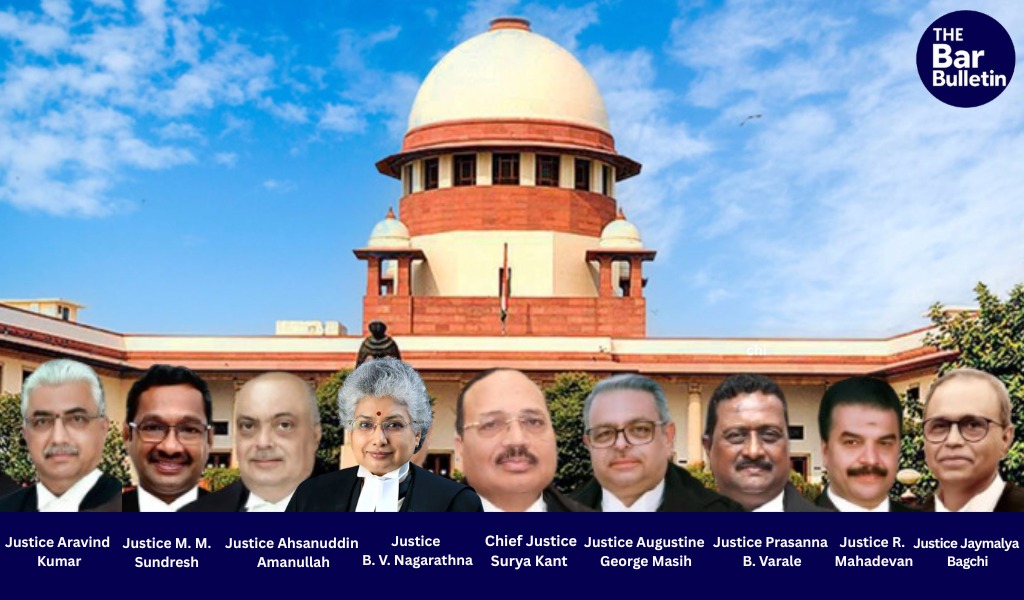
Day 2 of the Supreme Court begins hearing before a nine-judge Bench on reference arising from Sabarimala review pleas.
A brief but sharp exchange unfolded in Court when Senior Advocate Rajeev Dhavan objected to the allocation of time during arguments, interrupting Solicitor General Tushar Mehta.
Responding without escalating the exchange, Mr Mehta remarked, “My reply can only be a dignified silence,” drawing a moment of visible tension in the courtroom.
CJI Surya Kant urged counsels to go for “minimum oral arguments,” amid objections from several senior advocates who sought to present oral submissions first.
Arguing on the doctrine of essential religious practices, Solicitor General Tushar Mehta referred to precedents such as Shirur Mutt case, Ratilal Gandhi case and Devaru case to contend that these judgments did not lay down the “essential religious practices” test in the manner later articulated. He contrasted this with the Dargah Committee Ajmer case, where the Court introduced the need to distinguish essential and integral practices from superstitious or extraneous ones.
Mehta argued that allowing courts to determine what is “essential” would require judicial scrutiny of scriptures and beliefs, raising concerns about courts sitting in judgment over faith in a pluralistic society, and suggested that such determinations may instead fall within the legislative domain under Article 25(2)(b).
During the exchange, CJI sought to clarify the distinction between religious belief and practice in the context of Article 25(2)(a).
During the hearing, Justice Ahsanuddin Amanullah observed that the issue may be too narrowly framed if courts are excluded from examining whether a practice amounts to superstition, noting that judicial review permits such scrutiny, with the legislature subsequently acting upon it. Responding, Solicitor General submitted that a secular court lacks the scholarly competence to characterise religious practices as superstition, cautioning against such determinations in a pluralistic society. Justice Amanullah, in turn, clarified that while the legislature may have the final say in regulating such matters, any resulting law would remain justiciable before the court.
Justice Joymalya Bagchi posed a hypothetical situation to Solicitor General, asking whether practices such as witchcraft, if claimed as religious, could be termed superstitious, to which Mr Mehta agreed, while maintaining that regulation of such practices would fall within the legislative domain. The Bench then explored whether courts could intervene in the absence of legislation by invoking grounds such as public order, morality, or health.
Justice B. V. Nagarathna emphasised that the determination of essential religious practices must be rooted in the philosophy of the concerned religion, while Justice MM Sundresh observed that courts may adopt a limited or “hands-off” approach but cannot entirely abstain from scrutiny, particularly where no legislation occupies the field. Chief Justice indicated that in such cases, courts could test practices against constitutional parameters like public order and morality.
However, SG submitted that while courts may signal the need for regulation in unoccupied areas, they must remain within their assigned constitutional role, even suggesting that directions to the legislature may be issued.
Continuing his submissions, Solicitor General Tushar Mehta referred to criticism of the Dargah Committee Ajmer case by noted jurist H. M. Seervai, before turning to the Sardar Syedna Taher Saifuddin case concerning excommunication within the Dawoodi Bohra community. He noted that while the minority view held that excommunication could not strip individuals of civil rights, the majority treated Article 26(b) as a standalone protection for denominational autonomy. Mr Mehta cautioned that an expansive reading of such autonomy could allow denominations to justify exclusionary practices, including on gender or caste lines, potentially leading to fragmentation within religions. He argued that Article 26(b) must therefore be read purposively alongside constitutional guarantees under Articles 14, 15, and 17. Justice B. V. Nagarathna queried whether a law enacted under Article 25(2)(b) for social reform would alter this position, to which Mr Mehta responded that even then, judicial interpretation has recognised the primacy of Article 26(b).
Referring to the Seshammal case, Solicitor General Tushar Mehta argued that the State cannot reform a religion out of existence, noting that even practices such as hereditary appointment of priests, if integral to a denomination, have been held protected despite claims of social reform; Justice B. V. Nagarathna concurred that religion cannot lose its identity in the name of reform. Mr Mehta cautioned that the nine-judge Bench must consider whether Articles 25 and 26 should be interpreted along similar lines, while criticising the definition of “religious denomination” adopted in S. P. Mittal case as erroneous, despite it being relied upon in the Sabarimala Temple entry case. He contended that the threefold test of common faith, organisation, and distinctive name may not adequately capture lived religious practices, citing examples such as devotees visiting shrines like Nizamuddin Auliya or Sai Baba of Shirdi without a unified doctrinal structure.
SG Tushar Mehta argued that what qualifies as a religion should depend on the belief of its followers, contending that Aurobindo’s philosophy could be regarded as a religion if its adherents so perceive it. Justice B. V. Nagarathna, however, drew a distinction between a “denomination” and a “religious denomination,” observing that Aurobindo’s philosophy may not necessarily meet the latter threshold, while Chief Justice acknowledged that followers may treat their beliefs as religious and claim autonomy on that basis, even if such classification remains contested.
On this aspect, Justice Joymalya Bagchi observed that the test of a “religious denomination,” particularly the requirement of common organisation, may be better understood from the standpoint of those managing the institution, indicating that even if followers come from diverse backgrounds, the organising body could still reflect a shared structure or belief system relevant to the denomination analysis.
Responding on the issue, Solicitor General Tushar Mehta maintained that entities like Auroville or Swaminarayan are not religions per se but denominations within a broader faith, and argued that the determination of religion must rest on the subjective understanding of followers rather than judicial scholarship. Justice Surya Kant observed that the interpretation of Articles 25 and 26 must be viewed in the context of constitutional protection against State interference in religious matters, while Justice S. R. Amanullah questioned the need for expansive interpretation when the constitutional text is clear, suggesting the issue may turn on specific facts. Mehta further pointed out that in the Sabarimala Temple entry case, the Court had applied this definition to hold that Ayyappa devotees did not constitute a separate denomination, to which Justice Amanullah remarked that the issue would then require direct examination in the context of the temple itself.
Referring to the Bijoe Emmanuel case, Solicitor General Tushar Mehta argued that constitutional protection of religious freedom must be tested against explicit grounds such as public order, morality, and health, rather than the broader and, in his view, vague concept of “constitutional morality.” He contended that constitutional morality is rooted in political theory and governs the conduct of State functionaries, not a standalone ground for judicial review, criticising its application in the Sabarimala Temple entry case.
Justice B. V. Nagarathna observed that public morality may be understood from the standpoint of followers, while constitutional morality reflects a broader constitutional ethos. Justice Joymalya Bagchi suggested that constitutional morality may operate in the domain of secular rights, whereas religious freedoms are shaped by the moral framework within the faith, noting that in a secular democracy, a citizen’s religious beliefs and secular identity cannot be conflated into a single standard.
The Court will resume post lunch.