
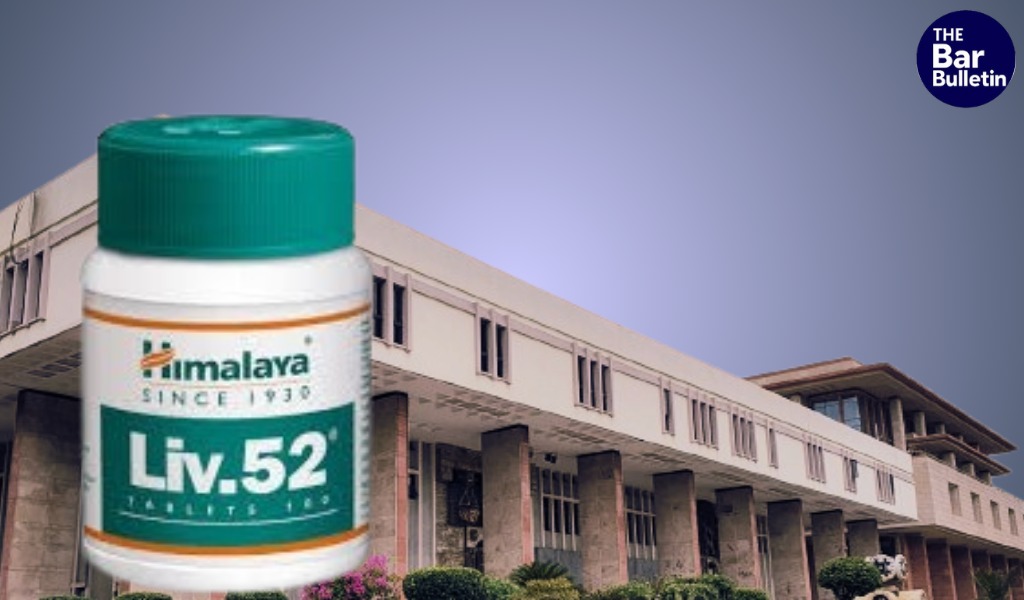

The Delhi High Court has held that, where on a visual comparison the rival medicinal marks are strikingly similar in their essential features, suffix, overall get up and packaging, and where the goods, trade channels and consumer base are common, the likelihood of confusion and deception is sufficient to justify grant of an ex parte ad interim injunction in favour of the prior user and registered proprietor. The Court applied the settled interim injunction tests by holding that the plaintiffs had made out a prima facie case, that the balance of convenience was tilted in their favour, and that irreparable injury would ensue in the absence of restraint orders.
Applying that position, the Court restrained the defendants and all persons acting on their behalf from manufacturing, selling, offering for sale, advertising, marketing or otherwise dealing in goods bearing the impugned mark “Liv-82 DS” or any identical or deceptively similar mark, and also restrained use of packaging formats resulting in passing off of the defendants’ goods as those of the plaintiffs. The Court additionally directed both defendants to disclose, by affidavit, the stock, manufacture and earnings relating to the impugned goods.
A Single Judge Bench of Justice Tushar Rao Gedela upon visual examination of the plaintiffs’ marks “Liv.52” and “Liv.52 DS” and the defendants’ mark “Liv-82 DS”, observed that the similarities were striking. It noted that the letters “Liv” and “LIV” were identical except for capitalization, which hardly mattered when considered as a whole, and that the use of the numerical “82” was confusing when compared with “52” of the plaintiffs’ mark. The Bench further observed that from a distance and at the retailer’s counter, the distinction may not be clear and would cause confusion.
The Bench also observed that the suffix “DS” in both marks was identical and that there was no distinction in that respect. Considering the overall get up and packaging, the Bench held that the defendants’ marks were likely to cause confusion and deception in the general public. It additionally noted that the defendants’ products were also for liver care, identical to the plaintiffs’ goods, and that the trade circles, distribution channels, retailers and consumers appeared to be common, thereby significantly increasing the likelihood of confusion or deception.
The Bench took note of the plaintiffs’ case that the defendants’ marks were unregistered and had entered the market much later than the plaintiffs’ established brand and trademarks. It also observed that the plaintiffs had been vigilant in protecting their proprietary rights against infringers and that the sales turnover and expenditure on advertisements and promotion lent credibility to the plaintiffs’ claim of having garnered substantial goodwill over the years. On that basis, the Bench found that the plaintiffs had prima facie established a strong case, that the balance of convenience was in their favour, and that they would suffer irreparable loss and injury not adequately compensable in monetary terms if interim protection were refused.
Briefly, the plaintiffs, Himalaya Global Holdings Ltd. and Himalaya Wellness Company, instituted a commercial suit against Kbir Wellness Private Limited and another seeking reliefs in respect of alleged infringement and passing off of their trademark “Liv.52”. The plaintiff no.1 claims ownership of the relevant trademarks, patents and other intellectual property rights, which are licensed to plaintiff no.2, and that plaintiff no.2 has been engaged in manufacture and marketing of ayurvedic medicines, health products and cosmetic products for several decades. The plaintiffs asserted long, continuous and extensive use of the trademark “Liv.52” since 1955 and of the current trade dress since 2001, and relied upon the goodwill, reputation, registrations and sales associated with the mark.
The plaintiffs pleaded that “Liv.52” is their flagship brand, sold in several variants, and that the products are marketed under the house mark Himalaya with a distinctive stylized presentation and colour combination of green, white and orange. They further claimed registrations of “Liv.52” and its variants in Class 5, including registrations in over 25 countries, substantial turnover, significant advertisement and promotional expenditure, and asserted that the mark is entitled to protection as a well-known trademark under Section 2(1)(zg) of the Trade Marks Act, 1999.
According to the plaint, defendant no.1 was marketing, and defendant no.2 was manufacturing, herbal/Ayurvedic liver care products under the impugned mark “Liv-82 DS”. The plaintiffs stated that they came across such listings in or around March 2026 on the defendants’ website and on e-commerce platforms such as Tata 1mg, Amazon and Flipkart. Investigation allegedly revealed that the defendants did not possess any registration for the impugned mark, though defendant no.1 had filed Trade Mark Application No. 5947348 in Class 5 claiming user since Dec 24, 2022, which had been objected to by the Registrar under Section 11(1) of the Trade Marks Act, 1999 on the ground of the plaintiffs’ prior registered mark.
The plaintiffs also alleged that the defendants had earlier used different packaging but had subsequently altered the packaging to a green and white combination resembling the plaintiffs’ trade dress, and contended that such change was deliberate and not coincidental. On that basis, they sought an ex parte ad interim injunction under Order XXXIX Rules 1 and 2 CPC. In the same proceedings, the Court also allowed the plaintiffs’ application for exemption from pre-institution mediation under Section 12A of the Commercial Courts Act, 2015, noting that the matter contemplated urgent interim relief.
Appearances:
Advocates Suhrita Majumdar, Vishal Nagpal, Sharad Besoya and Bal Krishan Singh, for the Plaintiff
NA, for the Defendant
