
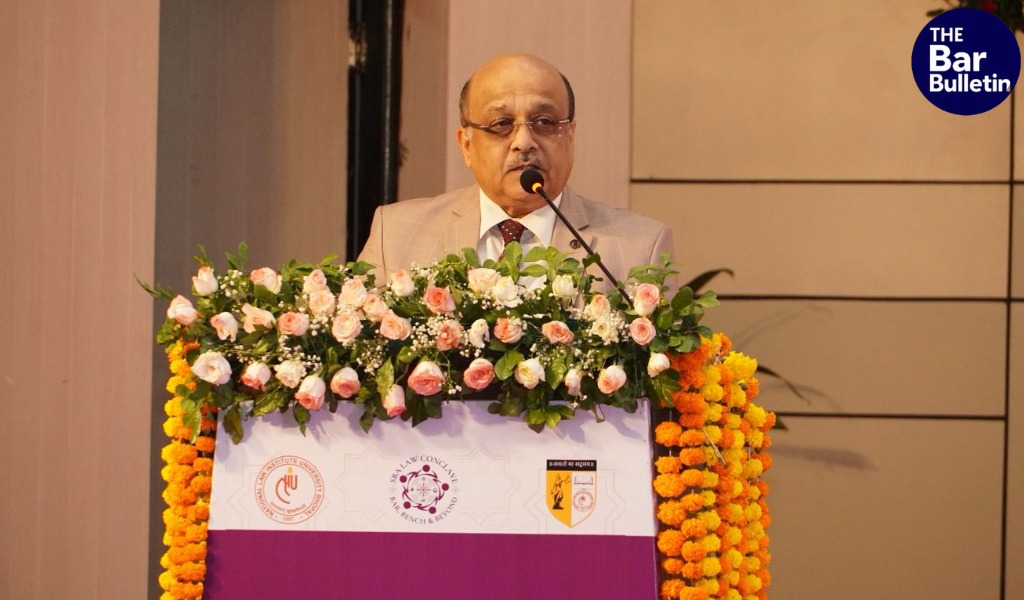

The fourth session of the 2nd NLIU SBA Law Conclave, organised by the Student Bar Association of the National Law Institute University, Bhopal, on the theme “Beyond Colonial Hangovers: Rethinking and Reforming the Western Influence on India’s Legal System,” featured an address by Justice Sushrut Arvind Dharmadhikari (Chief Justice, High Court of Madras). His address brought both historical sweep and constitutional urgency to the question of decolonising India’s legal framework.
Chief Justice Dharmadhikari began by tracing the philosophical foundations of India’s pre-colonial legal order. The Indian legal system, he said, was deeply rooted in religious and customary law, with Dharma at its centre. Diverse cultures across the subcontinent relied on principles of harmony and duty, expressed through the Dharmashastra which is an indigenous legal tradition in which legal decisions were expected to align with social values and tradition rather than with the imperatives of a distant sovereign. The three pillars of this system were Dharma, truth, and welfare. Crucially, the king was never the source of law, he was its servant. “The law is the king of kings,” Chief Justice Dharmadhikari quoted, “even the king must bow to it.” The principle of the rule of law, so often attributed to western jurisprudence, he suggested, was already embedded in India’s own tradition.
The onset of British colonial rule replaced this system with adversarial jurisprudence which is a model designed for a different society, a different culture, and a different set of social priorities. And yet, the essence did not die. The philosophical roots of India’s legal tradition continue to resonate beneath the surface of the statutes. The question is whether, seventy-eight years after independence, India is willing to do the work of reclaiming them. On that score, he was candid: we are still, in many respects, following the Victorian era.
He discussed the Supreme Court’s remark in M.C. Mehta v. Union of India (1987) It is one of the most celebrated environmental judgments in Indian legal history where the Court declared that we cannot allow our judicial thinking to be as the law prevails in England. We no longer need the crutches of a foreign legal order. The observation has grown only more relevant with time. India’s legal language, he argued, remains complex and inaccessible as it was written in Archaic English. He offered a vivid image: a farmer walks into a courtroom and is unable to understand a single word of what is being said about his own case. “If a litigant cannot understand the law,” he said, “justice is locked behind colonial gates.”
HMJ Dharmadhikari also spoke about the need to shift the criminal justice system’s orientation from punishment to justice, from filling prison cells to reconciling communities. He pointed to the Lok Adalat as a modern revival of the Panchayat system, noting that India already had a thriving culture of gram sabhas and alternative dispute resolution mechanisms long before arbitration was codified in statute. These traditions, he argued, are not footnotes to India’s legal history but they are its mainstream. He referenced the recent replacement of the IPC, 1860, CrPC,1973, and Indian Evidence Act, 1872 with the Bharatiya Nyaya Sanhita, Bharatiya Nagarik Suraksha Sanhita, 2023 and Bharatiya Sakshya Adhiniyam, 2023 as a significant move in the right direction. A shift from a punishment mindset to a justice mindset.
He drew attention to a symbolic but powerful change in the new statutes: the blindfold has been removed from the figure of Lady Justice, replaced with a constitution in her left hand and eyes that are open. The message, he said, is that law is not blind, rather it sees everyone equally, and does so with awareness of its own constitutional grounding. He discussed Buddha’s declaration that every person is their own master, concluding that the people of India are the true masters of their own lives and their legal system must reflect that sovereignty. He called on law schools to incorporate the principles of Dharma into the core curriculum, and expressed concern that NLU graduates, in their pursuit of lucrative careers, risk losing the sensitivity needed to serve the common man. “The Indianisation of the judiciary,” he said, is not a slogan but a constitutional imperative.
The 2nd NLIU SBA Law Conclave also featured a National Quiz Competition, conducted in collaboration with QuizGranny, which emerged as one of the most spirited highlights of the event. The competition witnessed enthusiastic participation from over 50 teams representing law schools and universities from across the country, and unfolded across three rigorous rounds that tested participants on their knowledge of law, current affairs, and legal history. With a prize pool of over ₹1,00,000, the competition drew fierce contest among the finalists. Jamia Millia Islamia University clinched the top position and were declared Winners, while Vidigya secured the First Runner-Up position and MNLU Nagpur finished as the Second Runner-Up, rounding off a keenly contested and intellectually enriching competition.
Mr. Gautam Bhatikar (Partner, Phoenix Legal), brought a precise and concrete illustration of what legal decolonisation looks like in practice by using the Admiralty (Jurisdiction and Settlement of Maritime Claims) Act, 2017 as his primary example. India’s admiralty law, he noted, traces its origins to a series of nineteenth-century colonial statutes – the Admiralty Courts Act of 1840, the Admiralty Courts Act of 1861, the Colonial Courts of Admiralty Act of 1890, and the Colonial Courts of Admiralty (India) Act of 1891. Even after independence, no Indian legislation replaced this framework, leading to decades of fragmentation and dependence on foreign jurisprudence, with Indian courts continuing to apply English case law.
The Admiralty Act of 2017 changed this. India’s first unified admiralty statute, it combined English common law, Indian case law, and international conventions into a coherent framework that governs jurisdiction, maritime claims, vessel arrest, sale, and priorities. It applies to all parties regardless of nationality. Mr. Bhatikar highlighted one of its most significant structural reforms: where pre-2017 admiralty jurisdiction was limited to the Presidency High Courts, the 2017 Act extended it to all High Courts of coastal states which is a shift from colonial centralisation to a decentralised, geography-based model aligned with India’s actual maritime realities. In his concluding remarks, he framed the Act as embodying a broader principle: “This is not a rejection of the past, but a refinement.” India, he said, is no longer merely applying inherited law, rather it is reimagining and shaping it, in line with its position and vision as a modern maritime power.
The words of both the dignitaries inspired the large gathering of legal professionals, faculty members and students who had gathered in the event. The session ended with some questions from the side of the audience.