
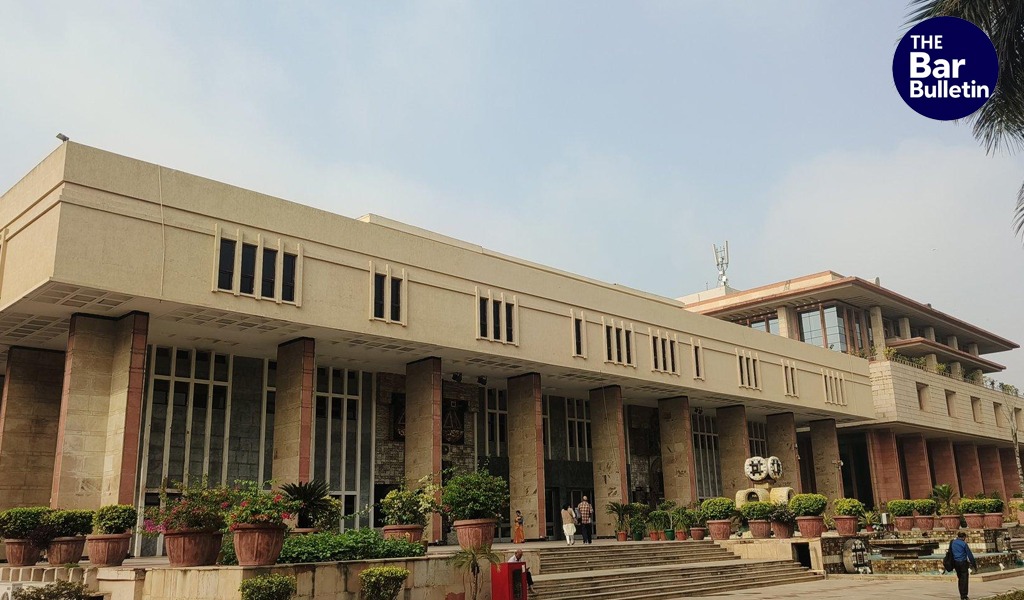

In a writ petition filed before the Delhi High Court under Articles 226/227 of the Constitution, to challenge an order dated 15-10-2025 by the Central Administrative Tribunal (CAT), whereby the contempt petition was dismissed, holding that no contempt was made out by the respondents, a Division Bench of Justice Anil Kshetarpal and Justice Amit Mahajan found that the respondents had not wilfully disobeyed the directions, and dismissed the petition.
The petitioner sought quashing of the impugned order and a direction to allocate him the post of Indian Administrative Service (IAS) under the Economically Weaker Section (EWS) quota, contending that the respondents ignored material communications and violated CAT’s directions.
In 2022, the petitioner appeared in the Civil Services Exam and secured a rank that entitled him to appointment as an IAS officer under the EWS category. His father was a government employee, and his mother filed income tax returns for the relevant assessment year 2021-22, in which a sum of Rs. 49,599/- was shown as income under the ‘salaries’ head. The petitioner’s family held an EWS (Income & Asset) certificate granted by the Tehsildar.
The petitioner was allotted to the Indian Police Service (IPS), even though other EWS-status candidates ranked below him were appointed as IAS officers. The reason communicated to him was that the Department of Personnel and Training (DoPT) had treated his family income of Rs. 8 lakhs for the relevant year as exceeding the EWS limit. The petitioner filed a representation in August 2023, but to no avail.
Thereafter, the petitioner filed an application before the CAT, but the same was disposed of by an order dated 30-04-2024. Aggrieved, the petitioner filed a revision application for modification of the said order, and DoPT also filed a cross-revision. Thereafter, CAT passed a reasoned order dated 07-08-2024, modifying the said earlier order.
Subsequently, DoPT denied the benefit of EWS reservation by an order dated 04-10-2024 and held that the said amount did not qualify as arrears of the previous year for income calculation, and hence, the petitioner’s family income exceeded Rs. 8 lakhs. Aggrieved, the petitioner filed a contempt petition before the CAT alleging that the respondents had wilfully disregarded the Tribunal’s directions. Thereafter, by the impugned order CAT held that the respondents had ‘re-confirmed’ the mother’s income as per their directions and concluded that no wilful disobedience had taken place. Hence, the present petition.
Examining CAT’s order dated 07-08-2024, the Court noted that the respondents were directed to reconfirm from CBDT whether income received by the petitioner’s mother was accounted for in the financial year 2020-21 or otherwise. It was stated that the direction was to ascertain whether the amounts reported were attributable to that year; upon verification, if it were found that the income was related to earlier years, the petitioner was to be granted the EWS benefit.
The Court said that even though the petitioner supplied letters from the Income Tax authorities which characterized the said amount as salary arrears for FY 2020-21, it was found to be important that CBDT’s communication was apparently a general statement from the investigation wing, and that the commissioner’s letter expressly confirmed the amount as a arrears for the said financial year. It was noted that the petitioner claimed that the respondents had this latter information but failed to act on it.
It was noted that DoPT’s order was issued after obtaining CBDT’s information and that the order concluded that the family income of the petitioner had exceeded Rs. 8 lakhs, and that there was no claim under Section 89. The respondents stated that in the absence of a Section 89 claim, the complete amount was assessable in the AY 2021-22, and that they had satisfied the CAT’s direction by reconfirming this.
The court stated that even though the CBDT’s response was incomplete, the respondents did not wilfully refuse to comply but only acted on the recorded material. It was said that in the present matter, at most, a factual dispute was created because of the existence of 2 contradictory letters and that the respondent’s reliance on CBDT’s main report could not by itself amount to wilful disobedience of CAT’s order.
Further, the Court held that if the petitioner’s real grievance was that he was wrongly deprived of the IAS seat, that issue falls outside contempt law, and concluded that the respondent’s conduct did not constitute civil contempt. It was stated that CAT had correctly closed the contempt petition, and even though contradictory communications from the Income Tax authorities created ambiguity, the respondents could not be said to have wilfully flouted the directions only because of a different interpretation.
Thus, the petition was dismissed.
Appearances:
For petitioner: Mr. M. K. Bhardwaj
For respondents: Mr. Amit Tiwari (CGSC), Ms. Ayushi Srivastava, Mr. Ayush Tanwar, Mr. Arpan Narwal, and Mr. Kushagra Malik
