
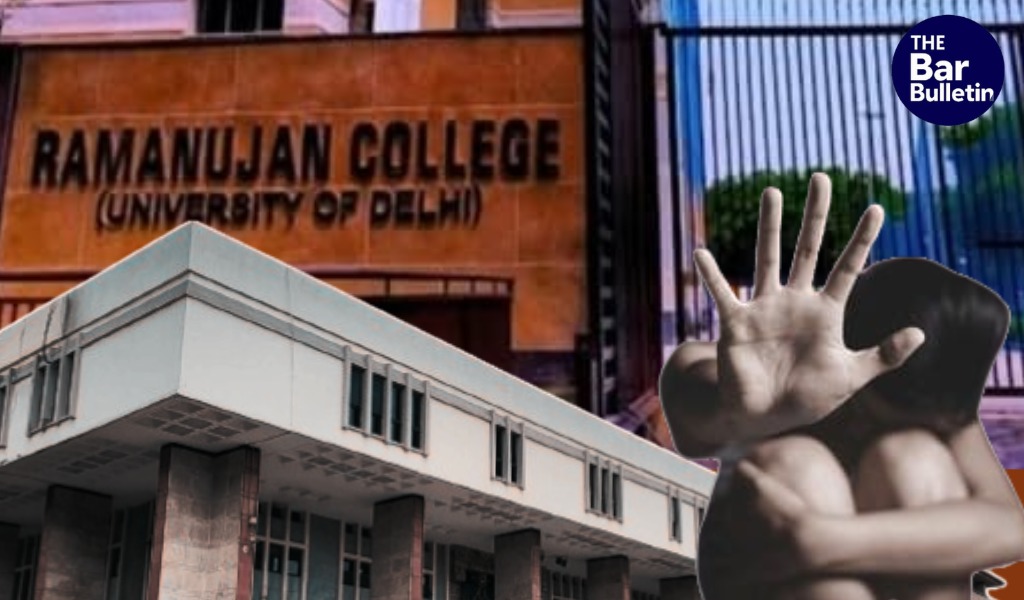

In a writ petition filed before the Delhi High Court by the Principal of Ramanujan College, University of Delhi (respondent 2) (College), to challenge the constitution of an ad hoc committee by the Deputy Registrar of the University of Delhi (respondent 1) (DU), as well as its report dated 23-06-2025, and a suspension order dated 18-09-2025, a Single Judge Bench of Justice Purushaindra Kumar Kaurav set aside the suspension order for being stigmatic in nature, held that the creation of an ad hoc committee was against the POSH Act, and that an employer can suspend an employee being inquired under the POSH Act.
By an order dated 26-09-2025, this Court granted an interim stay of the operation of the said suspension order and left it to the Internal Complaints Committee (ICC) to consider whether any interim measure was warranted against the petitioner. Aggrieved by the interim order, the respondents preferred a Letters Patent Appeal, in which a Division Bench stated that the issues were regarding the power of a University/College to suspend a principal in a case under the Sexual Harassment of Women at Workplace (Prevention, Prohibition, and Redressal) Act, 2013 (POSH Act) and the power of the University/College to constitute an ad hoc committee after receiving a complaint under POSH.
The Court noted that apart from the issues framed by the Division Bench, the Senior Counsel for the petitioner flagged another important issue regarding the sigmatic nature of the suspension order.
Between 13-03-2025 and 24-04-2025, the Assistant Professors at the College (respondents 3 to 5) made complaints against the petitioner, alleging misconduct, including sexual harassment. DU constituted a fact-finding committee (committee) to examine the said allegations. The committee ultimately concluded that the charges levelled against the petitioner were of a serious nature and potentially constituted sexual harassment under the POSH Act. It recommended that the complaints be referred to ICC. Thereafter, the College Chairperson passed the said suspension order.
Regarding whether the College had the power to suspend the petitioner in a case pertaining to the POSH Act, the Court said that the power of suspension lies with the College/University with respect to the services of a teacher, principal, or any other employee. It was stated that the employer/head of the institution may, in the larger interest of the institution, suspend an employee. The Court also noted that while an employer has such an inherent right, the suspension should be carried out with due application of mind.
The Court found the suspension order unassailable since the suspension procedure was adhered to and the power to suspend was vested in the Chairperson of the College. It was stated that neither does the POSH Act confer the power of suspension afresh, nor does it take it away, since Section 28 provides that the provisions of the POSH Act would be ‘in addition to’ and ‘not in derogation’ of the provisions of any other law for the time being in force. The Court held that the power of suspension vests in the employer and is governed by and circumscribed by the service rules as well as the office regulations of the institution or organization concerned.
Regarding the power of the Deputy Registrar (Colleges), DU, to constitute an ad hoc committee after receiving a complaint under the POSH Act, the Court referred to various cases and provisions to state that the Act provides for confidentiality and the constitution of two different committees – an internal complaints committee as well as a local committee. It was stated that if another committee, such as the one in the present case, is given the mandate to inquire into the sexual harassment complaint, it would be in violation of the POSH Act.
The Court stated that such an ad hoc committee, constituted without any governing rules or statutory mandate, operated without any assurance of impartiality under the rule of nemo judex in causa sua, and did not offer a structured, rule-governed opportunity for a hearing as mandated by the rule of audi alteram partem. Hence, the Court said that the constitution of such an extra-statutory committee in substitution of/prior to the ICC, not only offended the POSH Act, but also the foundational principles of natural justice. After perusing Section 12, the Court stated that it could not be declared that a person under inquiry based on sexual harassment complaints could not be suspended, pending the conclusion of ICC proceedings, as the suspension powers only supplement the ICC proceedings.
Considering whether the suspension order was stigmatic, the Court stated that the law does not require a suspension order to be elaborate or to stigmatize an officer. It was also said that, if circumstances require, an employer may state a brief reason for suspension in the order, and if the employee seeks the reason, it may be supplied to them alone. The Court stated that neither an opinion should be formed nor a stigma imposed when passing a suspension order. After perusing the said suspension order, the Court found that anyone who reads the order would form a negative opinion of the petitioner. It was also said that no one deserves to be subjected to such treatment when an inquiry is pending regarding their conduct.
Thus, the Court concluded that even though measures for interim suspension are not provided in the POSH Act, an employer, in exercise of their inherent rights, can suspend a person under inquiry related to the POSH Act. It was held that the creation of a fact-finding committee to determine whether a complaint is to be sent to the ICC/local committee is against the POSH Act and impermissible in law.
The Court set aside the suspension order, holding that the same was stigmatic in nature, and granted liberty to the College to pass a fresh order while disposing of the petition.
Appearances:
For Petitioner – Ms. Geeta Luthra (Sr. Adv), Ms. Shalini Singh, Ms. Prashansika Thakur, Mr. Lakshay Saini
For Respondents – Mr. Jayant Mehta (Sr. Adv), Mr. Mohinder JS Rupal, Mr. Hardik Rupal, Ms. Aishwarya Malhotra, Ms. Tripta Sharma, Ms. Jyoti Taneja, Mr. Shivam Malhotra, Mr. Pallav Arora
