


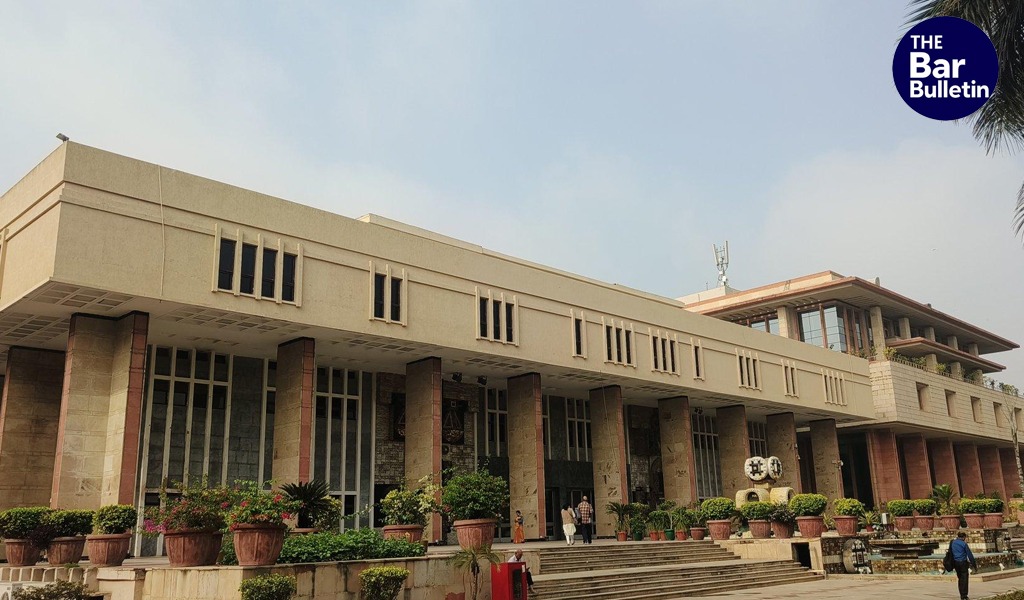

In a revision petition filed before the Delhi High Court seeking setting aside of a judgment dated 30-03-2024 by the Special Judge (NDPS), Shahdara, Karkardooma Courts, Delhi, whereby an appeal filed by the husband (petitioner) under Section 29 of the Protection of Women from Domestic Violence Act, 2005 (PWDV) was dismissed, a Single Judge Bench of Justice Swarana Kanta Sharma modified the interim maintenance to be paid for the children and upheld the impugned orders.
The wife (respondent) stated that soon after marriage, the husband and his family members harassed her with their demands for dowry, and to prevent harmony, her father acceded to the demands from time to time. It was also alleged that within a few weeks of her marriage, the wife was compelled to seek employment and hand over her entire salary to her husband.
Ultimately, the wife initiated proceedings under Section 12 of the PWDV Act. The Trial Court directed the husband to pay Rs. 30,000/- as interim monthly maintenance for the three minor children till the disposal of the complaint or till the children attain majority.
Aggrieved, the husband preferred an appeal under Section 29 of the PWDV Act before the Sessions Court, wherein the appeal was dismissed after detailed consideration of the record. The husband contended that he was incapable of paying the said amount of maintenance as his income was merely Rs. 9000/- since he used to work as a homoeopathic pharmacist. It was also mentioned that the wife used to earn a higher income of Rs. 34,500/-.
The Court noted that the wife was employed at a university where she earned about Rs. 35,000/- per month and that she had not sought any interim maintenance for herself. It was also noted that the husband did not have the custody of the children and that the day-to-day responsibility of their upbringing rested squarely on the wife.
The Court perused the Income Tax Returns (ITR) for the Assessment Year 2022-23 of the husband and calculated his monthly income to be roughly around Rs. 40,000/-. It was also noted that no explanation had been given for not placing the recent ITRs on record. The Court found merit in the observation of the lower courts that it was difficult to reconcile the possession and usage of a credit card with the claim of earning only Rs. 9000/- per month.
It was noted that the petitioner had taken inconsistent stands regarding his residence and family ties since warrants of attachment were returned with a report stating that the husband resided on the second floor of the property owned by his family, even though he contended that he was debarred from his parental property. Hence, the Court said that the findings of the lower courts in this regard could not be said to be perverse or unreasonable.
The Court stated that the obligation to maintain minor children is not only a statutory duty but also a legal, moral, and social responsibility of both parents. It was said that the maintenance of children encompasses their overall upbringing, education, health, and standard of living.
The Court found nothing on the record to suggest that the earning capacity of the husband had diminished due to any circumstance beyond his control.
Further, the Court stated that the wife was compelled to shoulder a dual burden of fulfilling her personal obligations along with her responsibility of taking care of three minor children. The Court said that it must be cautious in such cases not to equate the mere employment of a primary caregiver with financial sufficiency. It was stated that the obligation of the father towards the minor children does not diminish merely because the wife has been forced to take on the dual responsibility.
The Court found the conduct of the wife not of entitlement but of an effort to make the other partner realise his responsibility towards his children. It was stated that the law does not mandate a working woman to be forced to exhaust herself while allowing the father to take refuge behind selective and misleading disclosures about his income and technical pleas.
The Court stated that parenthood is a matter of responsibility and not of the convenience of a party. It was also said that the prime concern is always the children’s welfare, along with the dignity of a working woman. The Court held that the wife’s earnings and assumption of responsibility cannot be construed to absolve the father of his parental obligations.
It was viewed that a consolidated amount of Rs. 25,000/- per month towards the maintenance of the children would adequately serve the ends of justice. The Court further stated that the wife would also be contributing towards the expenses while also being responsible for their physical care, supervision, etc., which could not be assessed in monetary terms and was priceless.
Thus, the aforesaid modifications in the quantum of interim maintenance were done, and the impugned orders were upheld. Hence, the petition was disposed of.
Appearances:
For Petitioner – Mr. Amit Gupta, Mr. Kshitij Vaibhav, Ms. Muskan Nagpal
For Respondent – Ms. Shaini Bhardwaj, Ms. Rukhsar, Mr. Vedic Thukral
