
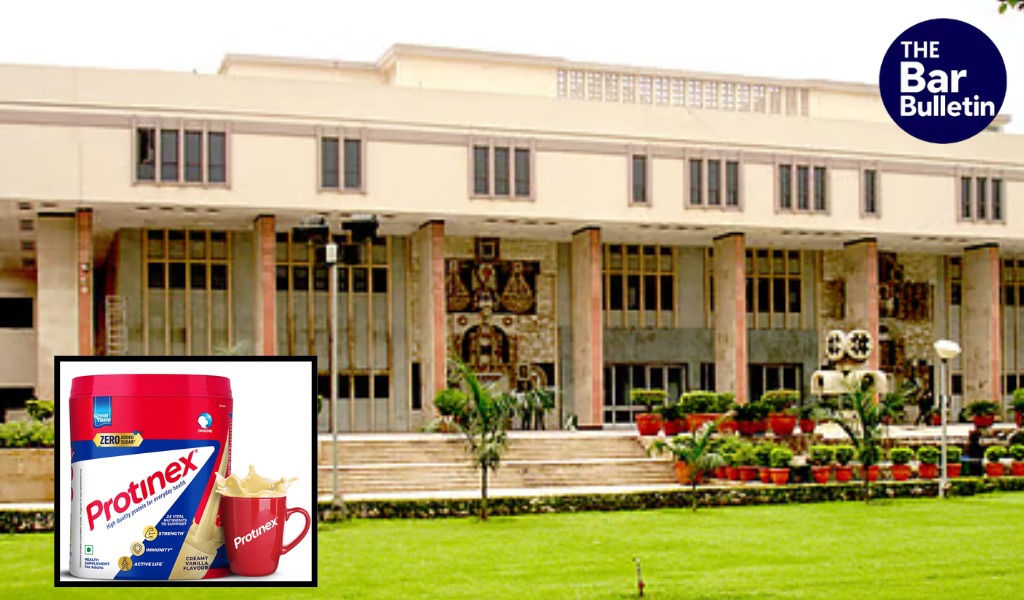

The Delhi High Court has held that where, in a trade mark infringement action, the plaintiff establishes registration, goodwill, and deceptive similarity between the rival marks on the basis of undisputed documentary evidence, and the served defendants neither appear nor file their written statements within the prescribed period, the Court may grant summary judgment under Order XIII-A CPC if the defendants have no real prospect of successfully defending the suit.
The Court further held that marks obtained by minor alterations to a registered trade mark, such as omission or substitution of letters, may still be deceptively similar if they retain structural, visual, and phonetic similarity so as to cause likelihood of confusion or association among consumers; and even initial interest confusion is sufficient to attract infringement under Section 29 of the Trade Marks Act, 1999.
A Single Judge Bench of Justice Tejas Karia observed that defendant nos. 1, 3, 4, 5 and 6 had failed to enter appearance or raise any defence despite due service of summons, and their right to file written statements had already been closed. In these circumstances, and in light of the documentary material placed on record, the Single Judge held that no useful purpose would be served by sending the matter to trial, particularly when no defence had been raised and the defendants did not appear to have any real prospect of successfully defending the suit.
The Bench took note of the plaintiff’s registration and goodwill in the mark “PROTINEX” and compared the competing marks. It observed that “PROTEX” had been devised by merely omitting the letters “IN” from “PROTINEX,” and “PROTRILEX” had been devised by adding the letter “R” and substituting the letter “N” with “L.” On that comparison, the Bench held that the impugned marks were deceptively similar to the plaintiff’s mark and bore structural, visual and phonetic similarity sufficient to create likelihood of confusion and association in the minds of the trade and public.
The Bench further observed that the defendants’ adoption and use of the impugned marks was dishonest and mala fide, intended to derive unfair advantage from and ride upon the goodwill and reputation attached to the plaintiff’s mark. Reference was made to Under Armour Inc. v. Anish Agarwal [2025 SCC OnLine Del 3784], to reiterate that even confusion at the initial stage is sufficient to attract infringement under Section 29 of the Trade Marks Act, 1999.
The Bench also referred to Inter Ikea Systems BV v. Imtiaz Ahamed [2016 SCC OnLine Del 6717], to observe that a defendant who chooses to stay away from proceedings should not be permitted to benefit from such evasion, and that in an appropriate case relief for infringement can be granted on the basis of the material on record. Applying that approach, the Bench found the present case fit for summary judgment under Order XIII-A CPC.
Briefly, the plaintiff had instituted a suit seeking permanent injunction against infringement of its trade mark “PROTINEX” and passing off by the defendants through use of the marks “PROTEX” and “PROTRILEX.” The Court had earlier, by order dated October 16, 2024, restrained defendant nos. 1 to 3 from using “PROTEX” and defendant nos. 4 to 6 from using “PROTRILEX” or any other deceptively similar mark to the plaintiff’s registered mark “PROTINEX.”
The plaintiff pleaded that it is part of the Danone Group, that its predecessors had used the mark “PROTINEX” in India since 1957, and that it held multiple registrations in relevant classes in respect of the said mark. The plaintiff further asserted that the mark had acquired substantial goodwill and reputation through long, continuous use, extensive manufacturing, commercial success, and considerable advertising and promotional activities in India.
According to the plaintiff, in September 2024 it came across products bearing the impugned mark “PROTEX,” which were being marketed by defendant no. 1 and manufactured by defendant no. 4. Its investigation further revealed that defendant no. 1, through interconnected proprietorship entities, had been marketing nutritional products under the impugned marks for several years, and that defendant no. 4, whose directors are defendant nos. 5 and 6, was manufacturing and selling products bearing “PROTRILEX” through online platforms and its own website.
Appearances:
Krishna V.S., Advocate, for the Plaintiff
None, for the Defendant
