


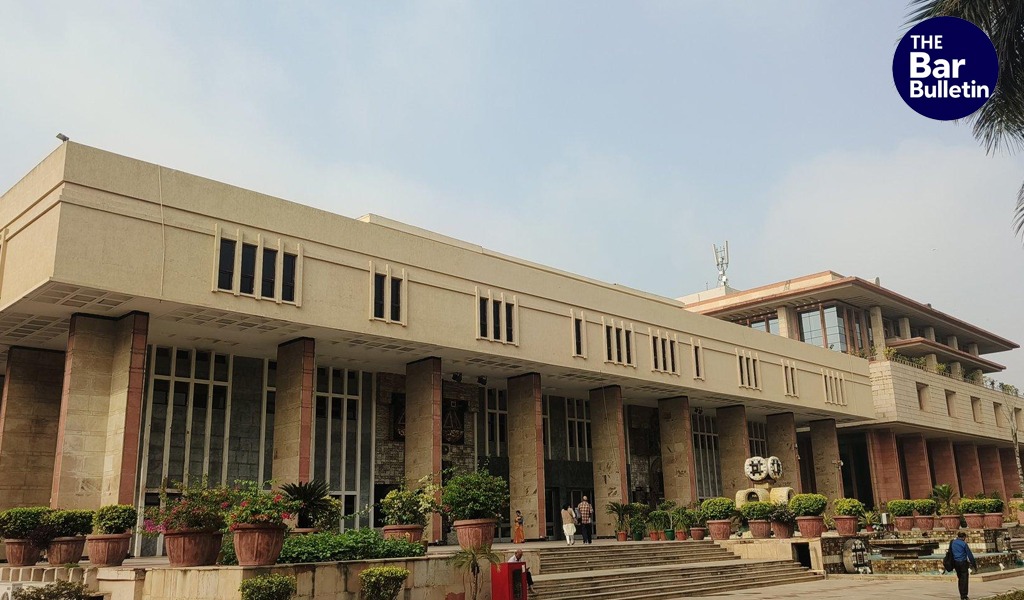

While granting relief to mobile dealers including Intex Technologies, and more, the Delhi High Court has clarified that as per Section 27A of the Customs Act, 1962, interest on delayed refunds is liable to be paid after the expiry of three months from the date of receipt of the application for refund. Where refunds are granted within the stipulated three-month period and there is no undue delay by the Department in re-assessing the applications, no interest is payable.
However, where there is a substantial delay on the part of the Department in passing re-assessment orders from the date of the applications for re-assessment, the taxpayer cannot be deprived of their valid refund amounts for such a long period and is entitled to interest computed from the date when the first re-assessment application was filed to the date of actual refunds. Accordingly, the High Court held the petitioners (mobile dealers) entitled to interest.
The Division Bench comprising Justice Prathiba M. Singh and Justice Shail Jain observed that after the Supreme Court decision in ITC Limited v. Commissioner of Central Excise [(2019) 17 SCC 46], it is the settled position in law that refund applications cannot be filed or entertained unless the original assessment order, whether by self-assessment or an assessment by the Customs Department, is re-assessed.
As far as Lava International is concerned, the Bench observed that the refunds were granted to the Petitioner within a period of three months from filing the application for refund, which is within the period stipulated in Section 27A of the Customs Act, 1962. Further, even prior to the period of filing the application for refund, there was no undue delay on the part of the Department in re-assessing or processing the applications once the said applications for re-assessment or for seeking refund were filed pursuant to the orders of the High Court. Hence, the Bench found no justification that entitles the Petitioner to interest upon the refund amounts that were granted and duly processed in a time-bound manner.
As far as Jaina Marketing, Intex, and UT Electronics are concerned, the Bench observed that the first applications for re-assessment were filed by the Petitioners in 2015 and 2019, but the re-assessment orders were passed several years later in 2022. Thus, for the substantial delay in the Department’s passing of the re-assessment orders, the Petitioners cannot be blamed or expected to unduly suffer.
The Bench also noted that the refunds were finally allowed as the additional customs duty was not at all payable in terms of SRF Ltd. v. Commissioner of Customs, (2015) 14 SCC 596, which was the prevalent law prior to the ITC decision. The Bench thus concluded that the Petitioners cannot be deprived of their valid refund amounts for such a long period, and hence, interest is payable.
Briefly, the Petitioners engaged in the business of importing mobile handsets, tablets, and parts, had filed various Bills of Entry (BoEs) classifying the imported goods under respective tariff headings by self-assessing the BoEs using the ICEGATE (Indian Customs Electronic Commerce/Electronic Data interchange Gateway) portal. The EDI system did not provide an option for the Petitioners to avail the exemption for a concessional rate of Countervailing Duty (CVD) at 1% in terms of Notification No. 12/2015-C.E. and Notification No. 12/2012-CE. Consequently, the Petitioners paid CVD at the rate of 12.5% or 6% under Section 3(1) of the Customs Tariff Act, 1975, which they claim was paid under protest.
Following the Supreme Court decision in SRF Ltd. v. Commissioner of Customs [(2015) 14 SCC 596], which held that importers were entitled to exemption from payment of CVD even if CENVAT credit was not availed, the Petitioners sought re-assessment of the BoEs and refund of the excess duty paid. The Adjudicating Authority allowed the refund applications, holding that the Petitioners successfully discharged the onus of unjust enrichment under Section 28D of the Customs Act, 1962, but denied the grant of interest on the said refunds.
Appearances:
Advocates Asha Jain Madan, Mukesh Jain and Ajay Goyal, for the Petitioner/ Taxpayer
Advocates Anushree Narain, Yamit Jeitley and Naman Choula, for the Respondent/ Revenue
