


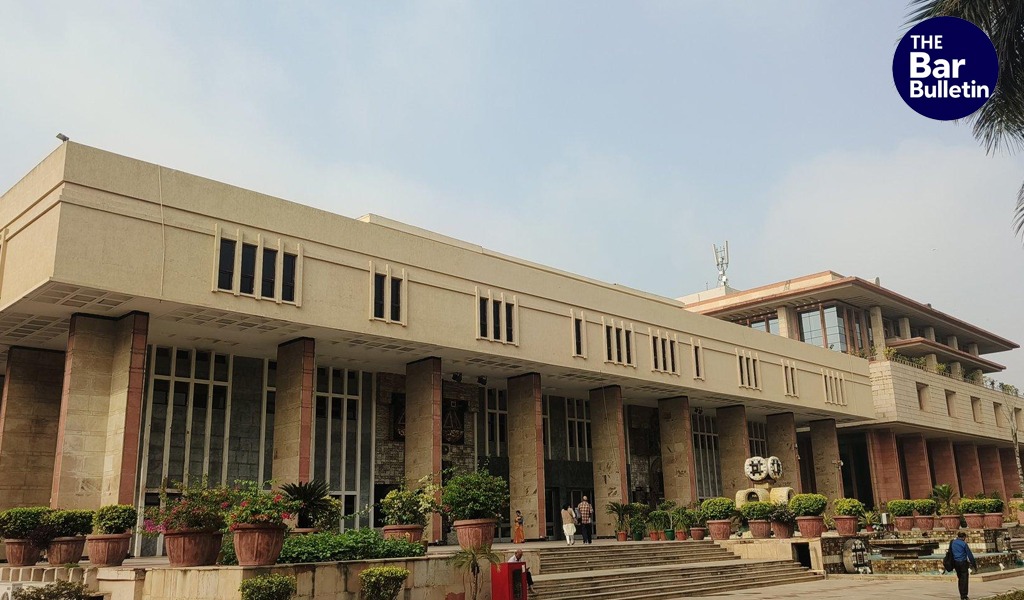

The Delhi High Court dismissed a writ petition challenging the Election Commission of India’s rejection of objections against the merger of the Muslim League Kerala State Committee (MLKSC) with the Indian Union Muslim League (IUML), holding that a person who is not a member of the political party concerned cannot claim locus standi to question such a merger.
Justice Amit Bansal was hearing a petition filed seeking to set aside the Election Commission’s order dated 20 April 2024, which had rejected his representation challenging the merger approved by the Commission on 3 March 2012. The petitioner had also sought directions to derecognise the merger of MLKSC with IUML.
The petitioner contended that he had been an active member of IUML and had served as State Secretary and President of its Tamil Nadu unit before being expelled in 2004. He argued that the expulsion was wrongful and was already under challenge in a civil suit pending before a court in Chennai. On this basis, he claimed the right to object to the merger and argued that the Election Commission had erred in rejecting his representation solely on the ground of lack of locus standi.
The dispute traces back to a resolution passed by IUML’s National Executive on 26 November 2011 approving the merger of MLKSC with IUML, which was subsequently ratified by the Election Commission on 3 March 2012. The petitioner had earlier raised objections to the merger and had also sent representations to the Election Commission in 2014 and later in 2022 after learning that a related writ petition challenging the merger had been withdrawn.
Before the Court, the petitioner relied on Paragraph 16 of the Election Symbols (Reservation and Allotment) Order, 1968, contending that the provision permits “any other persons as desire to be heard” to raise objections in cases involving amalgamation of political parties. The respondents, including the Election Commission and IUML, countered that the provision must be read contextually and cannot be interpreted to allow unrelated persons to challenge party mergers.
The Court agreed with the respondents’ interpretation and held that the phrase “any other persons as desire to be heard” must be construed in light of the principle of ejusdem generis, meaning that general words following specific ones must be limited to the same class as the specified persons. Accordingly, the expression would only cover representatives or members connected with the parties involved in the merger, and not outsiders or persons unconnected with them.
The Court observed that the petitioner had admittedly been expelled from IUML in 2004 and the civil suit challenging his expulsion remained pending without any interim order allowing him to participate in the party’s affairs. The Court also noted that an interim order in the suit restrained him from claiming association with IUML or using its name. In these circumstances, the petitioner could not claim locus standi to object to the merger under Paragraph 16 of the Election Symbols Order.
Holding that there was no infirmity in the Election Commission’s order rejecting the petitioner’s representation, the Court dismissed the writ petition. The Court clarified that since the petition was rejected on the ground of locus standi, it had not examined the merits of the merger itself.
Appearances:
For the Petitioners: Mr. Sanjoy Ghose, Senior Advocate with Mr. Rahul Shyam Bhandari, Mr. G. Priyadharshni, Mr. Satyam Pathak, Ms. Jasleen Kaur and Mr. Mohit Garg, Advocates
For the Respondents: Mr. Sanjay Vashishtha, Standing Counsel for ECI/R-1
Mr. Haris Beeran, Mr. Sayid Marzook Bafaki, Mr. Azhar Assees, Mr. Anand B. Menon, Mr. Ranjay N., and Mr. Rizwana R. Raj, Advocates for R-2