


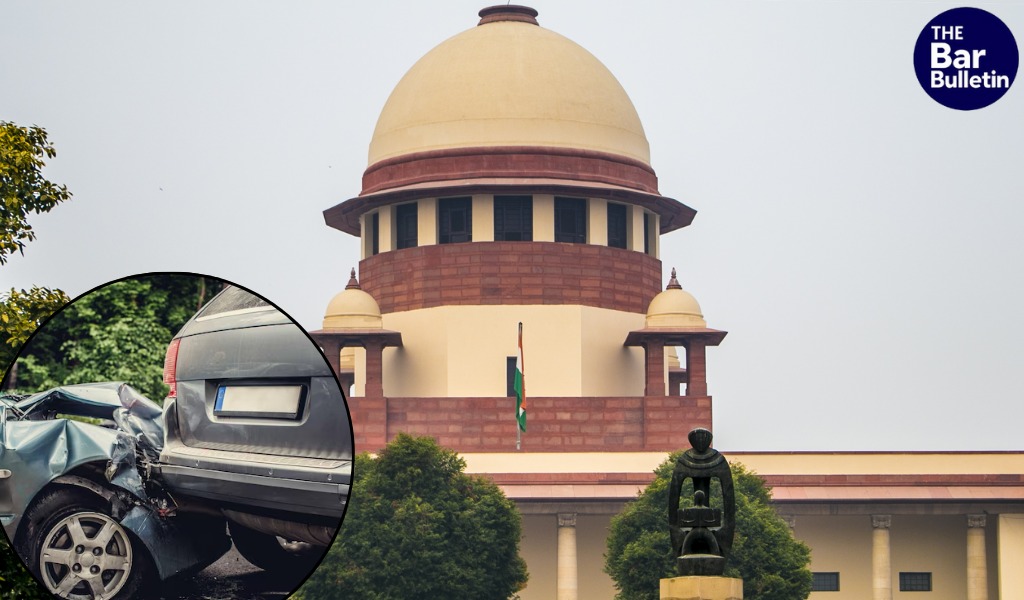

The Supreme Court has enhanced the compensation payable to the dependents of a motor accident victim to ₹20.8 lakh, holding that addition towards future prospects is mandatory even in the case of self-employed or fixed salary earners below the age of 40. The Bench of Justice Dipankar Datta and Justice Satish Chandra Sharma ruled that the denial of future prospects by the High Court was contrary to the Constitution Bench judgment in National Insurance Co. Ltd. v. Pranay Sethi, (2017) 16 SCC 680 and amounted to a manifest error of law.
The appeal arose from a fatal road accident that occurred in 2011, in which a 37-year-old driver lost his life after a tanker lorry, insured with the respondent insurance company, hit his two-wheeler due to rash and negligent driving. The dependants, including the widow, minor children and parents of the deceased, had filed a claim petition seeking compensation of ₹20 lakh. While the Motor Accidents Claims Tribunal (MACT) assessed the deceased’s monthly income at ₹6,000 in the absence of documentary proof, the Madras High Court marginally enhanced it to ₹7,000 and raised the total compensation to ₹10.51 lakh, but declined to grant future prospects.
Setting aside the High Court’s approach, the Supreme Court noted that the salary certificate issued by the deceased’s employer and the supporting affidavit clearly established that the deceased was earning a fixed monthly income of ₹10,000. The Court held that once such cogent documentary evidence was available and remained unimpeached, it was impermissible to determine income on conjecture or assumption. The Court further emphasised that assessment of future prospects is no longer a matter of discretion and flows directly from binding precedent under Article 141 of the Constitution.
Referring to Pranay Sethi, the Bench reiterated that where the deceased was below 40 years of age and on a fixed salary, a 40% addition towards future prospects is compulsory. Applying this principle, the Court recalculated the deceased’s monthly income at ₹14,000, deducted one-fourth towards personal expenses and applied a multiplier of 15, thereby assessing the loss of dependency at ₹18.9 lakh.
On the issue of compensation under the head of “loss of love and affection”, the Court reaffirmed that such a head is not separately permissible in view of Pranay Sethi and the subsequent ruling in United India Insurance Co. Ltd. v. Satinder Kaur, (2021) 11 SC 780. However, the Court clarified that emotional loss suffered by family members is subsumed within the concept of consortium, which includes spousal, parental and filial consortium, as recognised in Magma General Insurance Co. Ltd. v. Nanu Ram, (2018) 18 SCC 130. Accordingly, compensation was awarded under the recognised heads of consortium instead of as a separate claim for loss of love and affection.
Taking into account loss of dependency, consortium, funeral expenses and transport charges, the Supreme Court fixed the total compensation at ₹20.8 lakh. Noting that the dependants had been pursuing the claim for over fifteen years, the Court directed payment of interest at the rate of 9% per annum from the date of filing of the claim petition until realisation and ordered the insurer to deposit the balance amount within twelve weeks.
Appearances
Petitioner- Mr. T. Harish Kumar, AOR
Respondents- Mr. Sandeep Jha, Adv. Mr. Ram Ekbal Roy, Adv. Ms. Priyanka Das, Adv. Ms. Neha Das, Adv. Mr. Aman Nihal, Adv. Mr. Ravi Shankar Ravi, Adv. Mr. Binay Kumar Das, AOR
