


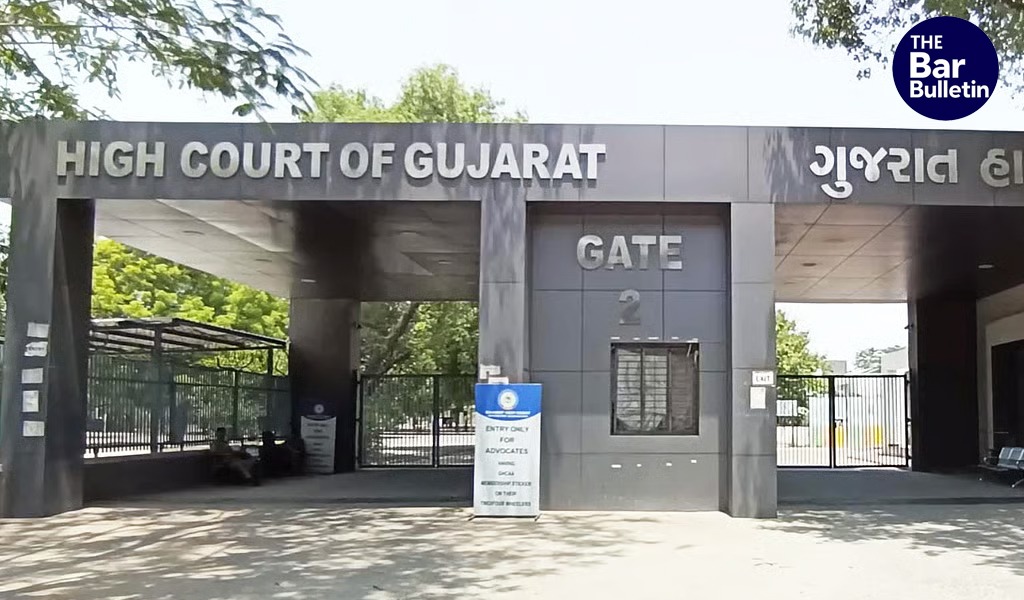

The Gujarat High Court (Ahmedabad Bench) has ruled that the act of an accused causing the death of his wife after witnessing her in a compromising position with a paramour in his own house, coupled with the wife’s immediate threat to his life upon confrontation, constitutes “grave and sudden provocation” under Exception-1 of Section 300 of the IPC, thereby reducing the offence from murder to culpable homicide not amounting to murder.
The Court explained that where the accused is deprived of the power of self-control by such grave and sudden provocation and causes death with knowledge but without the intention of causing death or such bodily injury as is likely to cause death, the conviction shall be sustained under Section 304 Part-II of the IPC.
However, the benefit of the right of private defence under Section 100 of the IPC or Exception-2 to Section 300 of the IPC cannot be claimed against a deceased who merely issued oral threats without launching any physical assault that would cause a reasonable apprehension of death or grievous hurt to the accused, added the Court.
A Single Judge Bench of Justice Gita Gopi observed that the extra-judicial confessions made by the accused before the ambulance driver and his superior officer were voluntary, truthful, and reliable. The Bench noted that if the evidence relating to an extra-judicial confession is found credible and acceptable, it can solely form the basis of conviction, as the requirement of corroboration is a matter of prudence and not an invariable rule of law.
Regarding the admissibility of the First Information Report filed by the accused, the Bench observed that while a confessional statement to a police officer is prohibited under Section 25 of the Evidence Act, the fact of the accused giving the information is admissible against him as evidence of his conduct under Section 8 of the Evidence Act.
The Bench thoroughly analysed Exception-1 to Section 300 of the IPC and observed that the compromising situation in which the accused saw his wife and her paramour in his own house constituted grave and sudden provocation. The wife’s retort threatening to kill the accused if he intervened further enraged him, leading to a complete loss of self-control. The Bench observed that the incessant beating resulting in the wife’s injuries was a simultaneous reaction to this grave and sudden provocation, making it a case of culpable homicide not amounting to murder punishable under Section 304 IPC.
Further, the Bench rejected the accused’s plea of the right of private defence under Section 100 IPC and Exception-2 to Section 300 IPC. The Court observed that the paramour had run away, and the wife had only orally threatened the accused without launching any physical assault that could cause an apprehension of death. Finally, the Bench noted that intent along with knowledge to commit the act could not be attributed to the accused, as he did not have a pre-meditated plan or weapon in hand awaiting to murder his wife; therefore, the conviction strictly falls under Section 304 Part-II and not Part-I of the IPC.
Briefly, in July 1997, the accused-appellant, at his residence situated at G.E.B. Quarter E/2, found his wife, Dhirajben, in an illicit relationship with her lover, Harshadkumar R. Sharma. Upon being confronted, the deceased wife threatened the accused-appellant that if he came between them, he would not be allowed to live. Enraged by the situation, the accused-appellant assaulted the deceased by giving fist and kick blows, dashed her against the wall, and inflicted blows with a wooden log obtained from the house stove, causing bodily injuries.
The deceased succumbed to these injuries, and the postmortem report noted the cause of death as shock due to internal hemorrhage due to rupture of the liver and multiple injuries. Following the incident, the accused made extra-judicial confessions to an ambulance driver and his superior officer, admitting that he had beaten his wife to death due to her illicit relationship. The accused himself filed the First Information Report with the police and simultaneously filed a separate complaint against Harshadkumar R. Sharma under Sections 452, 323, and 504 of the IPC for house-trespass and assault.
Later, the appellant was convicted under Section 304 Part-II of the IPC by the Additional Sessions Judge, Godhra, and was sentenced to serve five years of rigorous imprisonment along with a fine of Rs. 3,000/-.
Appearances:
Advocate VD Parghi, for the Appellant
APP Jyoti Bhatt, for the Respondent
