


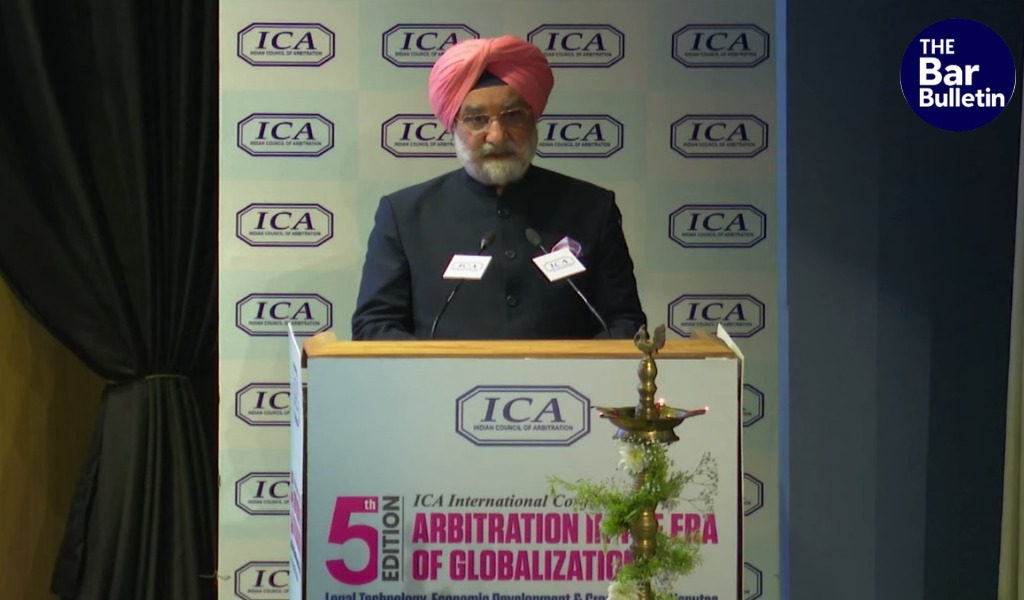

Addressing the 5th ICA International Conference on ‘Arbitration in the Era of Globalisation,’ the Lieutenant Governor of Delhi, Taranjit Singh Sandhu, said that India already has the foundational elements required to emerge as a global arbitration hub, and we can significantly enhance its global standing with focused efforts.
“International experience shows that credible arbitration hubs are built through sustained effort, combining strong institutions, supportive legal frameworks and consistent judicial backing.) India already possesses these foundational elements and with focused efforts can significantly enhance its global standing…Ultimately, arbitration is built on trust, trust in institutions, processes and outcomes. Strengthening that trust will be the key to India’s journey towards becoming a global arbitration hub.”
He highlighted the central role of arbitration in today’s global economic framework, stating that cross-border trade and investment have made efficient dispute resolution systems indispensable. Highlighting the evolution of arbitration, he remarked, “In today’s deeply interconnected world, economic activity transcends borders… In this environment, arbitration is no longer just an alternative mechanism, it is an essential pillar of global commerce.”
He pointed to the core strengths of arbitration, noting that its value lies in “neutrality, predictability and enforceability,”which ensure that disputes can be resolved fairly and efficiently across jurisdictions, thereby strengthening investor confidence and ease of doing business.
The Hon’ble LG also emphasised the role of institutions like the Indian Council of Arbitration (ICA), stating that they are well-positioned to “act not just as an administrator of disputes but as a driver of institutional excellence,” and can help build global confidence in India as a reliable arbitration destination.
Referring to international benchmarks, he observed that jurisdictions such as Singapore and London have emerged as leading arbitration hubs through sustained policy support, strong institutions, and consistent legal frameworks. He noted that India already has these foundational elements and can further enhance its global standing with focused efforts.
On Delhi’s role, he said the capital’s concentration of courts, regulatory bodies, law firms, and international institutions gives it a natural advantage in becoming a hub for arbitration and legal services.
He described arbitration as “more than a legal tool… an enabler of economic growth,” adding that building trust in institutions and processes will be key to positioning India as a preferred global destination for dispute resolution.