


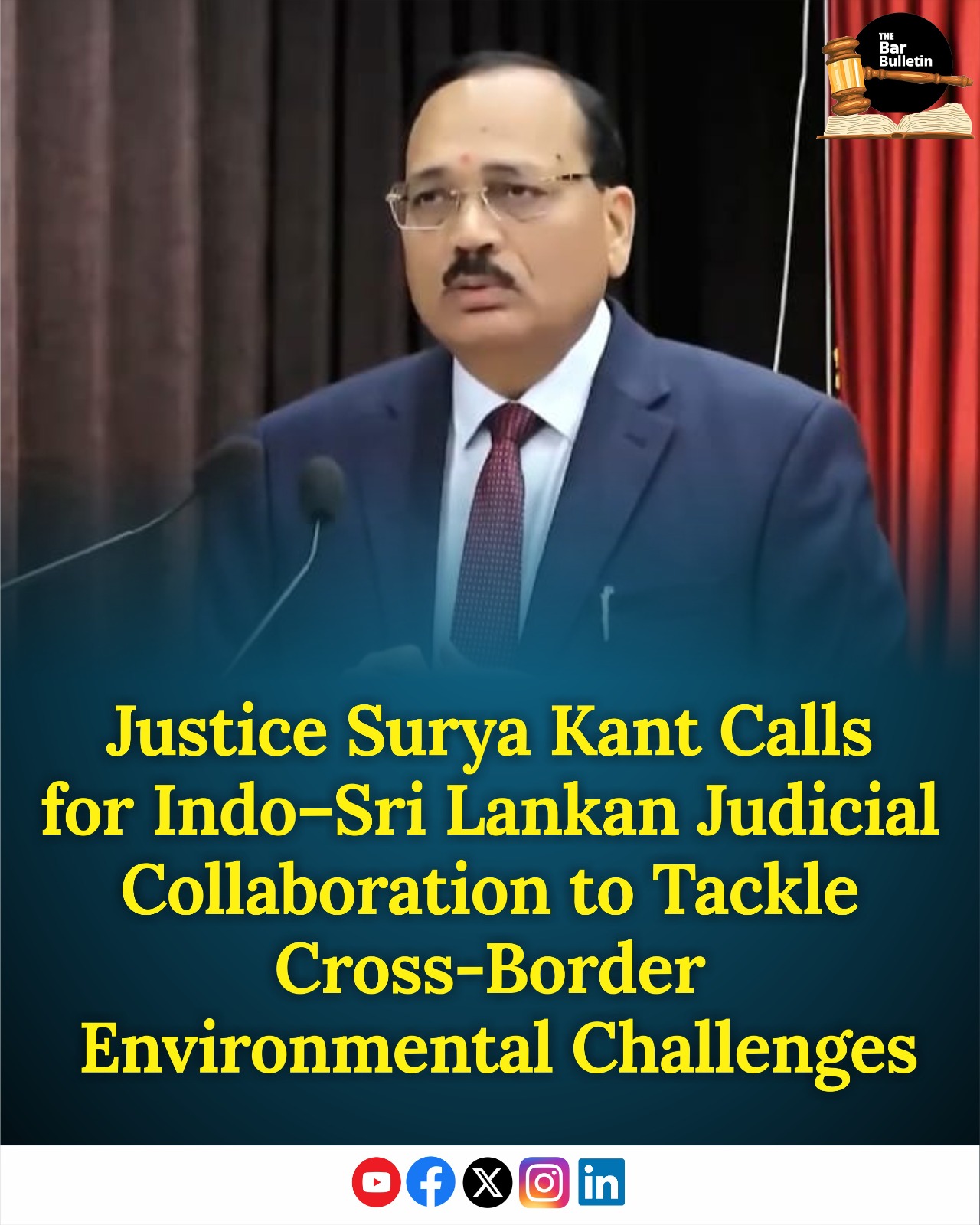

At the Indo–Sri Lanka Policy Dialogue on Advancing Environmental Sustainability and Regional Cooperation, Hon’ble Justice Surya Kant, Judge of the Supreme Court of India, underscored the urgent need for India and Sri Lanka to strengthen transboundary cooperation in addressing shared environmental challenges across the Palk Bay and the Indian Ocean region.
Speaking at the University of Colombo’s Faculty of Law, Justice Surya Kant highlighted that while the two nations are historically connected through cultural and maritime ties, they are now bound by a shared ecological responsibility. He noted that “the Bay of Bengal does not divide us; it binds us through a shared ecological fate,” calling for collaborative governance models to preserve fragile marine ecosystems.
Justice Surya Kant observed that the Palk Bay and Gulf of Mannar, rich in biodiversity, face mounting stress from overfishing, coastal degradation, and climate-induced changes such as sea-level rise. He urged for joint data-sharing, ecological monitoring, and coordinated disaster response mechanisms to mitigate these impacts.
Emphasizing the role of the judiciary in environmental governance, he lauded the proactive environmental jurisprudence developed by both the Indian and Sri Lankan Supreme Courts. Referring to India’s constitutional interpretation of the right to a healthy environment under Article 21 and Sri Lanka’s landmark Eppawela judgment, Justice Surya Kant described both courts as “moral custodians of inter-generational equity and public trust.”
He proposed the creation of a Joint Indo–Sri Lankan Commission on Marine Ecology to issue ecological advisories and coordinate data-sharing for pollution and fisheries management. He also encouraged the convening of judicial workshops under BIMSTEC to develop common interpretive standards for environmental rights across the region.
Justice Surya Kant welcomed the forthcoming visit of the Hon’ble Chief Justice of Sri Lanka, Justice P. Padman Surasena, and other Supreme Court judges to India, expected later this year, expressing hope that this engagement would further deepen judicial dialogue and regional environmental constitutionalism.
Concluding his address, Justice Surya Kant remarked that Indo–Sri Lankan environmental cooperation “is not a matter of charity or diplomacy, it is a matter of survival.” He urged both nations to view their partnership as a collective guardianship of the Indian Ocean commons, measured “not in treaties signed, but in ecosystems restored and communities made resilient.”