


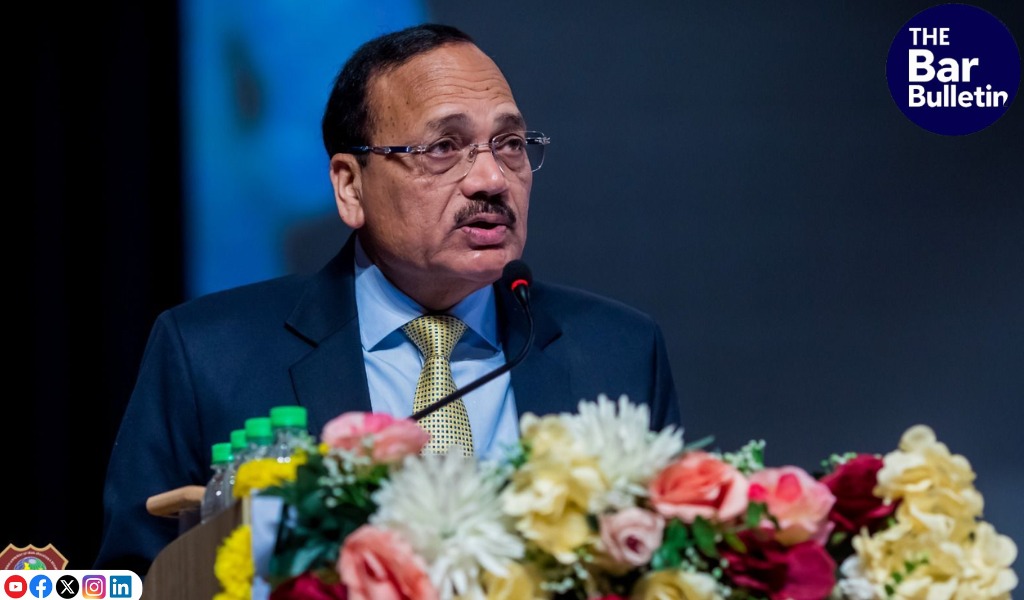

Justice Surya Kant on Sunday emphasised that robust judicial infrastructure is essential to fulfill the constitutional promise of access to justice, as he laid the foundation stone for Zone-II of the High Court complex for the State of Telangana.
Speaking at the foundation stone laying ceremony in Hyderabad, Justice Surya Kant highlighted that courts are sustained not merely by visible proceedings but by the institutional ecosystem that operates behind them, including training facilities, archives, and residential infrastructure.
Underscoring the constitutional mandate to establish High Courts in every State, he noted that such a mandate must be backed by adequate infrastructure, failing which it risks remaining “mere words on paper.”
Referring to the ongoing development, Justice Surya Kant stated that while construction of Zone-I is underway, the commencement of Zone-II reflects a parallel and forward-looking approach by the judiciary and the State government to create infrastructure capable of meeting requirements for the next 50 to 100 years.
He described Zone-II as the “root system” of the High Court campus, comprising multiple structures designed to sustain the institution beyond courtrooms, including administrative, residential, and training facilities.
Highlighting the importance of institutional independence, Justice Surya Kant observed that a self-contained judicial campus enables courts to function on their “own terms and turf,” reducing dependence on fragmented infrastructure.
He also stressed the significance of continuous judicial education and preservation of institutional memory, pointing to planned facilities such as an auditorium for training programmes and a central record room to maintain precedents and ensure consistency in judicial reasoning.
Tracing the project’s origins, Justice Surya Kant noted that the initiative dates back to 2009 following a fire at the existing High Court building, after which efforts by successive Chief Justices, the Bar, and governments culminated in the present development.
He acknowledged the role of the Telangana government in granting administrative sanction exceeding ₹2,500 crore, observing that alignment between the judiciary and the executive brings constitutional principles to life.
Concluding his address, Justice Surya Kant urged all stakeholders to adhere to timelines and uphold a sense of responsibility, noting that the infrastructure being created today will serve generations of judges, lawyers, and citizens in the future.
He emphasised that the true legacy of the project would be reflected in the experience of future legal professionals who would inherit the institution.
READ MORE