


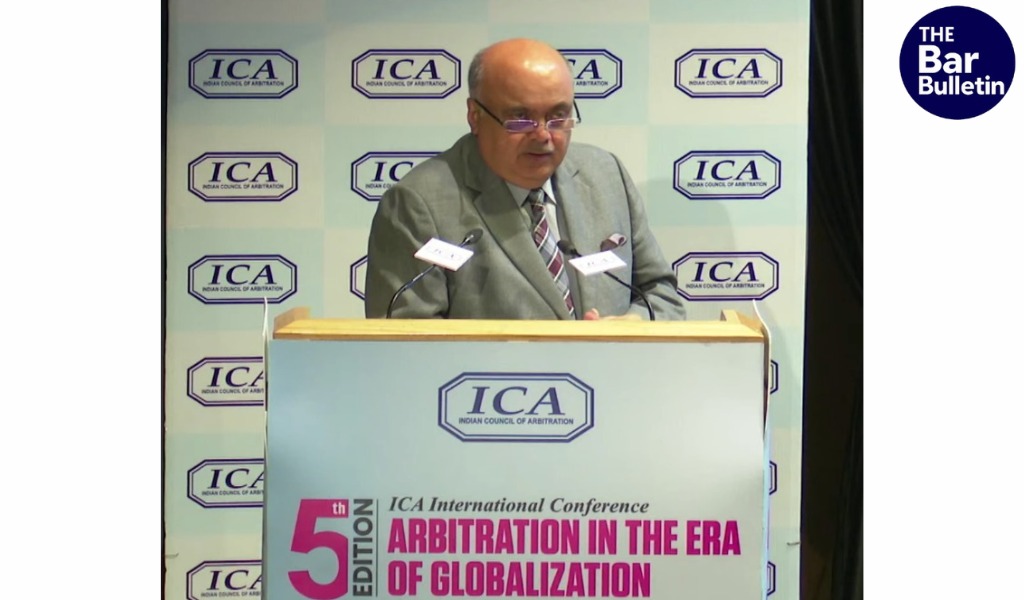

Justice Ahsanuddin Amanullah stated that the legislature must remain attentive to the concerns of key stakeholders in the arbitral process, and emphasised that the primary responsibility for addressing these issues lies with the legislature and the executive rather than the judiciary. He noted that the judiciary typically intervenes only when required to do so,
Justice Amanullah was speaking as the keynote speaker in the Technical Session–2 on ADR Mechanisms: A Catalyst for Global Economic Growth & Investor Confidence at the 5th ICA International Conference on “Arbitration in the Era of Globalisation.”
Justice Amanullah emphasised the need to expand the scope and effectiveness of alternative dispute resolution mechanisms, highlighting the benefits for MSMEs and smaller businesses, and not just for large corporations. He cautioned that India should not blindly follow global arbitration practices without adapting them to domestic realities.
Addressing the role of technology, he referred to the growing use of AI-assisted case management, while making it clear that technology should not replace arbitrators or tribunals. He stressed that the future of arbitration depends on maintaining trust in the process, ensuring procedural fairness, and upholding the rule of law, with certainty in procedural frameworks being essential. He also emphasised that parties should be able to appoint arbitrators with domain-specific expertise in sectors such as energy and construction, as this ensures that decisions are not only legally sound but also commercially practical, thereby enhancing reliability and strengthening investor confidence.
He observed that strengthening ADR is not solely the responsibility of the judiciary, but also requires active involvement from the legislature and executive, noting that legitimacy in the system will follow from coordinated institutional support. He described ADR as a diplomatic bridge that can contribute to business growth, investor confidence, and sustainable global development.
Focusing on key challenges, Justice Amanullah identified time delays as a major concern, stating that statutory timelines alone cannot ensure efficiency and that tribunals must exercise practical restraint by limiting the number of matters they take up at a given time, a discipline that is often not followed. He also highlighted the importance of promoting conciliation and mediation, referring to the Mediation Act, 2023, and emphasised that legal professionals must actively encourage clients to adopt these mechanisms.